1. Introducción
De entre los diversos enfoques desde los que ha sido abordado el estudio del modo a lo largo de su ya dilatada historia1, son mayoritarios los que atribuyen a esta categoría verbal un significado de naturaleza epistémica. La postura tradicional, en este sentido, es aquella que vincula directamente la elección modal al conocimiento que tiene el hablante de la realidad aludida. Así, se entiende el indicativo como expresión de lo factual (esto es, lo que el hablante entiende como experimentado, real o verificado), mientras que el subjuntivo se asocia a lo no factual (lo no experimentado, lo irreal y lo no verificado)2.
Los problemas a los que se enfrenta esta concepción del significado modal para dar cuenta del comportamiento de las unidades lingüísticas implicadas, en sus correspondientes contextos de uso (vid. Morera 1999: 179-180; Ruiz Campillo 2004; 2006-2007; 2008; Matte Bon 2008 [2001]; Barrios Sabador 2016; entre otros), han dado pie al desarrollo de enfoques alternativos, fundamentados en los conceptos de aserción y presuposición. Así, dentro del marco de la semántica de las condiciones de verdad, se ha propuesto que la función del indicativo es la de presentar explícitamente un estado de cosas como verdadero (aserción), mientras que el subjuntivo se reservaría para aquellos otros casos en los que el hablante no se compromete abiertamente con la verdad de lo afirmado (no aserción), lo que incluiría no solo los ejemplos de presuposición lógica3, sino también las oraciones que no pueden ser clasificadas dentro de ninguna de las dos categorías, como ocurre con las exhortativas o las que expresan duda (vid.
Terrell y Hooper 1974). Mejías-Bikandi (1994), en cambio, desde una concepción pragmática de estas mismas nociones, cuestiona la relevancia del fenómeno de la presuposición lógica, y vincula la selección del modo a la existencia (indicativo) o no (subjuntivo) de una intención por parte del hablante de presentar un estado de cosas ante el interlocutor como parte de la visión que un individuo (no necesariamente él mismo) tiene de la realidad. Tal intención, a su vez, es asociada por diversos autores al concepto de relevancia (Sperber y Wilson 1995 [1986]), y al hecho de que la información aludida sea entendida por el hablante, dentro del contexto de un intercambio comunicativo concreto, como verdadera y nueva (indicativo), o, por el contrario, como consabida, disponible o no verdadera (subjuntivo) (vid. Lunn 1989; Guitart 1991; Mejías-Bikandi 1998; Matte Bon 2008 [2001]).
También estas propuestas, sin embargo, tropiezan con contraejemplos y dificultades que cuestionan su validez como modelos explicativos generales del modo en español, tales como la no constatación, en la práctica, de la asociación constante que se postula entre el modo y los fenómenos de la aserción y la no aserción/presuposición lógica (Bergen 1978: 218; Mejías-Bikandi 1994; Vesterinen y Bylund 2013: 184-185); la vaguedad del concepto de intención (Mejías-Bikandi 1998); o la discordancia que se observa entre, por un lado, la libertad de elección entre ambos modos que presupone el enfoque pragmático, y, por otro, el reducido número de contextos sintácticos en los que realmente se produce la alternancia modal (Ruiz Campillo 2008).
En consecuencia, y ante la dificultad que entraña hacer corresponder los modos del español —especialmente el subjuntivo, en el que se han centrado tradicionalmente los esfuerzos de los gramáticos— con una significación invariante o esquema general, o de, en su defecto, mostrar el vínculo semántico existente entre los distintos valores que se les atribuyen, diversos autores, incluida la propia rae-asale (2009: 1866), acaban decantándose por una concepción semánticamente heterogénea o polifuncional de esta categoría, que trata de compensar las deficiencias de un enfoque con las aportaciones del otro, sin descartar tampoco, si la ocasión lo requiere, la posibilidad de recurrir al concepto de rección, entendido como relación meramente formal entre unidades lingüísticas4. Obviamente, tal actitud, si bien dota a este tipo de propuestas de un amplio potencial explicativo, constituye al mismo tiempo su talón de Aquiles, en la medida en que no vayan acompañadas de los criterios que determinan la aplicación de uno u otro valor en cada uno de los contextos de uso de la unidad en cuestión.
Por otro lado, la lingüística cognitiva, dentro de cuyo marco se desarrolla el presente trabajo, parte de la concepción del símbolo lingüístico como unidad producto de la asociación de una representación semántica y una representación fonológica (Langacker 1987: 11), cuyos diversos sentidos se encuentran siempre vinculados entre sí, a través de un esquema abstracto común y/o de diversos mecanismos conceptuales (prototipo, metáfora, metonimia) (Lakoff 1987; Taylor 2003; Evans y Green 2006: 339-355; Dirven y Ruiz de Mendoza Ibáñez 2010: 46-52; García Yanes 2019). Desde esta perspectiva, una concepción del subjuntivo como la sostenida por la rae-asale (2009), esto es, como entidad semánticamente heterogénea asociada a distintos significados y funciones sin vínculo conceptual alguno entre sí, resulta a todas luces inaceptable.
Ante tal panorama, cabe concluir —junto con Kratochvílová (2016)— que la cuestión del modo en español, pese a la enorme cantidad de esfuerzo invertido en su estudio, sigue sin recibir una respuesta satisfactoria ni desde el punto de vista estrictamente teórico ni desde el de su aplicación a la enseñanza del español como lengua extranjera.
Con todo, y en contraste con la situación general descrita hasta aquí, el ámbito concreto de las oraciones subordinadas temporales parece constituir para el investigador un refugio en la tormenta; un territorio excepcional, dentro de los contextos de uso del subjuntivo en español, en el que el enfoque epistémico tradicional se muestra capaz de dar cuenta del uso que los hablantes hacen de este modo. Tal escena, sin embargo, se ve empañada por la falta de resultados satisfactorios en lo que respecta a las construcciones antes (de) que y, especialmente, después (de) que.
En el presente trabajo, con el fin de dar una respuesta adecuada a esta cuestión, se procederá, en primer lugar, a la exposición y análisis crítico tanto de la naturaleza del problema como de los distintos estudios que lo abordan. A continuación, se expondrán las bases teóricas, aportadas por la lingüística cognitiva, sobre las que se asienta este estudio, así como el modelo que, según se postula, es capaz de dar cuenta del uso que hacen los hablantes del modo en el caso de las oraciones introducidas por antes/después (de). Por último, se extraerán las conclusiones pertinentes.
1.1. El modo en las oraciones subordinadas temporales: dimensiones del problema
Tal como señala Aurová (2013: 116), no abundan los trabajos dedicados al estudio del modo en las oraciones subordinadas temporales del español, probablemente porque se asume la adecuación explicativa dentro de los límites de este ámbito de los postulados planteados por el enfoque epistémico tradicional. Así, de hecho, lo da a entender Pérez Saldanya cuando, a propósito de esta cuestión, escribe:
De manera general, se puede afirmar que en estas oraciones temporales, la subordinada se construye con indicativo cuando tiene un carácter factual, esto es, cuando es verdadera en el mundo que se toma como referencia y remite a un hecho experimentado (pasado, presente o habitual) [...]. Por el contrario, las oraciones que remiten a situaciones posteriores al momento que se toma como referencia y, por lo tanto, a situaciones eventuales y no experimentadas exigen el modo subjuntivo. (Pérez Saldanya 1999: 3311-3312)
Ciertamente, desde tal perspectiva, es posible explicar sin grandes dificultades la selección modal en aquellas oraciones en las que, como ocurre en los ejemplos (1) y (2), el “momento que se toma como referencia” —al que alude Pérez Saldanya en la cita anterior— coincide con la situación comunicativa, y la subordinada introducida por antes/después (de)5 remite a una situación posterior a ella. En tales casos, según predice el modelo, el uso del subjuntivo en la subordinada, obligatorio en ambas construcciones, se corresponde invariablemente con la percepción de la situación aludida como eventual desde el punto de vista del hablante.
-
(1) Llegará antes de que salga el sol.
-
(2) Llegará después de que salga el sol.
1.2. Antes (de) que
Un primer obstáculo para este enfoque surge, sin embargo, en el caso de las oraciones introducidas por antes (de) cuando la situación a la que estas aluden se ubica en un intervalo temporal anterior a la situación comunicativa, como ocurre en el ejemplo (3).
-
(3) Llegó antes de que saliera el sol.
En efecto, la presencia del subjuntivo (saliera) en la subordinada no puede ser explicada en este caso apelando a la valoración epistémica que, acerca de la situación aludida, tiene el hablante en el momento de la enunciación, puesto que resulta evidente que, desde esa perspectiva, tal situación se entiende como factual6.
El concepto de modo nace dentro del ámbito de conocimiento de la lógica, y vinculado a una concepción del fenómeno de la modalidad en la que esta es entendida como propiedad de la oración (vid. González Calvo 1995). Como consecuencia, la gran mayoría de los estudios del modo desarrollados a la luz del enfoque epistémico tradicional adolecen de una deficiencia: la de obviar en gran parte la labor de identificación y análisis del conceptualizador7 al que, en cada caso, se atribuye la valoración epistémica de la situación en cuestión, dando a menudo por hecho que tal función recae sobre el propio hablante.
La propuesta de Pérez Saldanya, sin embargo, va más allá de este marco, y contempla dos “momentos” a los cuales “puede referirse [...] el valor de posterioridad” que justificaría el uso del subjuntivo en estas construcciones: el “momento del acto de habla” y “un momento del pasado” (Pérez Saldanya 1999: 3311-3312). Tal concepción parece responder al modelo propuesto por Reichenbach (2005 [1947]), según el cual los tiempos verbales pueden caracterizarse atendiendo a las posiciones relativas de tres puntos: el punto del habla o de la enunciación, que coincide con la situación comunicativa, en la que se encuentran los interlocutores; el punto del evento, que señala el intervalo temporal en el que se sitúa el evento señalado; y, por último, el punto de referencia, que indica el intervalo temporal con respecto al cual se ubica, de manera secundaria, tal evento.
Así pues, la solución que, en sintonía con el modelo de Reichenbach (2005 [1947]), ofrece Pérez Saldanya (1999) ante este primer inconveniente pasa por entender que, en la construcción antes (de) que, el “momento que se toma como referencia” para la descripción de la situación aludida por la subordinada no es el que corresponde a la situación comunicativa, sino el señalado por el verbo principal (llegó). Se entiende, de este modo, que el subjuntivo, en estos casos, “está exigido por el hecho de que la subordinada se refiere a un evento posterior al de la principal, a un evento no actualizado y, por lo tanto, virtual en el momento designado por esta oración” (Pérez Saldanya 1999: 3313). Tal salida, sin embargo, no hace sino terminar de complicar la explicación del uso del modo que presentan las introducidas por después (de), como trataré de mostrar a continuación.
Efectivamente, no se puede negar que, en el caso de las subordinadas sustantivas, el verbo principal cumple la función a la que se refiere Pérez Saldanya (1999), tal como se observa en los siguientes ejemplos8:
-
(4) No sospechaba que aquel fuera su último año de trabajo.
-
(5) No sospechaba que aquel era su último año de trabajo.
Así, en la oración (4), resulta razonable atribuir el uso del subjuntivo (fuera) en la subordinada al hecho de que la situación descrita sea percibida como no factual desde la perspectiva del sujeto del verbo principal (no sospechaba). Tal conceptualización contrasta claramente con la oración (5), en la que el uso del indicativo (era) en el mismo contexto sintáctico responde a la perspectiva, no de tal sujeto, sino del propio hablante, que ya ha incorporado la situación en cuestión a su conocimiento de la realidad.
Esta capacidad —no siempre ejercida, como se acaba de ver— que muestra el verbo principal de estas construcciones de aportar un punto de vista desde el cual se pueda llevar a cabo la descripción y valoración epistémica de la situación aludida por la subordinada no solo es posible cuando tal situación se ubica en un intervalo temporal anterior a la situación comunicativa, como en el caso de (4), sino también cuando su ubicación es posterior, como en el siguiente ejemplo:
-
(6) Es como cuando un hijo pregunta de dónde vienen los niños. No le vas a decir que vienen de París, porque al día siguiente sabrá que le has mentido y desconfiará de ti (Bilbao, febrero de 2004; http://www.bilbao.eus/bld/bitstream/handle/123456789/10075/pag39.pdf?sequence=1 [15/5/2021]).
Como puede observarse aquí, es la perspectiva aportada por el verbo del que depende la subordinada sustantiva (sabrá) la responsable —tal como ocurría en la oración (4)— de que la situación aludida (le has mentido) se presente como factual, en indicativo, por mucho que esa misma situación se entienda necesariamente como no efectiva desde el punto de vista del hablante, ubicado en la situación comunicativa.
La aplicación —propugnada por Pérez Saldanya (1999)— de este mismo análisis a las subordinadas temporales introducidas por antes/después (de), sin embargo, arroja resultados no deseables. Efectivamente, si el verbo de la oración principal puede, también en el caso de las construcciones antes/después (de) que, servir de punto de referencia para la valoración epistémica de la situación aludida por la subordinada —y, en consecuencia, para la elección del modo verbal en tal oración, según propone el enfoque epistémico tradicional—, ¿cómo explicar que, en una oración como Desconfiará de ti después de que le hayas mentido, paralela al ejemplo (6), la situación a la que alude la subordinada (le hayas mentido), pese a ubicarse en un intervalo temporal anterior al señalado por el verbo de la principal (desconfiará), no pueda ser presentada en ningún caso como factual, en indicativo, como sería de esperar si el verbo desconfiará constituyera realmente, como entiende Pérez Saldanya (1999), el punto de referencia desde el cual es descrita tal situación? La respuesta la avanzaba ya Juan José Acero, años antes de la publicación de la obra de Bosque y Demonte, en su trabajo sobre la propuesta de Reichenbach, al advertir que la atribución a un evento de las propiedades del punto de habla solo resulta aceptable
si se aplica a matrices en las que el verbo principal es un verbo de dicción —ampliamente entendido este término—. Si cobra sentido la identificación de un punto de habla con un punto del evento, eso se debe a que se entiende que este evento consiste él mismo en una proferencia, por más que pueda ser puramente mental, con su propio punto de habla. La motivación desaparece, simplemente, cuando no haya un verbo de dicción que justifique esa identificación. (Acero 1990: 65-67)
Así pues, ante las evidencias anteriores, habrá que concluir que, en las oraciones que incluyen las construcciones antes/después (de) que, el verbo principal no presenta de por sí la capacidad que le atribuye Pérez Saldanya (1999) de servir de punto de referencia para la valoración epistémica de la situación aludida por la oración subordinada.
1.3. Después (de) que
El modelo general planteado por Pérez Saldanya, que ya mostraba una capacidad explicativa limitada en el caso de la construcción antes (de) que, se da, de hecho, de bruces —como reconoce el propio autor— con el obstáculo que supone la construcción después (de) que cuando la situación aludida por la oración subordinada se ubica en un intervalo temporal anterior a la situación comunicativa:
Un contexto temporal donde el uso del subjuntivo no sigue las normas delimitadas hasta ahora es el de las oraciones introducidas por el nexo después (de) que. En la oración [Nos fuimos después de que {intentaron/intentasen} agredirnos], el indicativo y el subjuntivo pueden alternar en la subordinada sin que se altere el valor de verdad ni se introduzcan diferencias importantes de significado. (Pérez Saldanya 1999: 3314)
En efecto, ni el enfoque epistémico tradicional ni la lógica que el autor había aplicado hasta ahora a estas construcciones explican cómo es posible que, en una oración como (7), pueda aplicarse el subjuntivo (intentaran/intentasen) a una situación que es entendida como factual tanto desde el punto de vista de la situación comunicativa como desde la perspectiva de los participantes implicados en la situación descrita por la oración principal (nos fuimos), en tanto que anterior a ambos.
-
(7) Nos fuimos después de que {intentaran/intentasen} agredirnos.
El obstáculo tiene su relevancia, dada la frecuencia de uso del subjuntivo en estas construcciones. Según la rae-asale (2009: § 25.14h), en el español europeo el subjuntivo constituye, de hecho, hoy en día la opción mayoritaria, mientras que en el americano alternan ambos modos. Tal panorama parece confirmado por varios estudios estadísticos realizados en los últimos años. Ya Boiger (cit. en Hummel 2001: 272), en su trabajo de 2004, tras analizar 2032 ejemplos de uso de ambas variedades del español, extraídos de www.corpusdelespanol.org, recogía 268 ejemplos de subjuntivo frente a 163 de indicativo, en el caso de después de que; y 74 ejemplos de subjuntivo, frente a 252 de indicativo, en el de después que. Más clarificadora incluso resulta la aportación de Aurová (2013), quien, a través de un análisis de los usos de después (de) que presentes en los corpus corde y crea, de la Real Academia Española, constata, por un lado, la presencia —si bien minoritaria— desde el siglo XV del uso del subjuntivo en estas construcciones; y, por otro, en el caso concreto del español europeo escrito —no así en el oral—, una brusca transformación a partir de los años setenta del siglo XX, que eleva el porcentaje de uso del subjuntivo en tales contextos del 23,69% al 79,15%, invirtiendo completamente la situación anterior. Tal evolución parece ser, además, paralela a la señalada para la lengua francesa, en la que el uso del subjuntivo para las situaciones factuales aludidas por las subordinadas introducidas por après que no solo se documenta desde el siglo XIII, sino que, además, se ha convertido igualmente en la opción preferida por los hablantes, y ello a pesar de que su uso haya sido tradicionalmente censurado dentro del contexto de las gramáticas prescriptivas, y de que —probablemente como resultado de tal censura— no se documente apenas en los textos de los siglos XVIII y XIX (Hummel 2001: 267-268).
Los autores que han estudiado el fenómeno han querido establecer correspondencias entre tales usos y distintas variedades de la lengua, como el español europeo, los lenguajes periodístico y científico, el nivel culto o el “estilo literario afectado” (vid. Pérez Saldanya 1999: 3314; Hummel 2001: 272; Dunlap 2006; Aurová 2013); y han acudido, en busca de una explicación, a la analogía con otras construcciones, especialmente con antes (de) que / avant que (vid. Borrego et al. 1986: 139; Pérez Saldanya 1999: 3315; Hummel 2001: 267; Aurová 2013: 128-129), hipótesis esta “avalada —según defienden sus partidarios— no solo por la simetría ‘anterioridad/posterioridad’ que mantienen las dos locuciones, sino también por el hecho de que [...] la locución antes de que puede utilizarse en contextos factuales” (Pérez Saldanya 1999: 3315). Tales propuestas, sin embargo, como reconocen varios de los autores aquí citados, resultan insatisfactorias si se toman, en exclusiva, como explicación del fenómeno, puesto que esquivan el núcleo del problema: “Estas analogías [...] no podrían haberse producido sin la existencia de algún factor estrictamente modal que las haya posibilitado o, como mínimo, permitido” (Pérez Saldanya 1999: 3316; vid. también Hummel 2001: 272). En efecto, ni la variedad en la que se desarrolle una determinada construcción ni las posibles analogías que puedan establecerse entre diversas unidades de la lengua constituyen de por sí una explicación acerca del sentido que presenta una unidad concreta —el subjuntivo— en el contexto estudiado, ni del vínculo semántico que tal sentido mantiene con respecto a otros sentidos o a un posible significado esquemático general de la unidad.
En cuanto a las explicaciones alternativas ofrecidas por estos mismos autores al problema planteado, estas no van más allá de las ya expuestas al principio de este artículo, por lo que presentan igualmente los inconvenientes allí señalados. Así, Pérez Saldanya trata de salvar el escollo al que se enfrenta el enfoque epistémico tradicional por medio del pragmático-discursivo, atribuyendo este caso concreto de uso del subjuntivo al “carácter temático y la escasa relevancia informativa del contenido de la oración subordinada” (Pérez Saldanya 1999: 3316)9. Aurová, en esta misma línea, opta por combinar ambos enfoques a la hora de fijar el propio valor general del subjuntivo, que, de forma ecléctica, define como expresión de “falta de conocimiento o suspensión del compromiso con la verdad” (Aurová 2013: 126-127). Hummel, por su parte, sobre la base del contraste entre aserción y no aserción, entiende que el uso del subjuntivo en este contexto responde —en consonancia con los “valores básicos invariables” que asigna a los modos del español— al deseo del hablante de destacar “los aspectos incidenciales” de los eventos a los que se hace referencia, esto es, “la dinámica télica que los produce, sin tomar en cuenta si se realizan o no” (Hummel 2001: 269-272).
El presente trabajo comparte con Hummel (2001) y Aurová (2013) la convicción de que el uso del subjuntivo en las oraciones introducidas por después (de) no constituye en absoluto una anomalía, sino que, por el contrario, se limita a hacer efectiva una posibilidad contemplada y justificada por el propio valor general de este modo. En contraste con los postulados de estos autores, sin embargo, se entiende aquí que tal uso no se fundamenta sobre la posible valoración de tipo epistémico o pragmático que, acerca de la situación descrita, pudiera hacer el hablante desde la perspectiva de la situación comunicativa, sino que se debe a la estructuración conceptual inherente a esta construcción —coincidente en lo fundamental con la que se asocia a la construcción antes (de) que—, y, en particular, al hecho de que tal configuración incluya su propio punto de vista.
2. Un modelo para las construcciones antes/después (de) que dentro del marco de la lingüística cognitiva
Como se ha visto, Pérez Saldanya (1999) justifica el uso del subjuntivo en las subordinadas temporales a través de la perspectiva que de las situaciones aludidas podría tener un conceptualizador ubicado en determinado intervalo temporal, coincidente o no con la situación comunicativa. No es este, ni mucho menos, el único autor que, a la hora de dar cuenta del valor de los morfemas verbales (tanto del español como del inglés), recurre a nociones afines a las de perspectiva o punto de vista: el propio Reichenbach (1947), en su trabajo sobre los tiempos verbales del inglés10, llega a utilizar expresiones que —como señala Hamann (1987: 32-33)— van más allá de una concepción del punto de referencia como mero intervalo temporal relevante para la ubicación de un evento, y atribuyen a este concepto funciones propias del punto de vista, asociadas al fenómeno de la perspectiva. Así ocurre cuando, a propósito del contraste entre el present perfect inglés y el simple past, el lógico alemán afirma que en el caso de aquel “the past events are seen, not from a reference point situated also in the past, but from a point of reference which coincides with the point of speech” (Reichenbach 1947: 71; la cursiva es mía).
Con todo, el uso que de tales nociones se hace en estos trabajos, como en otros muchos de los desarrollados dentro del marco de la semántica de las condiciones de verdad, e incluso del estructuralismo, se ve seriamente limitado por la idea de significado lingüístico de la que se parte: un significado de naturaleza plenamente referencial, definido en función de su correspondencia con el estado de cosas que se dan en el mundo (o mundos posibles). Desde tales posiciones, y sin el necesario desarrollo teórico de los conceptos de punto de vista11 y perspectiva, así como del constructo mental que se asociaría a las unidades lingüísticas estudiadas, resulta complejo —tal como defienden Hewson y Bubenik (1997: 21-22)— otorgar a estas nociones la relevancia que poseen y que justificaría los fenómenos de estructuración conceptual aquí objeto de estudio.
Ante tal panorama, es, sin duda, la lingüística cognitiva la corriente que aporta el marco teórico idóneo para superar las dificultades planteadas. Ciertamente, esta corriente se sitúa al respecto de esta cuestión (como de otras muchas) en las antípodas de la semántica de las condiciones de verdad, en tanto que constituye uno de sus principios fundamentales la defensa de la capacidad del lenguaje de imponer distintas estructuraciones conceptuales a una misma situación objetiva (Langacker 1987: 5; 2008: cap. 3; Talmy 2000: 40-84; Croft y Cruse 2004: 40-73; Verhagen 2007). De hecho, entre las operaciones de estructuración conceptual propuestas por la lingüística cognitiva, ocupa un lugar privilegiado precisamente la de la perspectiva o disposición de la escena (viewing arrangement) (Croft y Cruse 2004: § 3.4; Verhagen 2007: 53-58; Langacker 2008: § 3.4), que depende, a su vez, de la noción del punto de vista.
Sobre la base de estos instrumentos teóricos, la lingüística cognitiva es capaz de incorporar de manera natural al estudio del lenguaje —tal como pretenden Pérez Saldanya (1999) o el propio Reichenbach (1947)— la consideración de los diversos puntos de vista desde los cuales puede ser observada una escena, y que en ningún caso se limitan al proporcionado por la situación comunicativa:
The same objective situation can be observed and described from any number of different vantage points12, resulting in different construals which may have overt consequences [...]. Of course, the vantage point assumed for linguistic purposes need not be the speaker’s actual location. We can easily adopt a fictive vantage point and imagine what the scene would look like from there. [...] This capacity to fictively adopt or at least accommodate a nonactual vantage point enables us to describe a situation from the perspective of the hearer or some other individual. (Langacker 2008: 75-76)
En cuanto a las unidades que la lingüística cognitiva vincula al fenómeno de la perspectiva, destacan, obviamente, los morfemas verbales: toda oración implica necesariamente un conceptualizador, explícito o implícito, y su correspondiente punto de vista, desde el cual es concebida y descrita la escena aludida. Pero la capacidad general del lenguaje de imponer distintas perspectivas a una misma situación no depende solo del verbo: “Many expressions undeniably invoke a vantage point as part of their meaning (arguably, all expressions do)” (Langacker 2008: 75; vid. también Langacker 1987: 123-124).
2.1. Explicitud e implicitud del punto de vista
El punto de vista desde el que es conceptualizada una determinada escena puede mostrarse de forma clara y explícita en un texto. Esto se consigue normalmente mediante el uso de unidades y construcciones que presentan el proceso13 subordinado a ellas como producto de la actividad cognitiva de un conceptualizador, tales como los verbos de pensamiento, lengua, etc. (vid.
Langacker 1991b: cap. 12; Achard 1998: § 2.3.4). Un ejemplo de este tipo de conceptualización lo encontramos en la oración (8), en la que tanto el conceptualizador (el hablante, señalado por la persona verbal -o) como el tipo de relación (cre-) que se establece entre este y su objeto de conceptualización (que el director viene esta tarde) se muestran de manera explícita (Verhagen 2006: 325-327), sometidos al tipo de estructuración conceptual que Langacker (1991b: cap. 12; 2008: 77-78) denomina en escena u objetiva.
-
(8) Creo que el director viene esta tarde.
Pero también puede ocurrir que tal punto de vista se sitúe fuera de escena o del alcance de la predicación, sometido a una estructuración conceptual de tipo subjetivo (Langacker 1991b: cap. 12; 2008: 77-78), como ocurre en el ejemplo (9), en el que tanto el conceptualizador como el tipo de relación que se establece entre este y su objeto de conceptualización se mantienen implícitos.
-
(9) El director viene esta tarde.
Las oraciones (8) y (9), pese a diferir en lo que respecta al grado de explicitud aplicada al conceptualizador del proceso al que se hace referencia, coinciden en ubicar el punto de vista en un intervalo temporal que se solapa con aquel que corresponde a la situación comunicativa. La conceptualización alternativa, en la que ambos elementos se muestran disociados, no supone variación alguna de las posibilidades con las que cuenta el hablante a este respecto: también en tales casos el punto de vista desde el que se describe el proceso en cuestión puede incluirse en la escena descrita, como ocurre en el ejemplo (10), aportado por el propio Pérez Saldanya (1999: 3312), o puede mantenerse implícito, como en (11).
-
(10) Le dije que podía volver siempre que quisiera.
-
(11) Hace poco, y sin saber que yo había tenido un hijo por maternidad subrogada, una antigua paciente vino a contarme el final de su historia. Al día siguiente salía para EE. UU. Y antes de irse quería hablar (Amparo M. “Los hijos de Julia”, 8/03/11; http://www.sonnuestroshijos.com/los-hijos-de-julia/ [15/5/2021]; la cursiva es mía).
Como puede verse, en el caso concreto del ejemplo (11), el carácter prospectivo que posee el proceso destacado en cursiva (salía para EE. UU.) es el resultado de la ubicación del punto de vista en un intervalo temporal anterior al que corresponde a dicho proceso. Tal punto de vista, sin embargo, se presenta en la oración de forma implícita, fuera del alcance de la predicación, a modo de sustento conceptual imprescindible del significado asociado a la unidad siguiente —y, probablemente, también de a, como parte de la expresión al día siguiente—, así como del conjunto de la conceptualización que se muestra en escena.
En consonancia con el panorama general que se acaba de dibujar, en el presente trabajo se entiende que las nociones de estructuración conceptual y perspectiva, así como la posibilidad de que el conceptualizador al que corresponde el punto de vista desde el que se describe una determinada escena pueda presentarse en el texto de forma implícita, son fundamentales para la comprensión del comportamiento del modo en las oraciones subordinadas introducidas por antes/después (de). La hipótesis que aquí se postula y que se tratará de demostrar en los siguientes apartados de este trabajo es, en concreto, que el punto de vista desde el cual se describe el proceso subordinado a las construcciones objeto de estudio —tanto antes (de) como después (de)— y que justifica el uso en ellas del modo subjuntivo no se corresponde ni con el del hablante ni con el de la entidad señalada por la persona del verbo del que depende la subordinada temporal —como pretende Pérez Saldanya (1999) a propósito de la construcción antes (de) que—, aunque pueda, según el caso, coincidir con ellos; sino que, por el contrario, es aportado por la propia estructuración conceptual requerida por los adverbios antes y después. Para entender cómo es esto posible y cuál es la ubicación de tal punto de vista, será conveniente profundizar antes en las relaciones que se establecen entre los dominios espacial y temporal, y que sostienen la estructuración conceptual atribuida en el presente trabajo a estas construcciones.
2.2. El dominio espacial: ante, delante, adelante, adelantar, anterior / tras, detrás, atrás, atrasar, posterior
Es consabida la estrecha relación que se da en el lenguaje, de manera universal, entre los dominios temporal y espacial (vid.
Haspelmath 1997). En lo que atañe a las unidades temporales aquí estudiadas, tal vínculo se establece con respecto a las unidades espaciales ante, delante, adelante, adelantar, anterior—en el caso de antes— y tras, detrás, atrás, atrasar, posterior —en el de después— (vid. Pottier: 1954-1955). Las afinidades semánticas entre estas unidades se ven reforzadas, además, por el parentesco etimológico que se da entre la mayoría de estas unidades, obvio en el caso de las primeras, pero también existente entre las unidades posterior y después (vid. Sánchez Lancis 1990: 347).
Años antes del surgimiento de la lingüística cognitiva, ya Clark (1973) aportaba, desde una perspectiva afín al realismo corporeizado14, un estudio en profundidad de las unidades espaciales del inglés in front of y behind (que podríamos considerar equivalentes, desde el punto de vista semántico, a ante - delante de y tras - detrás de, respectivamente). Según el autor, el valor de estas unidades depende directamente de uno de los tres planos naturales de referencia del ser humano, determinados por su propia configuración corporal (cfr. Talmy 2000: cap. 3): el que resulta de la asimetría característica de su aparato perceptual, orientado de manera predominante a la captación de estímulos provenientes de la parte frontal de su cuerpo, así como del sentido de su desplazamiento (vid. también Fillmore 1997 [1971]: “Space”, párr. 21). Es este plano, conocido como plano coronal o frontal, el que no solo permite distinguir entre los dos espacios señalados por las unidades a las que se dedica este apartado, sino que, además, constituye la referencia con respecto a la cual se atribuye a in front of / delante de un valor positivo (en tanto que señala la dirección de percepción óptima y de desplazamiento), reservando para behind / detrás de el valor negativo de la oposición.
En el uso deíctico de estos adverbios (vid. Fillmore 1997 [1971]: “Space”, párrs. 4-5), el hablante, ubicado fuera de escena o del alcance de la predicación (sometido, por tanto, a una estructuración conceptual de tipo subjetivo), cumple tanto la función de entidad de referencia para la ubicación del objeto aludido como la de punto de vista desde el que se describe tal objeto (perspectiva egocéntrica; vid. Klatzky 1998: 2) (vid. ilustración 1). Este tipo de estructuración conceptual, que Clark (1973: 45) considera la interpretación por defecto de in front of y behind, se encuentra ejemplificada en las oraciones (12) y (13).
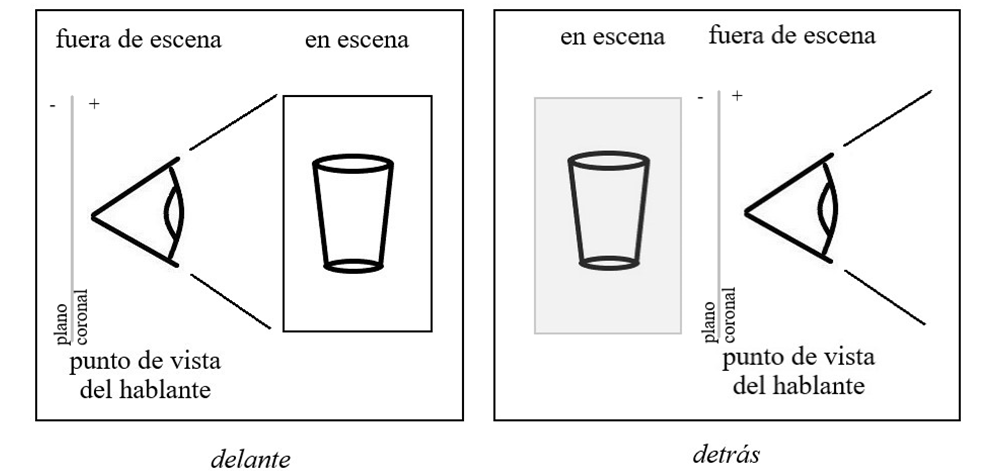 Ilustración 1.
Perspectiva egocéntrica
Ilustración 1.
Perspectiva egocéntrica
-
(12) Particularmente, tengo esperanzas puestas en poder estar ahí delante (Mundo Deportivo, 4/7/19; https://www.mundodeportivo.com/motor/motogp/20190704/463288835548/dovizioso-espero-estar-delante-motogp-gp-alemania-2019.html [15/5/2021]).
-
(13) Entonces los discípulos se le acercaron a decirle: “Atiéndela, que viene detrás gritando”15 (Cope.es, 13/08/20; https://www.cope.es/religion/vivir-la-fe/evangelio/noticias/mujer-grande-cumpla-deseas-20200813_855483 [15/5/2021]).
Estas mismas unidades, sin embargo, pueden igualmente ser utilizadas por el hablante de forma no deíctica (vid. Fillmore 1997 [1971]: “Space”, párrs. 4-5) para ubicar un objeto con respecto a una entidad incluida en la escena. Es el caso de las oraciones (14) y (15), en las que el hablante, desde el punto de vista propio, ubica un objeto con respecto a una entidad distinta de sí mismo —lo que, dentro del ámbito de la psicología, se ha denominado perspectiva alocéntrica (vid. Klatzky 1998: 2)—, tal como se muestra en la ilustración 2.
-
(14) El vaso está delante del cliente.
-
(15) El vaso está detrás del cliente.
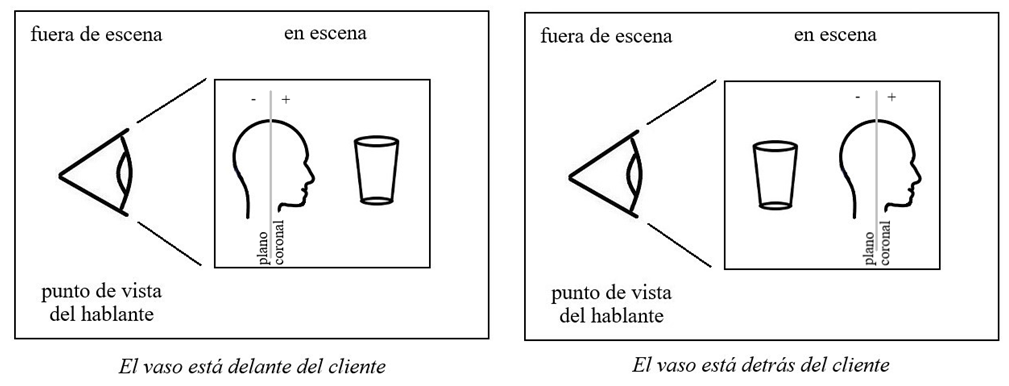 Ilustración 2.
Perspectiva alocéntrica
Ilustración 2.
Perspectiva alocéntrica
La lógica del paralelismo que subyace a esta operación, que probablemente resulte compleja de justificar desde un enfoque formalista como el adoptado por Klatzky (1998), se explica sin dificultad dentro del marco de la psicología y la lingüística cognitivas: de lo que se trata aquí es de que el hablante reconozca una orientación en la entidad escogida como referencia, y le atribuya el correspondiente punto de vista; recree mentalmente la escena en cuestión, tal como esta se vería desde tal punto de vista (vid. Vandeloise 1991: 26, 101-104; Filimon 2015); y, finalmente, utilice los adverbios delante y detrás como lo haría si, de hecho, compartiese la ubicación de la entidad de referencia, pero sin dejar de describir el conjunto de la escena desde un punto de vista externo16 a tal entidad17.
En cuanto a la orientación concreta atribuida a la entidad de referencia, esta dependerá de cómo entienda el hablante que se dispone en ella el plano coronal; bien porque lo posea de hecho, en tanto que ser humano, como ocurre en el caso del cliente de las oraciones (14) y (15); o bien porque, aun no siendo así, dicha entidad presente alguna cualidad inherente que haga posible atribuírselos por analogía (vid. Fillmore 1997 [1971]: “Space”, párr. 22; Vandeloise 1991: cap. 7). Así, el hablante puede reconocer una determinada orientación en el objeto de referencia atendiendo, por ejemplo, a la ubicación del aparato perceptual (o dispositivo de función análoga) de la entidad en cuestión, como ocurre en el ejemplo (16) (vid. ilustración 3); o a su dirección de desplazamiento, como sucede en (17); y utilizar los adverbios delante y detrás para señalar la ubicación que tendría un determinado objeto desde los puntos de vista que corresponderían a tales orientaciones.
-
(16) El vaso está delante de la cámara.
-
(17) La moto está aparcada delante del coche.
Con todo, puede también ocurrir que el hablante tome como referencia la orientación de un objeto que carezca de cualidad inherente alguna que permita delimitar en él una parte frontal y una trasera. Esto es posible, según Clark (1973: 34-35; cfr. Vandeloise 1991: caps. 3 y 9), gracias a que en tales casos se atribuyen a la escena descrita las características del arquetipo conceptual del encuentro canónico, según el cual los interlocutores se conciben ubicados el uno frente al otro:
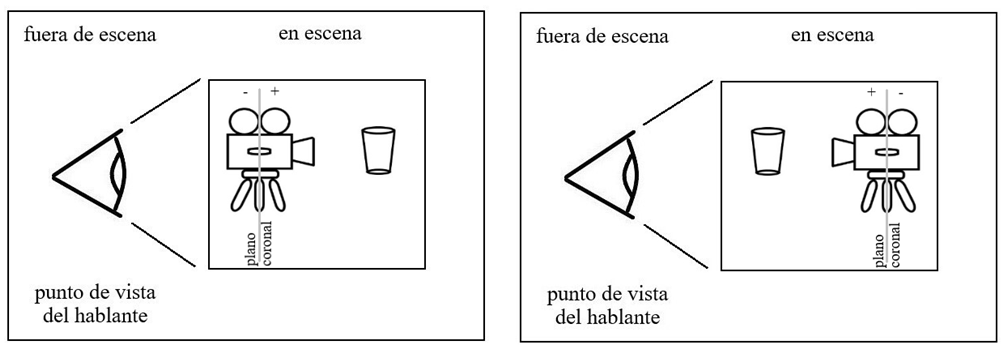 Ilustración 3.
Perspectiva alocéntrica: El vaso está delante de la cámara18
Ilustración 3.
Perspectiva alocéntrica: El vaso está delante de la cámara18
The use of front and back to refer to objects without specifiable fronts and backs [...] requires the notion of the canonical encounter. If the speaker is looking at a ball and a fly across the room, he can say: the fly is in front of the ball. By this he means “The fly is between the ball and me”. Since the ball has no front or back, we are forced to the following conclusion on the application of these words: the speaker treats such an object as if it were the other person in a canonical encounter, a person facing directly towards the speaker. Once we assume this principle of application, all sentences like the fly is in front of the ball, the ball is in back of the tree, etc., become explicable. (Clark 1973: 45-46)
Efectivamente, en las oraciones (18) —traducción del ejemplo propuesto por Clark en la cita anterior— y (19), tal como ocurría en (16) y (17), la ubicación del objeto en cuestión (la mosca) no se establece con respecto a la entidad desde cuyo punto de vista se describe el conjunto de la escena, sino tomando como referencia la orientación de la pelota. Tal orientación, sin embargo, no viene determinada por las propiedades inherentes atribuidas al objeto en cuestión, sino, a su vez, por la orientación de la entidad en la que se ubica el punto de vista (vid. también Fillmore 1997 [1971]: “Space”, párr. 22; “Deixis I”, párrs. 27-28), tal como puede observarse en la ilustración 4 (cfr. Talmy 2000: 210-211). Este tipo de perspectiva en espejo (vid.
Hill 1978; Kemmerer 2010: 311), que denominaré aquí perspectiva alocéntrica confrontada, se define, por tanto, por el hecho de que la orientación del objeto de referencia se alinea con la del conceptualizador, pero en sentido opuesto.
-
(18) La mosca está delante de la pelota.
-
(19) La mosca está detrás de la pelota.
Es precisamente a esta última posibilidad, la de la adopción de la perspectiva alocéntrica confrontada, a la que parece atender Langacker (2008: 76) en su propuesta de estructuración conceptual para el uso de in front of y behind que se da en oraciones como (20) y (21):
-
(20) El vaso está delante de la taza.
-
(21) La taza está detrás del vaso.
 Ilustración 4.
Perspectiva alocéntrica confrontada
Ilustración 4.
Perspectiva alocéntrica confrontada
Como puede observarse en la ilustración 5, el autor aplica a ambas construcciones una misma estructuración conceptual básica, que incluye tres elementos: un punto de vista y dos entidades, una de ellas interpuesta en la trayectoria que lleva desde el punto de vista hasta la segunda entidad. La única diferencia entre ambas conceptualizaciones residiría en que, en el caso de in front of, la entidad interpuesta se entendería como trayector, figura primaria o entidad con mayor prominencia, en contraste con la figura secundaria, landmark o entidad de menor prominencia; mientras que, en el caso de behind, las funciones de las dos entidades implicadas se intercambian (vid. Langacker 2008: 75-76; Maldonado 2012: 229-230). Así, según el autor, en una oración como (20), lo que tenemos es una figura primaria (el vaso) que se interpone en la trayectoria que lleva desde el punto de vista del conceptualizador —implícito, ubicado fuera del alcance de la predicación— a la figura secundaria (la taza); mientras que en (21) nos encontramos con una figura primaria (la taza) en cuya percepción por parte del conceptualizador —igualmente implícito— interfiere la figura secundaria (el vaso).
 Ilustración 5.
Estructuración conceptual de in front of y behind propuesta por Ronald W. Langacker. Ilustración de elaboración propia, a partir de la incluida en Langacker (2008: 76)
Ilustración 5.
Estructuración conceptual de in front of y behind propuesta por Ronald W. Langacker. Ilustración de elaboración propia, a partir de la incluida en Langacker (2008: 76)
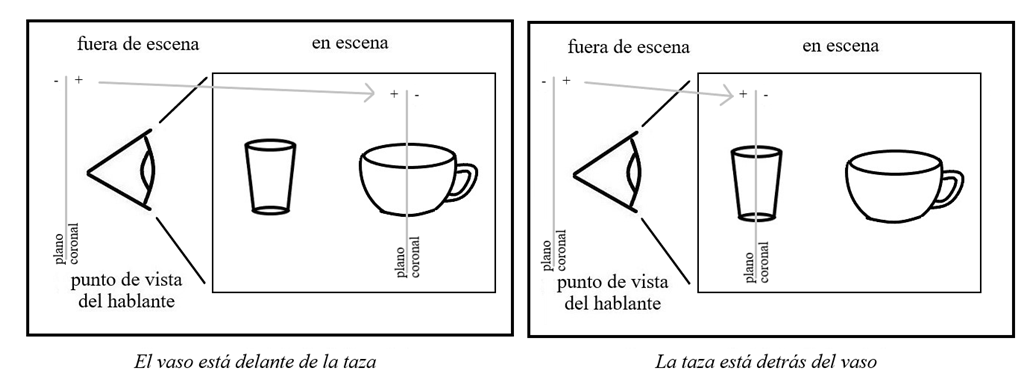 Ilustración 6.
Perspectiva alocéntrica confrontada
Ilustración 6.
Perspectiva alocéntrica confrontada
En realidad, como se ha visto, la cuestión es más compleja de lo que podría dar a entender la ilustración ofrecida por Langacker. Así (vid. ilustración 6), lo que tendríamos en el ejemplo (20) es una figura primaria (el vaso) ubicada positivamente con respecto al plano coronal de la figura secundaria (la taza), orientación que, a su vez, viene condicionada por la que posee la entidad que desempeña la función de conceptualizador —y que, en este caso, se encuentra implícita, fuera de escena—, como resultado de la aplicación al conjunto de la escena del arquetipo del encuentro canónico; mientras que en (21), nos encontramos con una figura primaria (la taza) ubicada negativamente con respecto al plano coronal de la figura secundaria (el vaso), orientación determinada, una vez más, por la del conceptualizador.
2.3. El dominio temporal: antes/después
Las relaciones conceptuales que se establecen entre los dominios espacial y temporal, anteriormente señaladas, son tan estrechas que llegan al punto de permitir que las mismas unidades a las que en el apartado precedente se les ha atribuido un valor espacial puedan ser utilizadas igualmente dentro de la dimensión temporal (vid. Hill 1978: 524; Sánchez Lancis 1990: cap. 4):
-
(22) Tras tanto temerlo, lo quiere ahora (ej. extraído de Pottier 1954-1955: 353).
-
(23) En las semanas que quedan por delante... (ej. extraído de Lakoff y Johnson 1986 [1980]: 79).
Para algunos autores, este fenómeno se debe al desarrollo histórico de sentidos tanto temporales como espaciales a partir de un significado esquemático general, base representativa o imagen relacional (Pottier 1954-55). La lingüística cognitiva, por el contrario, lo entiende como resultado de un proceso metafórico mediante el cual el dominio temporal, de carácter más abstracto, conforma su estructura interna (al menos parcialmente) a partir de elementos importados del espacial (vid. Lakoff y Johnson 1986 [1980]; 1999; Evans 2004)19. Tal proceso no solo permite el uso de unidades espaciales para la expresión de significados temporales, ejemplificado en las oraciones (22) y (23), sino que es también responsable de que incluso aquellas unidades que presentan un significado de naturaleza exclusivamente temporal20 conceptualicen la realidad aludida mediante la aplicación de estructuras igualmente tomadas del ámbito espacial.
De entre las metáforas conceptuales que configuran el dominio temporal, la más básica es aquella por la cual la propia dimensión temporal es concebida como una línea recta. Es importante subrayar, además, el hecho de que esta metáfora no se compone únicamente del concepto de línea, como mera forma geométrica, sino que incluye el punto de vista desde el que es percibida dicha línea: “It is as if time is pictured as a straight line stretching out into de visual field” (Hill 1978: 524). Sobre la base de esta metáfora se desarrollan, tanto en inglés como en español —al igual que en muchas otras lenguas (vid. Hewson y Bubenik 1997)—, dos nuevas metáforas conceptuales, que podrían parecer contradictorias (vid. Fillmore 1997 [1971]: “Time”, párrs. 2-3; Clark 1973: 50; Lakoff y Johnson 1986 [1980]: cap. 9): yo en movimiento (moving ego) o el tiempo está parado y nos movemos a través de él, en la que el conceptualizador se concibe a sí mismo como un objeto que se desplaza a lo largo de la línea temporal, en dirección al futuro, ejemplificada en las oraciones (22) y (23); y tiempo en movimiento (moving time) o el tiempo es un objeto que se mueve, en la que son los procesos y los propios intervalos temporales (días, semanas, meses...) los que avanzan en dirección al conceptualizador —de ahí la existencia de expresiones como la semana que viene—, y que justifica el uso de adelantar que se observa en la oración (24).
-
(24) Habrá que adelantar la reunión a esta semana.
La interacción entre estas metáforas conceptuales, el tipo de perspectiva adoptada (egocéntrica o alocéntrica) y la unidad lingüística concreta escogida para la conceptualización de la relación temporal aludida aporta múltiples posibilidades de estructuración conceptual, además de algunas restricciones. Así, la adopción de la metáfora conceptual el tiempo está parado y nos movemos a través de él resulta compatible con las unidades de origen espacial ante-delante-adelante y tras-detrás-atrás, pero no con antes y después, de naturaleza exclusivamente temporal.
En cuanto a su combinación con las diferentes perspectivas anteriormente analizadas, esta metáfora permite que el plano de referencia para la localización del objeto o proceso en cuestión se ubique en el propio hablante, coincidiendo así con el punto de vista, como ocurre en los ejemplos (23) —que reproduzco a continuación— y (25).
-
(23) En las semanas que quedan por delante...
-
(25) Por otro lado, creo que dejo atrás una obra ya consolidada que —cómo no— se podrá discutir, pero no hasta el extremo de negarme el pan y la sal (ABC Cultural, 27/09/96; CREA).
En tal caso, la metáfora el tiempo está parado y nos movemos a través de él se asocia a la estructuración conceptual característica de la perspectiva egocéntrica (vid. ilustración 7). Desde tal perspectiva, todo objeto o proceso que se ubica de forma positiva con respecto al hablante —ante su aparato perceptivo y en el sentido de su avance— (es decir, en un intervalo temporal futuro) se incluye, como es de esperar, dentro del espacio señalado por las unidades ante-delante-adelante; mientras que corresponde a tras-detrás-atrás señalar la ubicación de los objetos y procesos dentro del espacio definido de forma negativa con respecto a la percepción y el sentido del avance del hablante a lo largo de la línea temporal (esto es, en el pasado).
Esta misma metáfora conceptual puede igualmente utilizarse para situar un determinado proceso con respecto a un conceptualizador —coincidente o no con el propio hablante— ubicado en un intervalo temporal distinto del que corresponde al momento de la enunciación. Lo que se obtiene en este otro caso es la configuración propia de la perspectiva alocéntrica inherente, en la que la ubicación de un proceso u objeto se lleva a cabo con respecto a la orientación atribuida a la entidad de referencia, a partir del reconocimiento en ella —en tanto que ser humano— del correspondiente plano coronal. Es lo que ocurre en el ejemplo (26), en el que tras orienta la producción de las catorce obras de Odon von Horváth en sentido negativo, hacia el pasado, tomando como punto de referencia un conceptualizador ubicado en el intervalo temporal en el que se produjo la muerte del autor; o en el (27), en el que el despilfarro al que se hace referencia se ubica positivamente, hacia el futuro, con respecto al punto de referencia aportado por el minuto 20 del partido en cuestión, al que remite el adverbio ahí (vid. ilustración 8).
-
(26) Odon von Horváth murió trágicamente en París a los 37 años dejando tras de sí catorce obras (La Vanguardia, 9/11/94; CREA).
-
(27) En cuanto al triunfo de Santa Fe, hay que destacar que los cinco goles los consiguió en los primeros 20 minutos de juego y que, de ahí en adelante despilfarró por lo menos otras 7 oportunidades de convertir, entre ellas una pena máxima (El Tiempo, 1/12/87; CREA).
 Ilustración 7.
Perspectiva egocéntrica dentro del dominio temporal
Ilustración 7.
Perspectiva egocéntrica dentro del dominio temporal
 Ilustración 8.
Perspectiva alocéntrica inherente dentro del dominio temporal21
Ilustración 8.
Perspectiva alocéntrica inherente dentro del dominio temporal21
La metáfora conceptual el tiempo es un objeto que se mueve, ejemplificada en las oraciones (1), (2), (24) —que reproduzco a continuación— y (28), no muestra, en cambio, restricción alguna en cuanto al tipo de unidad lingüística al que puede asociarse —por lo que es posible tanto con las unidades de origen espacial como con las exclusivamente temporales—, pero sí en lo que respecta a la perspectiva desde la cual se conceptualizan los procesos aludidos.
-
(1) Llegará antes de que salga el sol.
-
(2) Llegará después de que salga el sol.
-
(24) Habrá que adelantar la reunión a esta semana.
-
(28) El funcionario, tras salir del bar, se dirigió a la comisaría de El Patriarca, situada en una zona de Valencia que la Policía conoce como el barrio chino de la ciudad (El Mundo, 10/11/1994; CREA).
Efectivamente, dado que en esta metáfora son los procesos y los propios intervalos temporales los que se desplazan en dirección al conceptualizador, los ámbitos positivo y negativo con respecto al plano de referencia se establecen en sentido justamente contrario al que correspondería al plano coronal del conceptualizador —que, en español, se concibe siempre orientado hacia el futuro—. Es precisamente por este motivo por el que la elección de esta metáfora conceptual resulta incompatible con la adopción de la perspectiva egocéntrica. En casos como los representados por las oraciones (29) y (30), en los que, en principio, podría pensarse que es el punto de vista del hablante el que se ha tomado como referencia para la ubicación temporal de los procesos señalados, el sentido en el que se distribuyen los ámbitos positivo y negativo, contrarios a los requeridos por la orientación de tal hablante en el eje temporal, evidencian que lo que se da, en realidad, en estos casos es la mera coincidencia temporal de la ubicación del hablante con el proceso que se toma en realidad como referencia, y cuyo avance determina los ámbitos positivo y negativo señalados por los adverbios antes y después, respectivamente.
-
(29) Sí, está en paz. Nunca antes pude verlo así (J. C. Onetti, Dejemos hablar al viento, p. 217; crea).
-
(30) Me parece que esto es una cosa armada, y después voy a explicar por qué digo esto (H. Verbitsky, El vuelo, p. 169; crea.
Una vez descartada la perspectiva egocéntrica, la siguiente cuestión que se plantea es si la perspectiva (alocéntrica) asociada a esta metáfora conceptual se establece en función de las cualidades inherentes atribuidas al proceso de referencia —tal como entiende Haspelmath (1997: 59-60)—, o si, por el contrario, depende de la ubicación del punto de vista desde el que se describe el conjunto de la escena.
Puesto que, en esta metáfora, como se ha señalado, los procesos son concebidos como objetos en movimiento, no sería descabellado entender que el sentido de tal movimiento aporta, de por sí —tal como ocurría en la oración (17)— el punto de referencia necesario para la orientación de las dimensiones aludidas por antes y después en el sentido mostrado. Si así fuera, habría que concluir que la metáfora conceptual el tiempo es un objeto que se mueve se asocia al tipo de perspectiva alocéntrica inherente al objeto de referencia, y que, en consecuencia, el punto de vista desde el que se describe el conjunto de la escena no desempeña función alguna dentro de este tipo de conceptualización.
Ya se ha señalado, sin embargo, que tanto esta metáfora conceptual como su contraria, el tiempo está parado y nos movemos a través de él, se sustentan en la aplicación al dominio temporal de una metáfora básica que no solo supone la conceptualización de tal dominio como línea recta, sino que, además, incluye su propio punto de vista. Por otro lado, repárese en que, en el caso de la metáfora conceptual el tiempo es un objeto que se mueve, el movimiento que exhiben los eventos y las unidades temporales es concebido no solo como un acercamiento progresivo a la ubicación temporal del conceptualizador, sino, además, como un movimiento descrito desde el punto de vista de tal conceptualizador —como evidencian expresiones del tipo la semana que viene—, cuestión esta que pasa por alto Haspelmath (1997: 59-60), pese a incluirla en su explicación.
En sintonía con el análisis que se sostiene en este trabajo, Traugott (1978: 380-381) entiende que, en el caso de los adverbios before y after, el punto de vista desde el que se describe el conjunto de la escena constituye un elemento esencial de la conceptualización que se asocia a ellos, y acude para justificar su postura a la noción de encuentro canónico, tal como esta había sido formulada por Clark (1973). Así, según esta autora, la orientación que presentan los procesos implicados en las subordinadas temporales introducidas por estas unidades es el resultado de aplicar el arquetipo del encuentro canónico a la escena descrita en tales casos, y, en consecuencia, de atribuir al proceso de referencia la orientación que, dentro de tal arquetipo, le correspondería al interlocutor: frente a frente con respecto al conceptualizador. Si esto es así, no cabría sino concluir, junto con Hill (1978: 528), que en estos casos nos encontramos ante un ejemplo de aplicación dentro del dominio temporal del tipo de perspectiva que aquí se ha denominado alocéntrica confrontada o en espejo.
La particularidad, con todo, que presenta la perspectiva alocéntrica confrontada en este caso es que, al aplicarse sobre una dimensión de naturaleza unidimensional, como es la temporal, requiere que el punto de vista desde el que se describe el conjunto de la escena se ubique en un intervalo temporal anterior al proceso que se toma como referencia (vid. Hill 1978: 529). Esto es así incluso en aquellos casos en los que el proceso descrito se desarrolla en un intervalo temporal anterior a la situación comunicativa. Tal requisito, como se verá más adelante, resulta crucial para comprender el uso del modo que presentan las oraciones subordinadas temporales del español.
En cuanto al modelo planteado por Langacker (2008: 76), como se recordará, de entre las diversas perspectivas que podrían asociarse a las unidades de valor espacial in front of y behind, era precisamente la alocéntrica confrontada la analizada por el autor. Debemos, pues, concluir que las construcciones después de y antes de, en tanto que resultado de la aplicación de esta misma perspectiva al ámbito temporal, requerirían, dentro del modelo planteado por el autor, de los tres mismos elementos contemplados para las unidades espaciales analizadas: el proceso que se pretende ubicar, concebido como figura primaria, trayector o proceso con mayor prominencia —el señalado por la forma verbal llegará, en los ejemplos (1) y (2)—; la figura secundaria, proceso de menor prominencia o de referencia, con respecto al cual se ubica el proceso primario —que salga el sol, en estos mismos ejemplos—; y, finalmente, el intervalo temporal en el cual se ubica el punto de vista, anterior a ambos, y que hace posible la conceptualización de uno de los procesos como interpuesto en la trayectoria que va desde tal punto de vista hasta la ubicación del otro (cfr. Langacker 2008: 72).
Como puede verse, tanto la transposición —que aquí se ha llevado a cabo— a los adverbios antes y después del modelo propuesto por Langacker (2008) para las unidades de valor espacial in front of y behind como los modelos postulados por Traugott (1978) y Hill (1978) para las unidades before y after requieren de la consideración de un punto de vista ubicado en un intervalo temporal anterior a los procesos presentados, como parte indispensable de la conceptualización asociada a estas unidades. La vinculación que se ha establecido en el presente trabajo entre estas unidades y la metáfora conceptual el tiempo es un objeto que se mueve insiste, además, en esta misma conclusión. Tal exigencia aporta un nuevo enfoque para el estudio del modo en las oraciones subordinadas temporales, no dependiente del punto de vista del hablante o de la relación particular de anterioridad o posterioridad que los procesos aludidos mantengan entre sí. Se abre, de este modo, la puerta a reconsiderar la posibilidad de aplicar al conjunto de las oraciones subordinadas temporales —también a las introducidas por los adverbios antes/después— la tesis expuesta por Pérez Saldanya (1999), según la cual la adopción en ellas del modo subjuntivo estaría vinculada a la ubicación del proceso subordinado en un intervalo temporal posterior al punto de vista, y su consiguiente conceptualización como eventual o no factual desde tal punto de vista.
3. Aplicación del modelo propuesto a la elección modal en las oraciones subordinadas temporales introducidas por antes/después (de)
El modelo teórico desarrollado en los epígrafes anteriores explica por qué las oraciones (1) y (2), que sirvieron de punto de partida para este estudio (y que son ahora objeto de las ilustraciones 9 y 10, respectivamente), no presentan dificultad alguna para su análisis, tal como muestra el trabajo de Pérez Saldanya (1999): en ellas, el conjunto de la estructuración conceptual a la que se somete la escena aludida depende de un único punto de vista, que, además, corresponde a un conceptualizador fácilmente identificable, pese a no presentarse de manera explícita en la escena, y que no es otro que el propio hablante22.
 Ilustración 9.
Llegará antes de que salga el sol23
Ilustración 9.
Llegará antes de que salga el sol23
 Ilustración 10.
Llegará después de que salga el sol
Ilustración 10.
Llegará después de que salga el sol
Efectivamente, es este el punto de vista
-
que determina, como elemento clave de la perspectiva alocéntrica confrontada, la orientación del proceso de referencia y, en consecuencia, la de los adverbios antes y después;
-
desde el cual es descrito el proceso de acercamiento que experimentan los eventos aludidos, concebidos dentro del marco de la metáfora conceptual el tiempo es un objeto que se mueve, a la que se asocian estos adverbios;
-
que, dentro del modelo propuesto por Langacker (2008), hace posible la conceptualización de uno de los procesos como interpuesto en la trayectoria que va desde tal punto de vista hasta la ubicación del otro; y
-
que, finalmente, aporta la perspectiva necesaria para que el proceso secundario o de referencia (que salga el sol) pueda ser entendido como eventual o no factual; lo que, en consecuencia, justifica —tal como sostiene la concepción epistémica tradicional del modo— el uso del subjuntivo en estos casos.
Que ningún otro elemento presente en estas oraciones puede aportar un punto de vista capaz de desempeñar todas estas funciones resulta especialmente evidente en el caso de la oración (2): en ella (vid. ilustración 10) se demuestra que el proceso primario señalado por llegará —considerado por Pérez Saldanya (1999) como alternativa al punto de vista del hablante en este sentido— no es en absoluto responsable de la conceptualización asociada a la subordinada adverbial, puesto que tal proceso primario se ubica en este caso en un intervalo temporal posterior al secundario, sin que tal hecho afecte en nada ni al sentido señalado por los adverbios antes/después ni al modo verbal de la subordinada.
Las oraciones (31) y (32) no son, con respecto a los aspectos que se acaban de analizar, distintas de las anteriores: en ellas, en tanto que instancias de las mismas construcciones temporales identificadas en las oraciones (1) y (2), sigue resultando indispensable, con el fin de justificar la perspectiva que en ellas se ofrece de la escena descrita, la inclusión de un punto de vista anterior tanto al proceso primario (llegó) como al secundario (que saliera el sol). Así lo requieren, también aquí, tanto la perspectiva alocéntrica confrontada como la metáfora conceptual el tiempo es un objeto que se mueve, asociadas, como se ha mostrado, a los adverbios antes y después. Es, además, únicamente este punto de vista el que, de nuevo —tal como ocurría en el ejemplo (2)—, hace posible que el proceso secundario se entienda, en ambas construcciones, como posterior, y, en consecuencia, como eventual o no factual; y, por ello, el único responsable del uso del subjuntivo en tales casos.
-
(31) Llegó antes de que saliera el sol.
-
(32) Llegó después de que saliera el sol.
Estas oraciones, sin embargo, difieren claramente de (1) y (2) en que tal punto de vista no coincide con el del hablante. No cabe duda de que el punto de partida de la conceptualización que presentan (31) y (32), al igual que en (1) y (2), se ubica en la situación comunicativa: es desde la perspectiva que tal ubicación proporciona al hablante desde la que el proceso primario (llegó) se concibe como anterior (vid. ilustraciones 11 y 12). Tal punto de vista, sin embargo, no responde a las exigencias de la conceptualización asociada a las construcciones antes/después (de) que, puesto que no presenta ni la orientación requerida por la perspectiva alocéntrica confrontada y la metáfora conceptual el tiempo es un objeto que se mueve, ni la ubicación temporal que haría posible la disposición esperada, según el modelo propuesto por Langacker (2008), de los procesos aludidos en un intervalo temporal posterior a tal punto de vista, y que, con ello, justificaría el uso del subjuntivo en la conceptualización del proceso subordinado (que saliera el sol).
 Ilustración 11.
Llegó antes de que saliera el sol
Ilustración 11.
Llegó antes de que saliera el sol
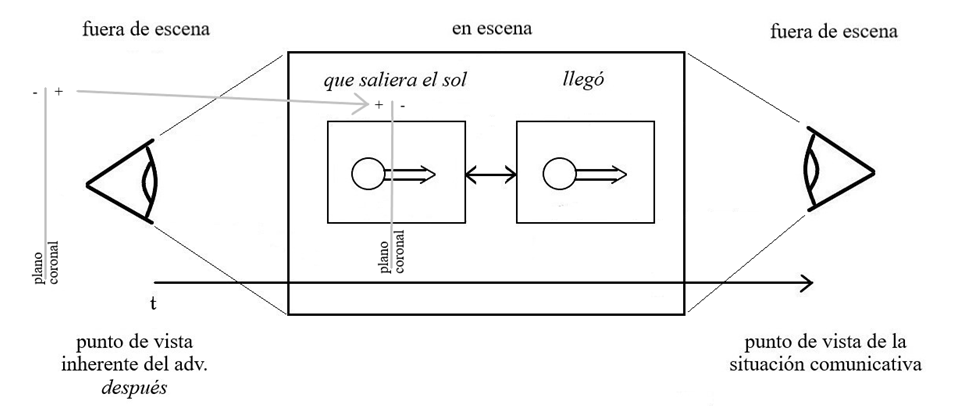 Ilustración 12.
Llegó después de que saliera el sol
Ilustración 12.
Llegó después de que saliera el sol
Se produce, de este modo, en estas oraciones —y a diferencia de lo observado en las oraciones (1) y (2)— una disociación entre el punto de vista que corresponde a la situación comunicativa y el inherente a las construcciones analizadas. Este último punto de vista presenta aquí, además, la particularidad de que no solo no coincide con el del hablante, sino tampoco con el de ninguna otra entidad explícitamente aludida en la oración: por el contrario, corresponde a un conceptualizador de naturaleza meramente virtual, exigido tanto por la estructuración conceptual asociada a estas construcciones como por una de las metáforas fundamentales de las que nos servimos para conceptualizar la dimensión temporal.
3.1. Perspectivas alternativas: de la pervivencia del punto de vista del hablante
Como se ha mostrado en el epígrafe anterior, las oraciones en las que el proceso introducido por antes/después de se ubica en un intervalo temporal anterior a la situación comunicativa contienen un doble punto de vista: el que corresponde al hablante y el inherente a los adverbios antes y después. Esta idea, tal cual se ha presentado, podría llevar a la conclusión de que, en estas oraciones, el punto de vista inherente a los adverbios antes y después viene a sustituir, dentro del marco de la oración subordinada, al aportado por la situación comunicativa. Tal conclusión, sin embargo, sería errónea: en realidad, el punto de vista propio de la situación comunicativa nunca deja de ejercer su influencia sobre la oración subordinada. Que esto es así lo evidencia el hecho de que el verbo de la subordinada, pese a presentarse como no factual, en subjuntivo, desde el punto de vista inherente de la construcción, adopta la forma saliera —tradicionalmente denominada de pretérito—, lo cual solo puede justificarse desde la lógica de la óptica aportada por el punto de vista que corresponde a la situación comunicativa.
La coexistencia de dos puntos de vista distintos en estas construcciones no deja de tener sus consecuencias en cuanto a las posibilidades que proporciona al hablante de estructuración conceptual de los procesos implicados en ella. Así, si bien el trabajo de Pérez Saldanya (1999) constituye, según espero haber demostrado, un análisis erróneo de la conceptualización asociada a estas construcciones, no carece de toda justificación la relevancia que el autor atribuye en ellas al proceso primario con respecto al comportamiento del secundario. Efectivamente, el proceso primario del que dependen las oraciones subordinadas temporales introducidas por antes/después de, si bien no presenta la capacidad de aportar un punto de vista alternativo al proporcionado por la situación comunicativa, como pretende Pérez Saldanya (1999), sí que puede condicionar, según su posición relativa, el que el proceso secundario pueda ser descrito, no desde la perspectiva aportada por el punto de vista inherente a la construcción antes/después de, sino desde la del hablante, ubicado en la situación comunicativa.
El fenómeno afecta, principalmente, a las oraciones que incluyen la construcción después (de) que, cuando, en ellas, el proceso secundario (o de referencia) se ubica en un intervalo temporal anterior a la situación comunicativa. En tal caso, los elementos que constituyen la conceptualización a la que se asocia esta construcción presentan, como se acaba de mostrar (vid. ilustración 12) la siguiente distribución a lo largo del eje temporal:
La contigüidad que se produce en tales casos entre el proceso primario y el punto de vista de la situación comunicativa —que, recordemos, nunca deja de ejercer su influencia sobre la conceptualización del proceso secundario—, unida a la distancia que separa a ambos elementos del punto de vista inherente a la construcción, hace posible una oración como la presentada en el ejemplo (33).
-
(33) Llegó después de que salió el sol.
En ella, el proceso secundario (salió) es conceptualizado, en su conjunto, desde el punto de vista del hablante —como factual, en indicativo, y como pasado—, lo que supone obviar (en lo que respecta al modo verbal, no a la orientación señalada por el adverbio) la perspectiva del punto de vista inherente al adverbio después24.
En cuanto a los motivos que podrían dar cuenta de la frecuencia con la que los hablantes hacen uso de esta posibilidad, descartando con ello la valoración epistémica del proceso subordinado desde el punto de vista inherente a la construcción después (de), quizás haya que recurrir a razones de economía cognitiva, dado el menor esfuerzo que parece requerir la producción y procesamiento de una conceptualización en la que todos los procesos implicados son valorados epistémicamente desde el punto de vista de la situación comunicativa. Así, por una parte, el hecho de que el uso del subjuntivo en estas construcciones responda a la adopción del punto de vista inherente a los adverbios implicados (antes/después) podría justificar la documentación de tal uso tanto en latín —de forma ocasional, tras postquam (Klaus Hunnius, cit. en Hummel 2001: 267)— como en todos los periodos de la evolución del castellano y del francés, pese a los intentos —en el caso de este último— de suprimirlo (vid. Hummel 2001: 267-268). Mientras que, por otra, el mayor esfuerzo cognitivo requerido por la conceptualización de los procesos implicados desde perspectivas modales diversas podría explicar su mayor incidencia en la lengua escrita y en ámbitos como el lenguaje periodístico, científico o literario, frente al español oral y popular25.
De forma paralela, la asociación (casi) absoluta de la construcción antes (de) con el subjuntivo, incluso cuando el proceso secundario se entiende como anterior a la situación comunicativa (*Llegó antes de que salió el sol), se explicaría por la ubicación relativa, a lo largo del eje temporal, de los distintos elementos que constituyen la conceptualización asociada a esta otra construcción (vid.
ilustración 11):
Como puede verse, en el caso de antes (de), el proceso primario se ubica en un intervalo temporal que no solo es contiguo al punto de vista propio de la construcción, sino que, además, se encuentra separado del punto de vista del hablante por el proceso secundario, lo que no haría sino reforzar la tendencia natural de esta construcción a asumir el punto de vista inherente a antes (de) para la descripción del proceso secundario26.
4. Conclusiones
En el presente artículo se ha defendido que el uso del subjuntivo en las oraciones subordinadas temporales introducidas por después (de), en aquellos casos en los que el proceso aludido se ubica en un intervalo temporal anterior a la situación comunicativa, no constituye una anomalía dentro del sistema modal español, como tradicionalmente se ha entendido. Muy al contrario, tal uso no solo responde a una estructuración conceptual paralela a la que presentan las oraciones introducidas por antes (de), sino que, además, es coherente con la conceptualización que, en español, se asocia al conjunto de subordinadas temporales.
Los intentos previos de dar cuenta de estas construcciones acertaban en hacer depender el uso del subjuntivo en tales casos de un punto de referencia distinto al proporcionado por la situación comunicativa. Erraban, sin embargo —según aquí se ha pretendido mostrar—, al ubicar tal punto de referencia alternativo en el evento señalado por el verbo principal. Con respecto a los motivos por los que hasta ahora no había sido posible vislumbrar una explicación adecuada de estas construcciones, se aduce aquí la ausencia de los instrumentos teóricos necesarios que permitieran apreciar la relevancia y amplitud de los fenómenos de la perspectiva y el punto de vista.
Con el fin de superar tales dificultades, el análisis que se acaba de exponer se ha sustentado en las aportaciones de la lingüística cognitiva. Gracias a ellas, ha sido posible justificar el uso del subjuntivo en las construcciones objeto de estudio atendiendo a un único esquema conceptual básico, rescatando con ello la construcción después (de) + subjuntivo de la categoría de anomalía a la que los trabajos anteriores la habían relegado.
Para ello, se ha sostenido que las construcciones antes/después (de) requieren, en consonancia con la conceptualización a la que se asocian los adverbios que constituyen su núcleo, de la descripción de la escena aludida desde un punto de vista inherente, anterior a los procesos implicados en estas construcciones. Tal punto de vista no solo resulta imprescindible para la conceptualización del sentido del desplazamiento al que están sometidos los procesos dentro del marco de la metáfora conceptual EL TIEMPO ES UN OBJETO QUE SE MUEVE; así como para la determinación del sentido positivo o negativo de la orientación del proceso primario con respecto al proceso secundario, en tanto que constituyente central del arquetipo de encuentro canónico; sino que, además, hace posible la adopción de la perspectiva prospectiva que justifica la presentación del proceso secundario de la construcción como no factual, en subjuntivo.
Asimismo, se ha demostrado que el punto de vista inherente a estas construcciones es independiente de la situación comunicativa. En consecuencia, su coincidencia con el punto de vista del propio hablante, o con el de cualquier otro conceptualizador específico señalado en el discurso, es solo una de las posibilidades que presentan estas construcciones, sin que se pueda considerar que tal coincidencia constituya, en ningún caso, una condición necesaria para la consideración de la existencia de tal punto de vista y de su influencia sobre la conceptualización del proceso subordinado.
En cuanto a la posibilidad, ampliamente documentada, de que el proceso secundario, introducido por después (de), en aquellos casos en los que se ubica en un intervalo temporal anterior a la situación comunicativa, se presente en indicativo, esta se ha relacionado aquí con la ubicación relativa que presenta en esta construcción el proceso primario, entre el secundario y la situación comunicativa, y lejos del punto de vista requerido por la construcción, lo que no determinaría, pero sí favorecería, por economía cognitiva, la adopción del punto de vista propio de la situación comunicativa para la valoración epistémica de ambas oraciones, obviando el inherente al adverbio después.
Las conclusiones de este estudio confirman, hasta cierto punto, como se ha visto, la validez de la asociación que establece el enfoque epistémico tradicional del indicativo con lo factual y el subjuntivo con lo eventual. Tal asociación, sin embargo, solo se mantiene constante si se tiene en cuenta el punto de vista inherente a las unidades y construcciones lingüísticas utilizadas, que —insisto— no tiene por qué coincidir, como erróneamente asume dicho enfoque, con el que corresponde al hablante o cualquier otro conceptualizador explícitamente incluido en la oración.
Esta posibilidad de que un proceso pueda ser valorado epistémicamente desde el punto de vista de un conceptualizador virtual, vinculado a una determinada construcción, independientemente del estatus epistémico que pudiera atribuirle el hablante en el momento de la enunciación, o cualquier otro conceptualizador incluido explícitamente en el discurso, abre una nueva vía de estudio del valor de los modos en español, alternativo al enfoque predominante. Desde esta perspectiva, la primera pregunta que debemos plantearnos a la hora de explicar el uso que se hace en un texto de los modos verbales no es qué sabe o cree saber el hablante acerca de la realidad, sino desde qué perspectiva —correspondiente o no con alguno de los participantes señalados en el texto—, asociada a la construcción lingüística escogida, se está conceptualizando en ese caso concreto el proceso al que se hace referencia.
Es de esperar que este nuevo modelo pueda dar cuenta de otros contextos de uso del subjuntivo a los que hasta ahora no han sabido dar una respuesta satisfactoria ni los trabajos desarrollados desde el enfoque epistémico tradicional ni aquellos otros que vinculan la concepción del modo a los fenómenos de la aserción y la presuposición. Con todo, no se debe pasar por alto el hecho de que la asociación aquí establecida entre el modo y el punto de vista inherente a los adverbios antes y después resulta especialmente clara gracias al valor temporal propio de estas unidades. Solo un estudio más amplio, que incluyera otro tipo de unidades y construcciones carentes de tal valor temporal, y que explorase la posibilidad de llevar a cabo una trasposición del esquema planteado al plano epistémico, podría determinar hasta qué punto las conclusiones del presente trabajo son aplicables al subjuntivo en su conjunto.
Agradecimientos
El autor desea dejar constancia de su agradecimiento a Luis Gómez Santacreu y Margarita Rodríguez Espinosa por sus correcciones y sugerencias a propósito de la redacción de este artículo. De gran ayuda han sido igualmente, en el proceso de elaboración de esta investigación, las aclaraciones y observaciones aportadas por Carlos Duque Gómez a propósito de aquellas nociones propias del ámbito de la geometría de las que se hace uso en este artículo. La responsabilidad sobre el texto definitivo es, en todo caso, exclusiva del autor.
Bibliografía
Acero, Juan José. 1990. Las ideas de Reichenbach acerca del tiempo verbal. En Ignacio Bosque (ed.), Tiempo y aspecto en español, Madrid: Ediciones Cátedra, 45-75.
Achard, Michel. 1998. Representation of cognitive structures. Syntax and semantics of French sentential complements, Berlín / Nueva York: Mouton de Gruyter. https://doi.org/10.1515/9783110805956
Alarcos Llorach, Emilio. 1994. Gramática de la lengua española, Madrid: Espasa Calpe.
Aurová, Miroslava. 2013. Diversidad lingüística: después de que y el modo verbal. En Miroslav Valeš y Salomír Míča (eds.), Diversidad lingüística del español, Liberec: Universidad Técnica de Liberec, 113-130.
Barrios Sabador, María José. 2016. Uso de indicativo y subjuntivo en los adverbios de modalidad epistémica de incertidumbre. Estudio en un corpus informatizado. E-AESLA 2, 260-273.
Barsalou, Lawrence W. 2008. Grounded cognition. Review of Psychology 59, 617-645. https://doi.org/10.1146/annurev.psych.59.103006.093639
Bergen, John J. 1978. One rule for the Spanish subjunctive. Hispania 61, 218-234. https://doi.org/10.2307/340865
Borrego, Julio; Gómez Asencio, José; Prieto, Emilio. 1986. El subjuntivo. Valores y usos, Madrid: Sociedad General Española de Librería.
Cabezas Holgado, Emilio. 2017. Paradigma de las expresiones espaciales. Estudio léxico-sintáctico. Language Design 19, 55-113.
Castronovo, Brian J. 1990. La categoría verbal de modo en la tradición gramatical española. En Ignacio Bosque (ed.), Indicativo y subjuntivo, Madrid: Taurus Universitaria, 66-80.
Clark, Herbert H. 1973. Space, time, semantics and the child. En Timothy E. Moore (ed.), Cognitive development and the acquisition of language, Nueva York: Academic Press, 27-63. https://doi.org/10.1016/B978-0-12-505850-6.50008-6
Croft, William; Cruse, D. Alan. 2004. Cognitive linguistics, Cambridge: Cambridge University Press. https://doi.org/10.1017/CBO9780511803864
Dirven, René; Ruiz de Mendoza Ibáñez, Francisco José. 2010. Looking back at 30 years of Cognitive Linguistics. En Elżbieta Tabakowska, Michał Choiński y Łukasz Wiraszka (eds.), Cognitive linguistics in action: from theory to application and back, Berlín / Nueva York: Mouton de Gruyter, 13-70.
Dunlap, Carolyn. 2006. Dialectal variation in mood choice in Spanish journalistic prose. Language Variation and Change 18, 35-53. https://doi.org/10.1017/S0954394506060029
Evans, Vyvyan. 2004. The structure of time. Language, meaning and temporal cognition, Ámsterdam/Filadelfia: John Benjamins Publishing Company.
Evans, Vyvyan; Green, Melanie. 2006. Cognitive linguistics: an introduction, Edimburgo: Edinburg University Press.
Filimon, Flavia. 2015. Are all spatial reference frames egocentric? Reinterpreting evidence for allocentric, object-centered, or world-centered reference frames. Frontiers in Human Neuroscience 9(648). https://doi.org/10.3389/fnhum.2015.00648
Fillmore, Charles J. 1997 [1971]. Lectures on deixis, Stanford, California: CSLI Publications.
García Fernández, Luis. 2000. La gramática de los complementos temporales, Madrid: Visor Libros.
García García, Serafina. 1991. Sobre algunos adverbios temporales + que. Revista de Filología, Universidad de La Laguna 10, 159-174.
García Yanes, Francisco Javier. 2019. El enfoque cognitivo como alternativa al estudio inmanente del significado: el caso de la Escuela de Semántica de La Laguna. Revista de Filología, Universidad de La Laguna 39, 213-236. https://doi.org/10.25145/j.refiull.2019.39.10.
González Calvo, José Manuel. 1995. Sobre el modo verbal en español. Anuario de Estudios Filológicos 18, 177-203.
Guitart, Jorge M. 1991. The pragmatics of Spanish mood in complements of knowledge and acquisition-of-knowledge predicates. En Suzanne Fleischman y Linda R. Waugh (eds.), Discourse-pragmatics and the verb, Londres / Nueva York: Routledge, 179-193. (Traducción al español en Ignacio Bosque (ed.), Indicativo y subjuntivo, Madrid: Taurus Universitaria, 315-329).
Hamann, Cornelia. 1987. The awesome seeds of reference time. En Alfred Schopf (ed.), Essays on tensing in English. Vol. 1, Tübingen: Niemeyer, 27-69. https://doi.org/10.1515/9783111358369-004
Haspelmath, Martin. 1997. From space to time. Temporal adverbials in the world’s languages, Múnich / Newcastle: Lincom Europa.
Hewson, John; Bubenik, Vit. 1997. Tense and aspect in Indo-European languages. Theory, typology, diachrony, Ámsterdam / Filadelfia: John Benjamins Publishing Company. https://doi.org/10.1075/cilt.145
Hill, Clifford Alden. 1978. Linguistic representation of spatial and temporal orientation. En Proceedings of the 4th Annual Meeting of the Berkeley Linguistics Society, 524-538. https://doi.org/10.3765/bls.v4i0.2202
Hummel, Martin. 2001. El valor básico del subjuntivo español y románico, Cáceres: Universidad de Extremadura.
Kemmerer, David. 2010. How words capture visual experience. The perspective from cognitive neuroscience. En Barbara C. Malt y Phillip Wolff (eds.), Words and the mind. How words capture human experience, Nueva York / Oxford: Oxford University Press, 289-329. https://doi.org/10.1093/acprof:oso/9780195311129.003.0015
Klatzky, Roberta L. 1998. Allocentric and egocentric spatial representations: definitions, distinctions, and interconnections. En Christian Freksa, Christopher Habel y Karl F. Wender (eds.), Spatial Cognition. An interdisciplinary approach to representing and processing spatial knowledge .Lecture notes in artificial intelligence, vol. 1404), Heidelberg: Springer, 1-17. https://doi.org/10.1007/3-540-69342-4_1
Kratochvílová, Dana. 2016. El subjuntivo español como tema central de investigación. Acta Universitatis Carolinae - Philologica 3, 197-209. https://doi.org/10.14712/24646830.2016.44
Lakoff, George. 1987. Women, fire and dangerous things: what categories reveal about the mind, Chicago: Chicago University Press. https://doi.org/10.7208/chicago/9780226471013.001.0001
Lakoff, George; Johnson, Mark. 1986 [1980]. Metáforas de la vida cotidiana, Madrid: Ediciones Cátedra.
Lakoff, George; Johnson, Mark. 1999. Philosophy in the flesh: the embodied mind and its challenge to Western thought, Nueva York: Basic Books.
Langacker, Ronald W. 1987. Foundations of cognitive grammar, vol. 1, Stanford: Stanford University Press.
Langacker, Ronald W. 1991a. Foundations of cognitive grammar, vol. 2, Stanford: Stanford University Press.
Langacker, Ronald W. 1991b. Concept, image, and symbol: the cognitive basis of grammar, Berlín: Mouton de Gruyter. https://doi.org/10.1515/9783110857733
Langacker, Ronald W. 2008. Cognitive grammar: a basic introduction, Nueva York: Oxford University Press. https://doi.org/10.1093/acprof:oso/9780195331967.001.0001
López Rivera, Juan José. 2002. El modo: la categoría gramatical y la cuestión modal, Santiago de Compostela: Universidade de Santiago de Compostela.
Lunn, Patricia V. 1989. Spanish mood and the prototype of assertability. Linguistics 27, 687-702.
Maldonado, Ricardo. 1995. Middle-subjunctive links. En Peggy Hamispour, Ricardo Maldonado, Margaret van Naerssen (eds.), Studies in Language Learning and Spanish Linguistics in Honor of Tracy D. Terrell, Nueva York: McGraw Hill, 399-418.
Maldonado, Ricardo. 2012. La gramática cognitiva. En Iraide Ibarretxe-Antuñano y Javier Valenzuela (dirs.), Lingüística cognitiva, Barcelona: Anthropos Editorial, 213-247.
Matte Bon, Francisco. 2008 [2001]. El subjuntivo español como operador metalingüístico de gestión de la información. MarcoELE, Revista de Didáctica ELE 6.
Mejías-Bikandi, Errapel. 1994. Assertion and speaker’s intention: a pragmatically based account of mood in Spanish. Hispania 77(4), 892-902. https://doi.org/10.2307/345752
Mejías-Bikandi, Errapel. 1998. Presupposition and old information in the use of the subjunctive mood in Spanish. Hispania 81(4), 941-948. https://doi.org/10.2307/345807
Morera, Marcial. 1999. Apuntes para una gramática del español de base semántica. Primera parte: morfología, Puerto del Rosario: Servicio de Publicaciones del Excmo. Cabildo de Fuerteventura.
Morera, Marcial. 2014. El punto de vista del observador como rasgo semántico de los signos descriptivos. Verba 41, 75-102. https://doi.org/10.15304/verba.41.1668
Navas Ruiz, Ricardo. 1990. El subjuntivo castellano. Teoría y bibliografía crítica. En Ignacio Bosque (ed.), Indicativo y subjuntivo, Madrid: Taurus Universitaria, 107-141.
Pérez Saldanya, Manuel. 1999. El modo en las subordinadas relativas y adverbiales. En Ignacio Bosque y Violeta Demonte (dirs.), Gramática descriptiva de la lengua española, vol. 2, Madrid: Espasa, 3253-3322.
Porto Dapena, José Álvaro. 1991. Del indicativo al subjuntivo, Madrid: Arco Libros.
Pottier, Bernard. 1954-1955. Espacio y tiempo en el sistema de las preposiciones. Boletín de Filología 8, 347-354.
Rae-asale 2009 = Real Academia Española y Asociación de Academias de la Lengua Española. 2009. Nueva gramática de la lengua española, Madrid: Espasa Libros.
Reichenbach, Hans. 2005 [1947]. The tenses of verbs. En Inderjeet Mani, James Pustejovsky y Robert Gaizauskas (eds.), The language of time: a reader, Oxford: Oxford University Press, 71-78.
Ruiz Campillo, José Plácido. 2004. La enseñanza significativa del sistema verbal: un modelo operativo [tesis doctoral], Ministerio de Educación y Ciencia. http://www.educacionyfp.gob.es/mc/redele/biblioteca-virtual/numerosanteriores/2004/memoriamaster/1-semestre/ruiz-c.html [15/5/2021].
Ruiz Campillo, José Plácido. 2006-2007. El concepto de no-declaración como valor del subjuntivo. Protocolo de instrucción operativa de la selección modal en español. En Carmen Pastor (coord.), Actas del programa de formación para profesorado de ELE, Múnich: Instituto Cervantes de Múnich, 89-146.
Ruiz Campillo, José Plácido. 2008. El valor central del subjuntivo: ¿informatividad o declaratividad? MarcoELE, Revista de Didáctica ELE 7.
Sánchez Lancis, Carlos Eliseo. 1990. Estudio de los adverbios de espacio y tiempo en el español medieval [tesis doctoral], Universidad Autónoma de Barcelona.
Sperber, Dan; Wilson, Deirdre. 1995 [1986]. Relevance: communication and cognition, 2.ª ed., Oxford / Cambridge, Massachusetts: Blackwell.
Talmy, Leonard. 2000. Toward a cognitive semantics, vol. 1: concept structuring systems, Cambridge: MIT Press. https://doi.org/10.7551/mitpress/6847.001.0001
Taylor, John R. 2003. Linguistic categorization, 3.ª ed., Oxford: Oxford University Press.
Terrell, Tracy; Hooper, Joan. 1974. A semantically based analysis of mood in Spanish. Hispania 57(3), 484-494. https://doi.org/10.2307/339187 (Traducción al español en Ignacio Bosque (ed.), Indicativo y subjuntivo. Madrid: Taurus Universitaria, 145-163).
Traugott, Elizabeth Closs. 1978. On the expression of spatio-temporal relations in language. En Joseph H. Greenberg (ed.), Universals of human language. Stanford, California: Stanford University Press, 369-400.
Vandeloise, Claude. 1991. Spatial prepositions. A case study from French, Chicago / Londres: The University of Chicago Press.
Veiga, Alexandre; Mosteiro Louzao, Manuel. 2006. El modo verbal en las cláusulas condicionales, causales, consecutivas, concesivas, finales y adverbiales de lugar, tiempo y modo, Salamanca: Ediciones Universidad de Salamanca.
Verhagen, Arie. 2006. On subjectivity and ‘long distance wh-movement’. En Angeliki Athanasiadou, Costas Canakis y Bert Cornillie (eds.), Subjectification. Various paths to subjectivity, Berlín / Nueva York: Mouton de Gruyter, 323-346. https://doi.org/10.1515/9783110892970.323
Verhagen, Arie. 2007. Construal and perspectivization. En Dirk Geeraerts y Hubert Cuyckens (eds.), The Oxford handbook of cognitive linguistics, Oxford: Oxford University Press, 48-81.
Vesterinen, Rainer; Bylund, Emanuel. 2013. Towards a unified account of the Spanish subjunctive mode: epistemic dominion and dominion of effective control. Lingua 131, 179-198. https://doi.org/10.1016/j.lingua.2013.03.001
Wilson, Margaret. 2002. Six views of embodied cognition. Psychonomic Bulletin & Review 9(4), 625-636. https://doi.org/10.3758/BF03196322
Zamorano Aguilar, Alfonso. 2005. El subjuntivo en la historia de la gramática española (1771-1973), Madrid: Arco Libros.
Notas
1
Para una visión de conjunto, véanse los trabajos de Navas Ruiz (1990), Castronovo (1990), González Calvo (1995), López Rivera (2002) y Zamorano Aguilar (2005).
2
Porto Dapena (1991: 23-25) ofrece una breve reseña de los gramáticos representativos de esta tradición, en el ámbito hispánico, en la segunda mitad del siglo XX. Dentro del marco de la lingüística cognitiva, esta postura es defendida por Maldonado (1991).
3
Dentro del marco de la semántica lógica o de las condiciones de verdad, se entiende que una proposición constituye un ejemplo de presuposición cuando la negación de la oración, en su conjunto, no afecta al valor de verdad de tal proposición.
4
Vesterinen y Bylund (2013: 179-180) y Kratochvílová (2016) ofrecen sendas revisiones de este tipo de enfoque.
5
Para una defensa de la consideración de las construcciones antes/después (de) que como estructuras complejas dependientes de un núcleo adverbial (antes/después), véase García García (1991).
6
La conceptualización de la situación a la que alude la subordinada como factual es, con todo, solo una de las interpretaciones admitidas por estas oraciones. Para un análisis en profundidad de esta cuestión, véase García Fernández (2000: 231-246).
7
La lingüística cognitiva utiliza el término conceptualizador (vid.
Langacker 1987: 128) con el fin de subrayar el papel activo de los participantes en cualquier acto de comunicación con respecto al proceso de conceptualización que implica tanto la producción como la comprensión del discurso.
8
Para una justificación de esta afirmación dentro del marco de la lingüística cognitiva, que Achard (1998) denomina precisamente construcciones con sujeto conceptualizador (conceptualizing subject constructions, CSC), véanse Langacker (1991a: 442) y Achard (1998: § 2.3.4).
9
Veiga y Mosteiro Louzao (2006: 372, n. 42) señalan la incongruencia que supone la defensa de tal postura por parte del autor después de haber afirmado que la alternancia modal en este contexto no estaba asociada a “diferencias importantes de significado”.
10
Para el caso del español, véanse Alarcos Llorach (1994: § 222) o Morera (1999: 176, 185), entre otros.
11
Para un intento reciente de introducir el concepto de punto de vista dentro del marco del estructuralismo, véase la propuesta de Morera (2014).
12
Langacker (1987: 123; 2008: 73-77) desglosa el concepto de punto de vista en dos componentes: la orientación, o alineación con respecto a los ejes del campo visual; y la ubicación del conceptualizador (vantage point), desde la cual la escena en cuestión es observada y descrita.
13
Se utiliza aquí el término proceso en el sentido expuesto en Langacker (1987: cap. 7), como el significado que se corresponde con la categoría verbal, y que consiste, básicamente, en una relación (esto es, un significado conceptualmente dependiente de un elemento nominal) compuesta de una sucesión de secuencias desarrolladas a lo largo del tiempo concebido.
14
La lingüística cognitiva se ha fundamentado, desde el punto de vista filosófico, en los principios del denominado realismo corporeizado o experiencial (Lakoff y Johnson 1986 [1980]; 1999), según el cual la cognición humana, en lo que se refiere a los propios conceptos y mecanismos mentales con los que opera —incluidas las unidades del lenguaje—, está condicionada, e incluso conformada, por nuestra experiencia corporal de la realidad (vid. Wilson 2002; Barsalou 2008). Para una exposición y valoración comparativa de tales fundamentos con respecto a los del inmanentismo estructuralista, véase García Yanes (2019: 223-224).
15
Es necesario, con todo, puntualizar que —como señala Verhagen (2006: 324)— todo acto comunicativo es un ejercicio de coordinación entre los conceptualizadores, en el que intervienen los puntos de vista del hablante y del interlocutor. Esto tiene como consecuencia el que, en este caso concreto del uso deíctico de los adverbios de orientación espacial, las funciones de entidad de referencia y punto de vista no las desempeñe el hablante de forma exclusiva, sino que incluyan también al interlocutor o interlocutores (Fillmore 1997 [1971]: “Deixis I”, párr. 31), como puede observarse en estos ejemplos.
16
Dada la capacidad del ser humano —señalada por Langacker (2008)— de presentar de manera efectiva una determinada escena desde un punto de vista distinto del que le corresponde a su ubicación real, este punto de vista externo no tiene por qué coincidir con el del propio hablante. Así, puede ocurrir que el hablante adopte el punto de vista del interlocutor, y se tome a sí mismo como entidad de referencia para la ubicación del objeto en cuestión. En tal caso, estaríamos igualmente ante un uso no deíctico de los adverbios de orientación, tal como defiende Fillmore (1997 [1971]: “Deixis I”, párr. 32), puesto que las funciones de entidad de referencia y punto de vista no coinciden en la misma entidad, pero con la particularidad de que es el propio hablante el que cumple la función de entidad de referencia, externo —aunque pudiera parecer paradójico— al punto de vista. Es este tipo de conceptualización el que encontramos en oraciones como El vaso está delante/detrás de mí.
17
De ahí que el adverbio, en estos casos, requiera por lo general de un complemento introducido por la preposición de, que señale la entidad que se toma como referencia, y que, en el caso del uso deíctico de estos adverbios, aporta de forma implícita la propia situación comunicativa (cfr. Vandeloise 1991: 24-28).
18
Las representaciones aquí incluidas no agotan, ni mucho menos, las posibles ubicaciones del punto de vista del hablante, que podría igualmente situarse de forma perpendicular u oblicua al eje formado por la cámara y el vaso, sin que tal hecho resultase relevante para la ubicación del vaso, que toma como único punto de referencia la orientación de la cámara.
19
Esta postura encuentra su fundamento filosófico en los principios del realismo corporeizado o experiencial (Lakoff y Johnson 1986 [1980]; 1999). Además, se sustenta empíricamente sobre la base de estudios como el llevado a cabo por Haspelmath (1997), a propósito de los adverbios temporales, dentro del marco de la tipología lingüística. En todo caso, la consideración del sentido temporal de estas unidades como derivado —desde el punto de vista diacrónico— del espacial no resulta incompatible con la postulación de un esquema general que, en el estado actual de la lengua, abarque ambos sentidos, tal como, de hecho, propone Langacker (1987: 126) para las unidades de la lengua francesa avant y après.
20
La posibilidad de conceptualizar el espacio por medio de unidades de valor temporal, que se constata en oraciones del tipo En el templo, la columna está antes/después de la pared (Cabezas Holgado 2017: 79), no parece que deba ser entendida como resultado de la aplicación de una metáfora conceptual de sentido inverso al señalado por la lingüística cognitiva, sino más bien como un ejemplo del fenómeno que Talmy (2000: cap. 2) denomina movimiento ficticio, mediante el cual conceptualizaciones que incluyen la idea de movimiento (como es el caso de los adverbios de valor temporal) se utilizan para describir realidades de naturaleza estática. En la oración aportada por Cabezas Holgado, el tipo de movimiento ficticio en concreto al que se recurre sería el de vía de acceso (access path) (Talmy 2000: 136-137), a través del cual el hablante atribuye a los objetos descritos (la columna y la pared) la dinamicidad que corresponde, en realidad, al orden temporal en el que una entidad se encontraría con los objetos aludidos, en su recorrido (físico o visual) por el espacio en el que se ubican tales objetos.
21
Se asume aquí la existencia de (al menos) dos tipos sustancialmente diversos de puntos de vista: por un lado, el aquí estudiado, vinculado a la manera en que se conciben dos eventos secuenciados, esto es, ordenados a lo largo del eje temporal; y, por otro, el que corresponde a los tradicionalmente denominados tiempos verbales, ajeno a la existencia o no de tal secuenciación (vid.
Traugott 1978). Es esta diferencia la que hace posible atribuir en estas ilustraciones al punto de vista del hablante una orientación hacia el pasado, justamente en sentido opuesto a la que se asocia a la secuenciación de eventos.
22
Bastaría para demostrar esta afirmación con recurrir a alguna de las construcciones que, como defiende Verhagen (2006), tienen como función explicitar el conceptualizador responsable del objeto de conceptualización presentado, así como el tipo de relación que se establece entre ambos ({sé/creo/supongo...} que), y, luego, comprobar su equivalencia con las oraciones analizadas.
23
Tanto en esta ilustración como en las que siguen se adoptan algunas de las convenciones de la gramática cognitiva. Así, los círculos representan las entidades; mientras que los rectángulos en los que aquellos se inscriben simbolizan los procesos en los que están implicadas tales entidades. Dentro de los rectángulos, los vectores que tienen su origen en las entidades aluden al carácter intransitivo de los procesos aludidos. La flecha de doble sentido que une ambos rectángulos, por su parte, pretende reflejar las relaciones de dependencia que se establecen entre los procesos aludidos, como figura primaria y secundaria de la conceptualización asociada al adverbio (vid. Langacker 2008: § 12.2.1). Por último, la flecha horizontal marcada con el símbolo t representa el eje temporal, con el sentido de la flecha señalando el sentido canónico atribuido a esta dimensión. (Recuérdese, con todo, que en el caso de la metáfora conceptual EL TIEMPO ES UN OBJETO QUE SE MUEVE, que representan estas construcciones, el desplazamiento de los eventos y los intervalos temporales se produce justo en el sentido contrario al canónico: desde el futuro hacia la ubicación del conceptualizador, que permanece inmóvil).
24
Lógicamente, esta alternativa no se presenta en la oración Llegará después de que salga el sol, porque, en ella, tanto el punto de vista del hablante como el requerido por después son coincidentes y anteriores a los procesos aludidos.
25
Esta justificación no es incompatible con el hecho de que el contraste proporcionado por ambas conceptualizaciones, en aquellas variedades del español en las que se documentan con la frecuencia necesaria como para que el hablante las perciba como alternativas, pueda ser explotado desde el punto de vista pragmático. En tales casos, la elección del punto de vista inherente al adverbio para la conceptualización del proceso aludido, en subjuntivo, en lugar del punto de vista del hablante, puede entenderse como expresión de desconocimiento o falta de compromiso del hablante con respecto al proceso aludido, tal como proponen autores como Pérez Saldanya (1999: 3316), Hummel (2001: 269-272) o Aurová (2013: 126-127), en la medida en que tal perspectiva no aporta información acerca de la valoración epistémica del proceso aludido por parte del hablante, sino solo del conceptualizador virtual inherente a la construcción.
26
Hummel (2001: 271) recoge, con todo, un ejemplo de uso del indicativo en este contexto, perteneciente al español americano y al ámbito literario: “[...] un investigador americano que estuvo trabajando en el Paraguay, pero se fue del país antes de que pudimos conocernos”. Más allá de la valoración del grado de representatividad o de la posible influencia del inglés en tal ejemplo —aspectos estos que merecerían un estudio en profundidad—, el uso del indicativo en estos casos no estaría del todo injustificado a la luz del modelo aquí presentado, en tanto que este contempla el punto de vista desde el que, en tal ejemplo, es conceptualizado el proceso secundario: el que se corresponde con la situación comunicativa. En todo caso, de admitirse la representatividad del ejemplo en cuestión, los factores que aquí se han planteado no deberían entenderse como bloqueadores de una determinada conceptualización, sino como justificación de su baja frecuencia estadística, en tanto que favorecedores de la adopción de la perspectiva alternativa.