Este estudo investiga as preferencias da cidadanía respecto á implementación de medidas de adaptación ao cambio climático (CC) ao longo da costa galega, centrándose nos servizos ecosistémicos (SE) culturais e de aprovisionamento crave. As ameazas medioambientais consideradas inclúen os impactos na calidade da auga de mar, a presenza de medusas nas praias e os impactos xerais na produtividade do ecosistema mariño. Este estudo explora as diferenzas nas preferencias entre as persoas que viven en zonas costeiras e as que viven en zonas do interior. Os datos recompiláronse mediante unha enquisa en liña, que incluía un experimento de elección discreta (DCE) e escalas de percepción adicionais relacionadas co CC. Os resultados indican que un maior sentido de identidade local e de identificación coa costa conduce a unha maior disposición a apoiar iniciativas medioambientais, o que suxire que o sentido de identidade pode influír nas actitudes favorables ao medio ambiente.
Palabras clave:
Experimento de elección discreta, Disposición a pagar, Cambio climático, Valoración, Servizos ecosistémicos
Castro-Atanes, Iglesias Caride, and Loureiro: Coastal ties, identity, and climate change adaptation preferences
1. INTRODUCTION
Coastal habitats are vital, offering a wide range of ecosystem services (ES) essential
to human well-being () and biodiversity conservation (; ). According to the Common International Classification of Ecosystem Services (CICES),
coastal areas generate provisioning services (e.g., fisheries), regulating services
(e.g., protection from erosion and natural hazards), and cultural or recreational
services (e.g., tourism) ().
The economic valuation of coastal environments is a dynamic interdisciplinary field
() aimed at quantifying coastal areas’ market and non-market contributions, including
fisheries, tourism, coastal protection, and carbon sequestration. While the economic
relevance of these ecosystems is well-established, the challenges posed by Climate
Change (CC)—driven by both natural and anthropogenic factors—necessitate a re-evaluation
of their value and resilience (; ). Recent research calls for the integration of CC dimensions into coastal ecosystem
valuation frameworks ().
There is a growing body of literature focusing on preferences for implementing adaptation
strategies in coastal regions to counteract climate change impacts (Mallette et al.,
2021). This study focuses on the Galician coast —a region with a high dependency on
the fishing industry, where CC is bringing significant disruptions. Unlike terrestrial
systems, where climate impacts are more direct, marine ecosystems are influenced by
a complex interplay of oceanographic dynamics (e.g., currents, salinity) and broader
climate variability (e.g., warming trends, atmospheric shifts) ().
We offer a novel contribution by comparing adaptation preferences among coastal and
inland residents in Galicia—an aspect rarely addressed in the context of CC adaptation.
While previous studies have examined preferences among tourists and residents (), few have explored this topic specifically for climate adaptation measures. We add
to the literature following who explored the role of identity on preferences for forests in the Bask Country.
Hence, the primary objectives of this study are threefold: (1) to assess public preferences
and willingness-to-pay (WTP) for various climate adaptation strategies aimed at protecting
key coastal ES, such as seawater quality, ecosystem productivity, and beach conditions
related to jellyfish; (2) to compare preferences between coastal residents and inland
populations; and (3) to explore how identification with the local identity influences
preferences for adaptation to CC.
Understanding public preferences and WTP for coastal adaptation options has considerable
implications for policymaking, sustainable tourism, and environmental conservation.
As emphasized by the Spanish Ministry of Environment (), public knowledge and perception of climate adaptation are crucial for guiding educational
campaigns, enhancing civic engagement, and supporting cost-benefit analyses for policy
development.
This article is structured as follows: after the introduction, the second section
outlines the characteristics of the study area. Next, the methodology section specifies
the aspects related to the research methods used. The fourth section presents the
results obtained after the relevant empirical analyses, while the fifth section is
dedicated to the discussion of the findings. Finally, the study concludes with the
main results, limitations, and prospects.
2. STUDY AREA
Spain is highly vulnerable to climate alterations due to both its geographic location
and socioeconomic characteristics (; ). Galicia, the Spanish autonomous community with the longest coastline —1,885 km
excluding islands and up to 2,555 km when including all coastal features (; )— is characterized by unique estuarine systems known as 'rías' and a globally significant
concentration of phytoplankton (). This mesotidal region supports substantial aquaculture, particularly shellfish
production ().
To operationalize the concept of 'coast,' this study includes all Galician municipalities
with direct access to the waterfront (Figure 1), totaling 5,009 km2 (16.9% of Galicia), distributed across 82 municipalities (26.2%) and home to over
1.4 million people (53.34%). The region features diverse land covers, predominantly
forested areas, with variation between the north (grasslands and croplands) and south
(shrubland and agriculture).
Figure 1Coast lands found in the Galician municipalities (NW Spain) according to
Climate change (CC) translates into various impacts in this study area, which entail
profound implications at the ecosystem level. One of the most evident effects is the
rise in temperature; in Galicia, air temperatures in the oceanic zone have increased
by approximately +0.1 ºC per decade since 1900, while sea temperatures have risen
at a similar rate since 1960 (). These changes affect both native species —such as the disappearance of traditional
populations like the plaice, highly sensitive to warm waters— and the spread of invasive
species (; ; ; ). Alongside the expansion of maritime trade, rising sea temperatures have facilitated
biological invasions along the Galician coast and increased the presence of toxins
() and parasites, particularly in clam and oyster farming (). Furthermore, warming intensifies ocean stratification (), promoting eutrophication () —an especially concerning process in the sensitive estuarine ecosystems of Galicia
().
Eutrophication has two key ecological consequences: the proliferation of jellyfish
and the overgrowth of algae (). Jellyfish thrive in nutrient-rich, low-competition environments, often becoming
apex predators and disrupting marine trophic chains (; ). Their reproductive dynamics are strongly influenced by rising temperatures, which
accelerate their proliferation (). Additionally, extreme precipitation events are altering salinity levels in estuarine
systems such as the Rías Baixas (), reducing upwelling, daily water renewal, and overall productivity (), further encouraging jellyfish outbreaks (). Historically rare along the Galician coast, jellyfish have become an occasional
threat to tourism and coastal activities, sometimes even forcing temporary beach closures.
On the other hand, eutrophication promotes the proliferation of both micro and macroalgae
(; ; ), with implications for human health (), tourism (), and native biodiversity (; ). In Galicia, the invasion of Sargassum muticum (Japanese seaweed) has notably altered
coastal ecosystems, displacing native species and reducing biodiversity (; ).
Another major impact is the acidification of ocean waters. Since 1975, the pH of the
first 700 meters of the Atlantic off the northwest Iberian Peninsula has decreased
by 0.0164 units per decade (; ), affecting organisms' ability to build shells and interfering with key biological
processes (). In Galicia, this phenomenon threatens provisioning ecosystem services by jeopardizing
shellfish species such as mussels —vital to the regional economy— and other particularly
vulnerable marine resources (). Coupled with these changes, recent studies indicate a decline in the productivity
of local marine species (Rossi et al., 2019; Veiga-Malta et al., 2019) and a decrease
in catches of traditional species like sole (). Furthermore, the geographical range of some species has shifted, as seen with the
gradual expansion of the Japanese oyster’s cultivation range (), reflecting broader ecological transformations.
Lastly, the region faces increasing risks linked to sea-level rise and coastal erosion.
Water levels have been steadily rising, contributing to more frequent episodes of
erosion and flooding (). This trend is compounded by a rise in wave energy impacting the Cantabrian coast
and a lengthening of storm durations (). Consequently, erosion —already considered moderate along the Galician coast ()— is expected to worsen. Between the 20th century and 1990, sea levels along the
Atlantic Galician coast rose by 1 to 2 mm per year, accelerating to 4 to 8 mm annually
thereafter (). The rate varies by location; for example, near Vigo, sea level has increased by
over 2 cm per decade since 1940 ().
Additionally, there are other anthropogenic issues, such as the growth of global maritime
trade carrying significant risks related to oil spills (; ; ), as well as the impacts of higher tourism and population pressure (; ).
All these factors affect the ES provided by altering species composition and the abundance
of individuals, which are essential for activities like coastal fishing and shellfish
harvesting. Similarly, they impact regulation and maintenance services by reducing
the genetic diversity of certain species while simultaneously increasing the prevalence
of parasites and toxins. Lastly, recreational or cultural ES are affected, with a
decline in the aesthetic value of coastal areas and a reduction in leisure activities
such as swimming or boating (; ). In sum, these processes collectively lead to declines in regulation, provisioning,
and cultural ES, resulting in reduced productivity and recreational activities in
a region highly dependent on the sea.
3. MATERIALS & METHODS
To examine population preferences regarding climate adaptation on the Galician coast,
we employed a Discrete Choice Experiment (DCE), a method widely used in economics
for its flexibility and close resemblance to real-life decision-making scenarios (). It presents respondents with sets of potential alternatives that vary across several
attributes.
These alternatives represent characteristics or attributes of a good, each measured
at different levels. According to these authors, the sets of choices presented to
respondents include at least two other alternatives that represent potential improvement
plans and a constant alternative, known as the "status quo" (), which represents the current situation.
Participants are asked to select their preferred option. By analyzing the participants'
preferences on these choice cards, it is possible to estimate the monetary value that
they assign to each displayed attribute.
For the experimental analysis, we performed a mixed logit regression analysis, based
on the premises of random utility models. The Mixed Logit Model (MXL) allows for preference
heterogeneity across individuals by incorporating random coefficients. Thus, although
utility remains unobservable, we expect individuals to choose the alternative that
provides them with the highest utility while accounting for variation in preferences:
(1)
In the formula, U represents the associated utility generated by each selection made, which contains
a vector x representing the various attributes associated with each election, including the
explicit cost. The parameters β follow a normal distribution and may vary across individuals,
capturing preference heterogeneity. The term ε accounts for unobserved factors affecting
utility.
To estimate the willingness to pay (WTP) for each attribute level based on the expressed
preferences, we consider the specification of the coefficients in the model. It is
obtained using the following equation:
This represents the amount of money that makes respondents indifferent between having
a particular type of coastal adaptation program or not having it, while preserving
a larger budget.
To establish the different attributes of the DCE and their respective levels, a face-to-face
focus group was conducted, consisting of workers from maritime and fisheries sectors,
such as shellfish harvesters, coastal fishermen, and representatives of local tourist-sport
facilities; in addition, we were assisted as well by biologists with expertise in
the marine environment. Based on these consultations, attributes and corresponding
levels were determined, as detailed in Table 1; these attributes are estimated for 30 years, given that climate projections for
the area have shown to be more severe than expected and attempt to capture this environmental
decline the most realistically and understandably possible.
Table 1Attributes and levels of the DCE
Attributes
Levels
Marine water quality
Status Quo: In the absence of additional protective and adaptative measures, 30 years from now,
the state of marine water hinders primary and secondary recreation due to excessive
eutrophication, presence of micro and macroalgae, microorganisms, unpleasant odor,
etc. Low: In a scenario of limited protection and measures, 30 years from now, marine water
is not suitable for bathing as it poses a risk to bathers. Average: Under a scenario of certain measures, 30 years from now, the state of marine water
is acceptable for bathing but does not meet the minimum criteria for obtaining a Blue
Flag High: With effective and holistic conservation and adaptation measures, 30 years from
now, the state of marine water is equivalent to that of a beach with a Blue Flag.
Jellyfish Proliferation
Status Quo: In the absence of additional adaptation and control measures, beaches remain closed for a total of 15 days per year, 30 years from now, due to the presence of these organisms. In a scenario with limited
adaptation and control measures, beaches remain closed for a total of 12 days per year, 30 years from now, due to the presence of these organisms. In a scenario with certain
adaptation and control measures, beaches remain closed for a total of 6 days per year, 30 years from now, due to the presence of these organisms. In a scenario with sufficient
adaptation and control measures, beaches remain closed for a total of 2 days per year, 30 years from now, due to the presence of these organisms.
Ecosystem Productivity
Status Quo: In the absence of any additional protection, biodiversity suffers a significant
impact; 30 years from now, coastal fishing catches decrease by 20%. Low: Biodiversity suffers a high impact in a scenario of limited protection; coastal
fishing catches decrease by 10% over a 30- year period. Average: Marine biodiversity suffers a moderate impact; 30 years from now, coastal fishing
catches remain stable at current levels. High: With protective measures, biodiversity is protected; coastal fishing catches increase
by 10% over a 30-year period.
Additional Annual Cost
0 euros
105 euros
(through a new tax)
35 euros
140 euros
70 euros
The choice cards were developed using the JMP program (). The final model exhibited very good levels of efficiency (D-Efficiency = 99.34;
G-Efficiency = 95.24; A-Efficiency = 98.76), as well as an acceptable prediction variance
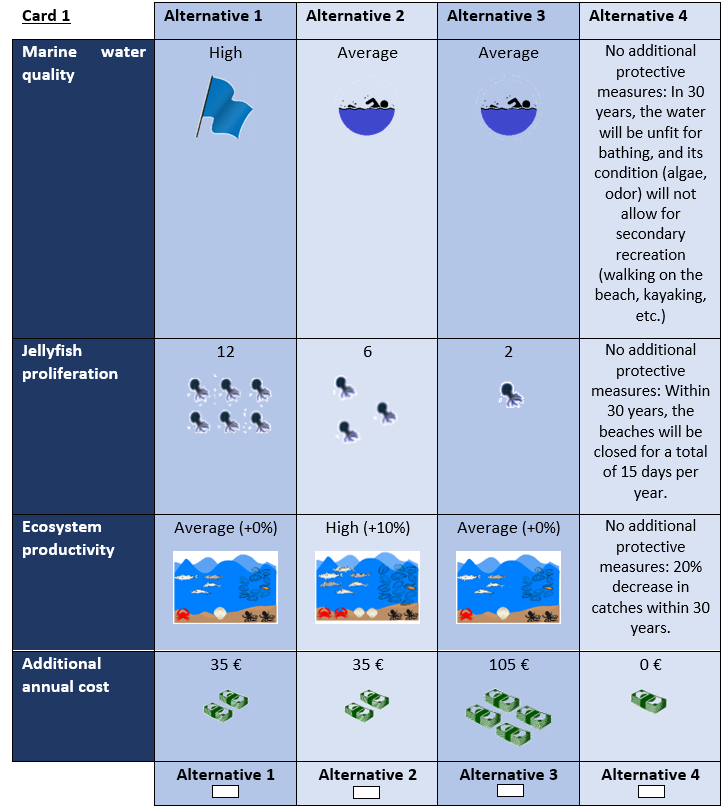
(σ2 = .37). Each participant completed a total of nine choice cards, with each card
containing three alternatives plus a status quo option.
In addition to the mere presentation of alternatives, the decision was made to incorporate
images for two fundamental purposes: enhancing intuitive understanding and making
the questionnaire more engaging. In the case of the status quo option, it is important
to clarify that choosing “none of the alternatives” has implications. In other words,
by not taking action, participants are effectively deciding that these ecosystem resources
may be potentially lost. The first choice is presented below (Figure 2), and the valuation question can be found in the Appendix (A.1).
Figure 2Example of a Choice Experiment card from our survey
3.1. Fieldwork
The target population comprised individuals above 18 years old, either residents on
the coast or inlands, but with real estate properties or family in the coastal area,
or regular visitors. When determining the sample size, the specialized software G*Power
version 3.1.9.7 (; ) was utilized with the following key specifications: the odds ratio was set at 1.6,
the confidence interval at 95%, and lastly, the statistical power at 95% as well.
The minimum sample size calculated was 212 individuals, well below our sample of 1,009
initial participants.
As a previous step to administering the final questionnaire, a pilot test was conducted
face-to-face with a total of 25 participants chosen through non-probabilistic snowball
sampling. The results of this pilot study demonstrated the appropriateness of using
the survey instrument, as well as minor changes to be addressed. In general terms,
the individuals had no difficulty understanding the attributes or the status quo,
agreeing that the images and explanatory texts helped in clearly expressing their
preferences. The definitive survey was carried out online by a reputable marketing
firm in September 2023, a company specializing in market research, marketing, and
opinion studies. Stata version 14 () was the software employed for conducting the analyses.
3.2. Data quality check
Before conducting the pertinent analyses, scrutiny of all participants who completed
the questionnaire was undertaken to exclude those who, despite completion, exhibited
indications of poor attention. This exclusion aimed to prevent the introduction of
noise into the data. We eliminate the participants who rushed through the survey.
In our case, the participants who finished in under 4 minutes and 28 seconds were
eliminated, as the time below this limit was clearly insufficient for reading and
carefully completing the survey. Besides, and based as well on the pilot test, those
who completed the entire DCE in less than 45 seconds (“DCE Speeders”) or exceeded
5 minutes on a single DCE task (“DCE Super Slow”) were also excluded: the first ones
didn’t have enough time to properly understand and answer the DCE, whereas the second
group took so much time that it is reasonable to assume that they lost the common
conductor thread of the task (). Finally, participants who reported that the instrument had a level of difficulty
of 9 or 10 on a scale from 0 to 10 were omitted as well. It is worth noting that these
groups are not mutually exclusive, and the same participant can belong to both, the
DCE speeders and general speeders groups simultaneously.
Hence, the final sample comprised a total of 703 individuals, well above the threshold
of 212 individuals set by the statistical power calculation software G*Power. In Appendix A.4, more information is provided regarding the participants who comprise the initial
sample of the study.
4. RESULTS
Approximately 60% of respondents reside along the Galician coast, while 85.20% of
them maintain direct ties to the region —through primary or secondary homes or family
connections. The remaining 14.80% are recurrent visitors, averaging 36.91 days of
coastal visits annually (SD = 22.82), primarily during holiday periods.
Provincial distribution aligns with population patterns, with most participants residing
in A Coruña (44.85%) and Pontevedra (35.27%), which mirrors the regional demographics
according to .
Educational attainment reveals two primary groups: 44% of participants have not completed
university studies, while the remainder either possess or are pursuing a degree. Regarding
employment, 56.02% are in full-time paid positions, and 28.59% report monthly incomes
above €2,000. Income distribution shows representation across economic strata, although
education and income levels may be slightly overrepresented due to the online survey
format.
Responses to the Climate Change Perception Scale (Appendix A.2) show broad agreement that CC is real and anthropogenic. The highest-rated items
include: 'Climate change is real' (M = 5.99, SD = 1.58), 'It causes biodiversity loss'
(M = 5.98, SD = 1.48), and 'It may intensify extreme weather events' (M = 5.96, SD
= 1.54). Lowest agreement was found for reverse-coded items downplaying its effects.
The Local Climate Change Threat Scale (Appendix A.3) reveals that participants view CC as a major threat to their area of residence or
visitation. Highest concern was expressed for: 'Increase in extreme climatic events'
(M = 5.64, SD = 1.58), 'Marine water pollution' (M = 5.49, SD = 1.69), 'Disturbance
from invasive species' (M = 5.49, SD = 1.60), and 'Impacts on fisheries' (M = 5.48,
SD = 1.61).
In the Multigroup Ethnic Identity Scale (see Appendix A.4) we observe that there is a relatively high degree of similarity across the different
mean scores obtained from the different items. "I am happy to be a member of my ethnic
group" (M = 5.58; SD = 1.49) and "I feel good about my ethnic or cultural tradition" (M = 5.54; SD = 1.45) stand out slightly, with the highest mean scores.
At the opposite end of the spectrum, we find the item "I feel strongly committed to
my ethnic group" (M = 5.13; SD = 1.54) with the lowest mean score. As observable in Table 2, these three overall scales provide means which are not different across the various
groups.
Table 2Descriptive statistics by respondent group (n = 703)
Variable
Categories
Total
Coastal residents(n = 415)
Inland residents(n = 288)
Gender
Male
Female
46.15
53.83
45.72
54.28
46.79
53.21
Age
18-29
30-44
45-64
65+
14.95
34.25
42.53
8.27
15.65
34.96
42.54
6.85
13.93
33.21
42.50
10.36
Ties with the
Galician coast
Yes
No
85.20
14.80
100
66.43
33.57
(If no ties)
When do you
visit the
Galician littoral
For most of the year
During the summer
period and other vacation
times (Christmas, Easter,
etc.)
Only during the summer
period
A few days, at any time of
the year that coincides
with their vacation.
Doesn’t Know/Answer
9.18
29.59
22.45
34.69
4.08
-
-
-
-
-
8.89
30.00
20.00
36.67
4.44
Province
A Coruña
Lugo
Ourense
Pontevedra
44.85
9.43
10.45
35.27
50.43
3.42
-
46.21
36.79
18.21
25.71
19.29
Ideological
orientation
(Left) 0
1
2
3
4
5
6
7
8
9
(Right) 10
Doesn’t Know/Answer
5.52
4.93
10.16
11.47
9.87
20.61
7.11
9.29
7.40
3.19
3.77
6.68
6.11
5.38
9.05
12.22
10.51
18.83
6.11
9.54
7.33
4.16
3.91
6.85
4.64
4.29
11.79
10.36
8.93
23.21
8.57
8.93
7.50
1.79
3.57
6.43
Formal
education
Up to Primary Education
Secondary Education
High School/Vocational
Training
University Studies
1.89
5.52
43.83
48.77
1.71
4.40
44.50
49.39
2.14
7.14
42.86
47.86
Current
occupation
Student
Full-time paid
employment
Part-time paid
employment
Unpaid work (e.g.,
household tasks)
None of the above
6.10
56.02
14.37
8.42
15.09
6.85
57.70
13.69
6.60
15.16
5.00
53.57
15.36
11.07
15.36
Monthly
income
No income
Less than 500 euros
From 500 to less than
1,000 euros
From 1,000 to less than
1,500 euros
From 1,500 to less than
2,000 euros
More than 2,000 euros
7.69
4.64
12.19
27.00
19.88
28.59
7.09
4.65
12.71
26.65
20.05
28.85
8.57
4.64
11.43
27.50
19.64
28.21
Ethnical Identity Scale
5.40 (1.26)
5.44 (1.23)
5.34 (1.29)
Climate Change Perception
5.31 (1.11)
5.34 (1.10)
5.26 (1.12)
Local Climate Change Threat
5.24 (1.21)
5.22 (1.28)
5.22 (1.28)
4.1. Estimation results
4.1.1. Utility coefficients
To test whether coastal and inland residents exhibit significantly different preferences,
we performed a likelihood ratio (LR) test comparing a pooled mixed logit model —including
all respondents— with two separately estimated subgroup models for coastal and inland
residents. All models share the same specification, and no interaction terms were
included in the pooled version.
The LR test compares the goodness-of-fit of the pooled model to the combined log-likelihoods
of the two subgroup models. The test statistic is calculated as:
The resulting test statistic was LR = 106.06 with 5 degrees of freedom, yielding a
p-value < 0.001 (See Appendix A.5). This indicates a highly statistically significant difference in coefficients between
the two groups at the 1% level, supporting the use of separate mixed logit models
for coastal and inland populations.
Table 3Mixed Logit Model Results: utility coefficients for inland and coastal populations
Both inland and coastal populations show strong and significant preferences for improvements
in seawater quality and ecosystem productivity, as well as a clear dislike for the
presence of jellyfish on beaches. The model with the coastal residents generally shows
higher mean coefficients for seawater quality improvements, indicating a stronger
willingness to pay for these measures compared to inland residents. However, inland
respondents exhibit a slightly stronger negative preference toward jellyfish presence.
Coastal individuals strongly reject the no-improvement (status quo) option. This suggests
that coastal respondents have a clearer desire for environmental improvements, while
inland respondents don’t show a significant tendency towards this.
A stronger ethnic identity increases the likelihood of choosing the status quo (0.0288
[0.0070]) for inland population, while for coastal respondents, the opposite occurs:
ethnic identity decreases the likelihood of choosing the no-improvement scenario (-0.0199
[0.0101]). This contrast indicates the higher cultural ties of residents in coastal
areas and a sense of belonging and responsibility toward their local environment,
motivating them to favour actions that protect or enhance coastal ecosystems. This
is in line with the findings by . However, working in the marine sectors significantly increases the likelihood of
sticking with the status quo in coastal populations, suggesting professional interests
may moderate WTP for change, as proposed actions may be associated with additional
requirements to the sector. This effect is absent in the inland population.
In both samples, higher income significantly reduces the probability of choosing the
status quo, though the effect is stronger in the inland group. This suggests that
higher-income individuals are more open to supporting environmental improvements.
Among inland respondents, older individuals are more likely to reject the status quo
(-0.4959 [0.2216]), whereas for coastal respondents the opposite occurs (0.0157 [0.0061]).
Gender has no significant effect in either group.
Overall, while both groups prioritize similar environmental attributes, coastal residents
tend to have stronger and more consistent preferences, reflecting their closer connection
to coastal conditions, although individuals working on the fisheries and related sectors
prefer not to select any policy adaptation measure. This may be due to the concern
of potential limitations of their extracting activities to make them more environmentally
sound.
4.1.2. Willingness To Pay (WTP) Estimation
The results of the current study reveal that seawater quality is the most valued attribute
across both population groups. Coastal residents show a higher valuation, with a WTP
of 215.15 €/year (CI [167.04, 263.26]) for high and 178.49 €/year (CI [136.07, 220.90])
for medium seawater quality, while inland residents are willing to pay 188.79 €/year
(CI [119.88, 257.71]) and 152.60 €/year (CI [95.11, 210.09]) respectively.
Ecosystem productivity is also a key attribute, with inland residents showing the
strongest preference for high (122.96 €/year) and medium (43.13 €/year) ecosystem
productivity, compared to coastal residents (108.92 €/year and 29.94 €/year).
In contrast, the presence of jellyfish at the beach is associated with a negative
WTP across all groups, indicating a clear disutility: –13.26 €/year (CI [–18.53, –7.99])
for inland residents, with coastal residents again showing a slightly lower disutility
(–10.24 €/year).
These findings emphasize the critical importance of improving and preserving seawater
quality and ecosystem productivity in coastal areas, while the presence of jellyfish
—although undesirable— is a relatively less influential factor in shaping preferences.
All WTP estimates are statistically significant at the 95% confidence level.
Table 4WTP (€/year) per attribute with 95% confidence intervals
Inland Population
Coastal Population
Variable
WTP
95% CI
WTP
95% CI
Medium seawater quality (€/year)
152.6
[95.11, 210.09]
178.49
[136.07, 220.90]
High seawater quality (€/year)
188.79
[119.88, 257.71]
215.15
[167.04, 263.26]
Presence of jellyfish at the beach (€/year)
-13.26
[-18.53, -7.99]
-10.24
[-13.16, -7.33]
Medium ecosystem productivity (€/year)
43.13
[16.63, 69.63]
29.94
[13.59, 46.28]
High ecosystem productivity (€/year)
122.96
[75.54, 170.37]
108.92
[80.43, 137.41]
[i] Note. *** p < .01.
[ii] All WTP estimates are statistically significant at the 95% CI.
5. DISCUSSION
This study highlights the strong societal support for climate adaptation strategies
along the Galician coast. Using a DCE, we find that both coastal and inland populations
show a clear willingness to support environmental improvement plans, placing the highest
value on seawater quality, followed by ecosystem productivity. These results are consistent
with , who noted that recreational and safety aspects often outweigh purely ecological
concerns in public preferences for coastal management.
Coastal residents display the highest WTP for seawater quality —215.15 €/year for
high and 178.49 €/year for medium quality— reflecting their closer ties to coastal
conditions. Inland residents also highly value seawater quality, with WTPs of 188.79
€/year for high and 152.60 €/year for medium quality but show a slightly stronger
WTP for ecosystem productivity (122.96 €/year) compared to coastal residents (108.92
€/year). Although generally disliked, the presence of jellyfish plays a secondary
role in shaping preferences, consistently generating negative WTPs—more pronounced
among inland respondents (–13.26 €/year) than coastal ones (–10.24 €/year).
The role of identity emerges as a key factor differentiating preferences between groups.
For inland residents, a stronger identity increases the likelihood of sticking with
the status quo, suggesting a cautious attitude toward change or a weaker perceived
connection to coastal environmental issues. In contrast, among coastal residents,
a stronger ethnic identity decreases the probability of accepting the status quo,
reinforcing the idea that cultural ties drive greater support for adaptation measures.
These differential effects underscore how local identity shapes environmental attitudes
differently depending on place-based experiences.
Other sociodemographic factors reveal additional nuances. Marine sector employment
increases the likelihood of maintaining the status quo among coastal respondents,
possibly reflecting concerns about the impacts of change on professional interests.
Higher income consistently reduces status quo preference across both groups, indicating
a greater openness to environmental investment among wealthier individuals. Age shows
divergent effects: inland and older individuals are less likely to accept the status
quo, while coastal older respondents tend to prefer it. Gender has no significant
effect.
Overall, while both groups value similar attributes, coastal residents exhibit stronger,
more consistent preferences for adaptation measures, likely reflecting their deeper
cultural and emotional ties to the coastal environment.
Future research should aim for broader representation of inland residents without
coastal ties and mitigate potential online survey biases. Additionally, in-person
data collection in coastal zones —especially among tourists— and surveys across different
seasons could provide a more nuanced, spatially detailed understanding of public preferences
for coastal adaptation strategies.
Acknowledgement
The authors wish to thank, without implicating, the Consellería de Medio Ambiente,
Territorio e Vivenda for the funding of the collaborative agreement to analyze the
incidence of climate change on the Galician coast (reference 2021-CP180).
Authors contribution
Conceptualization, G.I.C, M.L.G; Methodology, A.C.A. and G.I.C; Data Curation, A.C.A.
and G.I.C; Formal Analysis, A.C.A, G.I.C; Investigation, M.L.G; Validation, A.C.A,
G.I.C; Funding Acquisition, M.L.G; Supervision, M.L.G; Writing – Original Draft Preparation,
G.I.C, M.L.G; Writing – Review & Editing, A.C.A and M.L.G. All authors have read and
agreed to the published version of the manuscript.
References
1
Anthoff, D., Tol, R. S., & Yohe, G. W. (2009). Risk aversion, time preference, and
the social cost of carbon. Environmental Research Letters, 4(2), 1-7. https://doi.org/10.1088/1748-9326/4/2/024002
2
Bañón, R., Pardo, P. C., Álvarez-Salgado, X. A., de Carlos, A., Arronte, J. C., &
Piedracoba, S. (2024). Tropicalization of fish fauna of Galician coastal waters, in
the NW Iberian upwelling system. Regional Studies in Marine Science, 70, 103369. https://doi.org./10.1016/j.rsma.2024.103369
3
Barbier, E. B., Hacker, S. D., Kennedy, C., Koch, E. W., Stier, A. C., & Silliman,
B. R. (2011). The value of estuarine and coastal ecosystem services. Ecological monographs, 81(2), 169-193. https://doi.org/10.1890/10-1510.1
4
Barca‐Bravo, S., Servia, M. J., Cobo, F., & Gonzalez, M. A. (2008). The effect of
human use of sandy beaches on developmental stability of Talitrus saltator (Montagu,
1808) (Crustacea, Amphipoda). A study on fluctuating asymmetry. Marine Ecology, 29, 91-98. https://doi.org/10.1111/j.1439-0485.2007.00208.x
5
Bateman, I. J., Mace, G. M., Fezzi, C., Atkinson, G., & Turner, K. (2011). Economic
analysis for ecosystem service assessments. Environmental and Resource Economics, 48, 177-218. https://doi.org/10.1007/s10640-010-9418-x
6
Blanco, J., Moroño, Á., Arévalo, F., Correa, J., Salgado, C., Rossignoli, A. E., &
Lamas, J. P. (2021). Twenty-five years of domoic acid monitoring in Galicia (NW Spain):
spatial, temporal, and interspecific variations. Toxins, 13(11), 756. https://doi.org/10.3390/toxins13110756
7
BOE [Boletín Oficial del Estado/Official State Gazette]. (2023). Ley 4/2023, de 6
de julio, de ordenación y gestión integrada del litoral de Galicia. BOE nº 220, 14th September 2023, pp. 124490-124541. https://tinyurl.com/4uph8h83
8
Bode, A. (2011, May 7). Cambio climático en el océano costero. [Conference Paper]. III Xornadas Climantíca: Auga e Cambio climático. Culleredo.
https://bit.ly/3VtzDUH
9
Bode, A., Álvarez, M., García García, L. M., Louro, M. Á., Nieto-Cid, M., Ruíz-Villarreal,
M., & Varela, M. M. (2020). Climate and local hydrography underlie recent regime shifts
in plankton communities off Galicia (NW Spain). Oceans1(4), 181–197) https://doi.org/10.3390/oceans1040014
10
Capdevila-Argüelles, L., Zilleti, B. & Suárez, V. A. (2011). Cambio climático y especies exóticas invasoras en España. Diagnóstico preliminar y
bases de conocimiento sobre impactos y vulnerabilidad. Oficina Española de Cambio Climático, Ministerio de Medio Ambiente & Medio Rural
y Marino. https://tinyurl.com/3jsw58fh
11
Castro, C. G., Álvarez-Salgado, X. A., Nogueira, E., Gago, J., Pérez, F.F., Bode,
A., Ríos, A. F., Rosón, G. & Varela, M. (2009). Evidencias bioxeoquímicas do cambio
climático. In Consejería de Medio Ambiente y Desarrollo Sostenible (Ed.), Evidencias e impactos do cambio climático en Galicia (pp. 303-326). https://tinyurl.com/53x2njth
12
Castro-Atanes, A. & Loureiro, M. (2023, September 1). Recommendations for data quality in Discrete Choice Experiments: a comparison across
countries. [Conference Paper] XXIV Annual BIOECON Conference, Santiago de Compostela. https://tinyurl.com/yaukjdf7
Costanza, R., d'Arge, R., De Groot, R., Farber, S., Grasso, M., Hannon, B., Linburg,
K., Naeem, S., O’Neill, R. V., Paruelo, J., Raskin, R. G., Sutton, P. & Van Den Belt,
M. (1997). The value of the world's ecosystem services and natural capital. Nature, 387, 253-260. https://doi.org/10.1038/387253a0
Des, M., Fernández-Nóvoa, D., de Castro, M., Gómez-Gesteira, J. L., Sousa, M. C.,
y Gómez-Gesteira, M. (2021). Modeling salinity drop in estuarine areas under extreme
precipitation events within a context of climate change: effect on bivalve mortality
in Galician Rías Baixas. Science of the Total Environment, 790, 1-11. https://doi.org/10.1016/j.scitotenv.2021.148147
17
Des, M., Gómez-Gesteira, J. L., de castro, M., Iglesias, D., Sousa, M. C., El Serafy,
G., & Gómez-Gesteira, M. (2022). Historical and future naturalization of Magallana gigas in the Galician coast in a context of climate change. Science of the Total Environment, 838, 1-10. http://dx.doi.org/10.1016/j.scitotenv.2022.156437
18
Dorgham, M. (2014). Effects of Eutrophication. In: Ansari, A., Gill, S. (eds) Eutrophication: Causes, Consequences and Control. Springer. https://doi.org/10.1007/978-94-007-7814-6_3
19
Esteban-Guitart, M. (2010). Propiedades psicométricas y estructura factorial de la
Escala de Identidad Étnica Multigrupo en español (MEIM). Revista Latinoamericana de Psicología, 42(3), 405-412. https://tinyurl.com/2tatr9y3
20
FAO [Food and Agriculture Organization of the United Nations]. (2023, September 8).
Impacts of Sargassum on marine resources in the region and utilization of initiatives. https://tinyurl.com/2naajzz9
21
Faul, F., Erdfelder, E., Buchner, A., & Lang, A.-G. (2009). Statistical power analyses
using G*Power 3.1: Tests for correlation and regression analyses. Behavior Research Methods, 41, 1149-1160. https://doi.org/10.3758/BRM.41.4.1149
22
Faul, F., Erdfelder, E., Lang, A. G., & Buchner, A. (2007). G*Power 3: a flexible
statistical power analysis program for the social, behavioral, and biomedical sciences.
Behavior research methods, 39(2), 175–191. https://doi.org/10.3758/bf03193146
23
Fernández, E. M., (2006). Evaluación de impactos y observación ambiental en el marco del plan gallego de lucha
contra el cambio climático. Conama9. Retrieved November, 4, 2023, from https://tinyurl.com/38f4z3ec
24
Ferrer, L., Sagarminaga, Y., Borja, Á., Nogues, M., Alegre, M. J., Santos, M., ...
& Rodríguez, J. G. (2024). The Portuguese man-of-war: Adrift in the North Atlantic
Ocean. Estuarine, Coastal and Shelf Science, 301, 108732. https://doi.rog/10.1016/j.ecss.2024.108732
25
García, C., & Remiro, J. (2013). Cambio climático y acuicultura. Fundación Observatorio Español de Acuicultura [FOESA]. https://tinyurl.com/2878cpm5
26
García-Oliveira, P., Jiménez-López, C., Pereira, A. G., Lourenço-Lopes, C., Carpena,
Fraga, M., Prieto, M. A., Simal-Gándara, J. (2020). Sargassum muticum: Estudio para
su valorización industrial en Galicia. In J. C. Vélez-Chica, E. Zapata-Vívenes, V.
Acosta, F. Isea, A. M. Santana -Piñeros, Y. Cruz-Quintana, J. Sonnenholzer, M. Rey-Méndez,
N. González-Henríquez & C. Lodeiros (Eds.), IX Foro Iberoamericano de los Recursos Marinos y Acuicultura (pp. 498-506). Ediciones Universidad Técnica de Manabí. https://tinyurl.com/2s35ne5m
27
Gazzaz, N. M., y Aldeseet, B. A. (2021). Assessment of the Level of Knowledge of Climate
Change of Undergraduate Science and Agriculture Students. World Journal of Education, 11(5), 41-60. https://doi.org/10.5430/wje.v11n5p41
28
Haines-Young, R., & Potschin, M. (2018). Common International Classification of Ecosystem Services (CICES) V5.1 Guidance on
the Application of the Revised Structure. Fabis Consulting Ltd. https://bit.ly/3N5Ni1Q
29
Hoyos, D. (2010). The state of the art of environmental valuation with discrete choice
experiments. Ecological economics, 69(8), 1595-1603. https://doi.org/10.1016/j.ecolecon.2010.04.011
30
Hoyos, D., P. Mariel, J. Fernández-Macho (2009). The influence of cultural identity
on the WTP to protect natural resources: Some empirical evidence. Ecological Economics, 68(6-8), 2372-2381. https://doi.org/10.1016/j.ecolecon.2009.03.015
31
Ibarra, A. D. & Belmonte, F. (2017). Comprendiendo el litoral: Dinámica y procesos. Ediciones de la Universidad de Murcia. https://bit.ly/3p1zuLN
JMP Pro 17 (2023). SAS Institute Inc., Cary, NC, 1989–2023.
34
Kennerley, A., Wood, L. E., Luisetti, T., Ferrini, S., & Lorenzoni, I. (2022). Economic
impacts of jellyfish blooms on coastal recreation in a UK coastal town and potential
management options. Ocean & Coastal Management, 227, 106284. https://doi.org/10.1016/j.ocecoaman.2022.106284
Lavín, A., Valdés, L., Sánchez, F., Abaunza, P., Punzón, A., Bellas, J., Parra, S.,
Lens, S., Besada, V., Viñas, L., González-Quijano, A., Franco, M. A., Fumega, J.,
Serrano y de Armas, D. (2012). Estrategias marinas: evaluación inicial, buen estado ambiental y objetivos ambientales. Ministerio de Agricultura, Alimentación y Medio Ambiente Secretaría General Técnica.
https://tinyurl.com/y6frxrbu
37
Liu, Y., Cao, J., Chu, Y., Liu, Y., Wang, Q., Gong, Q. & Li, J. (2021). The Brown
Algae Saccharina japonica and Sargassum horneri Exhibit Species-Specific Responses to Synergistic Stress of Ocean Acidification and
Eutrophication. Journal of Ocean University of China, 20, 1253–1262. https://doi.org/10.1007/s11802-021-4853-6
Loureiro, M.L., Loomis, J.B. & Vázquez, M.X. (2009). Economic Valuation of Environmental
Damages due to the Prestige Oil Spill in Spain. Environmental & Resource Economics 44, 537–553. https://doi.org/10.1007/s10640-009-9300-x
40
Marambio, M., Salazar, J., Ballesteros, A., y Gili, J. M. (2021). Dosier del proyecto La Mar de Medusas. Consejo Superior de Investigaciones Científicas [CSIC]; Instituto de Ciencias del
Mar [ICM]. https://doi.org/10.20350/digitalCSIC/13977
41
MAUC & MITECO [Ministerio de Asuntos Exteriores, Unión Europea y Cooperación & Ministerio
para la Transición Ecológica]. (2019). Spain: A global Actor in the Fight against Climate Change. COP 25. http://tinyurl.com/32xjhxt7
42
Medina, R. (2008, February 21). Impacto del cambio climático en las zonas costeras españolas y afección a las infraestructuras
portuarias. [Conference Paper]. I Jornadas sobre Puertos Deportivos y Medio Ambiente. Marbella.
https://tinyurl.com/4fdj46nh
43
Meyerhoff, J., Rehdanz, K., & Wunsch, A. (2021). Preferences for coastal adaptation
to climate change: evidence from a choice experiment. Journal of Environmental Economics and Policy, 10(4), 374-390.
MITECO (2020). Plan Nacional de Adaptación al Cambio Climático 2021-2030. Ministerio para la Transición Ecológica y el Reto Demográfico. https://tinyurl.com/vpc44mtt
46
Monaco, D., Chianese, E., Riccio, A., Delgado-Sanchez, A., & Lacorte, S. (2017). Spatial
distribution of heavy hydrocarbons, PAHs and metals in polluted areas. The case of
“Galicia”, Spain. Marine Pollution Bulletin, 121(1-2), 230-237. https://doi.org/10.1016/j.marpolbul.2017.06.003
47
Nieto, C. E., Martínez-Graña, A. M., & Encinas, B. (2023). Analysis of the Risk of
Coastal Flooding Due to Rising Sea Levels in Ría of Arosa (Pontevedra, Spain). Applied Sciences, 13(22), 12099. https://doi.org/10.3390/app132212099
48
Pereira, A. G., Fraga-Corral, M., Garcia-Oliveira, P., Lourenço-Lopes, C., Carpena,
M., Prieto, M. A., & Simal-Gandara, J. (2021). The use of invasive algae species as
a source of secondary metabolites and biological activities: Spain as case-study.
Marine Drugs, 19(4), 178. https://doi.org/10.3390/md19040178
49
Pörtner, H. O., Roberts, D. C., Masson-Delmotte, V., Zhai, P., Tignor, M., Poloczanska,
E., Mintenbeck, K., Nicolai, M., Okem, A., Petzold, J., Rama, B. & Weyer, N. M. (2019).
El océano y la criosfera en un clima cambiante. Informe especial del Grupo Intergubernamental
de Expertos sobre el Cambio Climático. Intergovernmental Panel on Climate Change. https://tinyurl.com/mtf8uywy
50
Pousa, A. (2023). La pluralidad competencial en materia de costas y litoral (Illes
Balears). In J. M. Trayter (Ed.), Autonomía, costas y litoral (pp. 107-140). Generalitat de Catalunya. Institut d’Estudis de l’Autogovern & Govern
de les Illes Balears. Institut d’Estudis Autonòmic.
51
Remoundou, K., Diaz-Simal, P., Koundouri, P., & Rulleau, B. (2015). Valuing climate
change mitigation: A choice experiment on a coastal and marine ecosystem. Ecosystem Services, 11, 87-94. https://doi.org/10.1016/j.ecoser.2014.11.003
52
Smetacek, V., & Zingone, A. (2013). Green and golden seaweed tides on the rise. Nature, 504, 84-88. https://tinyurl.com/4crk8zsk
53
Spyrakos, E., González Vilas, L., Torres Palenzuela, J. M., & Barton, E. D. (2011).
Remote sensing chlorophyll a of optically complex waters (Rías Baixas, NW Spain):
Application of a regionally specific chlorophyll a algorithm for MERIS full resolution
data during an upwelling cycle. Remote sensing of environment, 115(10), 2471-2485. https://doi.org/10.1016/j.rse.2011.05.008
54
StataCorp (2015). Stata Statistical Software: Release 14. College Station, TX: StataCorp LLC.
55
The Ocean Foundation. (2019, December 20). Sargassum Factsheet - Scientific Information. https://tinyurl.com/msecwhva
56
Tiller, R. G., Mork, J., Liu, Y., Borgersen, Å. L., y Richards, R. (2015). To adapt
or not adapt: assessing the adaptive capacity of artisanal fishers in the Trondheimsfjord
(Norway) to jellyfish (Periphylla periphylla) bloom and purse seiners. Marine and Coastal Fisheries, 7(1), 260-273. https://doi.org/10.1080/19425120.2015.1037873
57
Ulargui, V. A. (2018). Spain’s response to the challenge of climate change in the
new international scenario. In Ministry of Defense & Spanish Institute for Strategic
Studies (Eds.), Strategic Dossiers 193 B. Climate change and its impact on defence (pp. 119–142). Ministry of Defense & Spanish Institute for Strategic Studies. http://tinyurl.com/nhd8748d
UN [United Nations]. (2017). Los efectos del cambio climático y los cambios atmosféricos conexos en los océanos
resumen técnico de la primera evaluación integrada del medio marino a escala mundial. https://tinyurl.com/563wekbc
60
Vaz-Pinto, F., Gestoso, I., Gómez, M., Barreiro,F., Olabarria , C., Arenas, F., Lastra,
M., & López. J. (2019, July). Invasións biolóxicas nas nosas costas:o sargazo do Xapón
e o mexillón de Nova Zelandia. University of Vigo. Retrieved November 14, 2023, from
https://tinyurl.com/h8zfy7nk
61
Vidal-Abad, A., Casal, M. A., Rey-Aguiño, J. M., Pichel-González, A., Solana-Muñoz,
A., Poza-Nogueiras, V., ... & Collaborative, V. I. E. I. R. A. (2024). Case report
of plastic nurdles pollution in Galicia (NW Atlantic) following the Toconao's spill
in December 2023: The VIEIRA Collaborative. Marine Pollution Bulletin, 203, 116442. https://doi.org/10.1016/j.marpolbul.2024.116442
62
Villacampa, Y., López, I., Aragonés, L., García, M. López, C., Palazón, A. (2017).
Water quality of the beach in an urban and not urban environment. International Journal of Sustainable Development and Planning,12, 713-723, https://doi.org/10.2495/SDP-V12-N4-713-723
63
Villares, R., Puente, X., & Carballeira, A. (1999). Nitrogen and phosphorus in Ulva
sp. in the Galician Rias Bajas (northwest Spain): Seasonal fluctuations and influence
on growth. Boletin. Instituto Español de Oceanografia, 15(1-4), 337-342. https://tinyurl.com/255v6dvc
Wolf, D., Georgic, W., & Klaiber, H. A. (2017). Reeling in the damages: Harmful algal
blooms' impact on Lake Erie's recreational fishing industry. Journal of environmental management, 199, 148-157. https://doi.org/10.1016/j.jenvman.2017.05.031
APPENDIXES
Appendix A.1. Prior to the administration of the discrete choice experiment, this
brief text was presented to address the topic
“To minimize the effects of climate change, various adaptation measures can be implemented.
These measures aim to reduce the impacts of climate change but are costly. Below,
we define the fields of action that characterize the different measures on which adapting
policies would be based.
Climate change, along with direct human action, promotes a deterioration in the quality
of marine water. If this trend continues, recreational opportunities related to marine
water will be seriously compromised.
Measures related to water quality, for example, can focus on preventing the reduction
of marine pH, something that is currently achieved only by reducing CO2 emissions
into the atmosphere. One way to promote such reduction may be by reducing the use
of fossil fuels and promoting the development of renewable energy sources, such as
solar or wind power.
These changes in usual marine conditions favor the appearance of non-native species
such as jellyfish. In a non-interventionist scenario, these episodes will potentially
become a common occurrence on the Galician coast.
Adaptation measures for this issue may include the creation of a real-time surveillance
network of the movements of these organisms or the installation of nets to prevent
their passage.
In the last 15 years, records indicate a decrease of around 10% in catches from inshore
fishing (including bivalves, octopuses, various fish species, and crustaceans). Therefore,
in a scenario where no measures are taken, it can be expected that, in the next 30
years, the total catches from inshore fishing will decrease by 20%.
In order to prevent the decline of biodiversity, useful strategies may include implementing
controls and improvements to reduce bycatch, increasing coastal protection, or reducing
sediment loads present”.
Appendix A.2. Mean score and standard deviation of Climate Change Perception Scale
Items
Coastal residents (n = 415)
Inland residents (n = 288)
Participants with coastal affiliation (n = 602)
Total (n = 703)
1. Climate change is real, that is, it is taking place
6.07 (1.51)
5.89 (1.68)
6.02 (1.54)
6.00 (1.58)
2. Climate change causes biodiversity loss
6.00 (1.46)
5.93 (1.50)
5.98 (1.47)
5.98 (1.48)
3. Climate change is not a threat to sustainable development (I).
3.18 (2.27)
3.39 (2.32)
3.29 (2.30)
3.27 (2.30)
4. Climate change is caused by human activity, not solely by natural environmental
changes.
5.58 (1.58)
5.38 (1.77)
5.51 (1.65)
5.49 (1.66)
5. Climate change promotes increases in ocean fertility (I).
3.86 (2.03)
3.91 (2.02)
3.85 (2.03)
3.89 (2.03)
6. Climate change causes economic crises.
5.62 (1.54)
5.59 (1.64)
5.63 (1.55)
5.61 (1.58)
7. Climate change leads to decrease in incidence of contagious and infectious plant,
animal, and human diseases (I).
3.44 (2.16)
3.39 (2.17)
3.42 (2.15)
3.42 (2.16)
8. Climate change does not cause coastal erosion (I).
2.89 (2.09)
2.99 (2.12)
2.90 (2.10)
2.93 (2.10)
9. Shortage of water that is suitable for domestic use and for irrigation of plants
and animals may result from climate change.
5.61 (1.67)
5.57 (1.67)
5.58 (1.67)
5.59 (1.67)
10. Climate change may cause an increase in the frequency and intensity of extreme
weather conditions such as heat waves, drought, hurricanes, and heavy rains in some
areas in the world
5.96 (1.52)
5.95 (1.58)
5.95 (1.53)
5.96 (1.54)
Overall Scale
5.46 (1.78)
5.26 (1.84)
5.31 (1.80)
5.31 (1.81)
Note These items belong to a modified version of the Climate Change Knowledge Test
(CCKT; ). Items 1, 2, 7, 9, and 10 were unchanged from the original scale; Item 4 was modified;
Items 3, 5, 6, and 8 were added.
(I) The items are phrased in reverse; when calculating the mean of the total scale,
they were recoded.
Appendix A.3. Mean score and standard deviation of the Climate Change Threat Awareness
Scale
Items
Coastal residents (n = 415)
Inland residents (n = 288)
Participants with coastal affiliation (n = 602)
Total (n = 703)
1. Recreational activities from beaches
4.82 (1.63)
4.79 (1.79)
4.84 (1.65)
4.80 (1.67)
2. Marine water pollution
5.52 (1.69)
5.46 (1.68)
5.50 (1.69)
5.49 (1.69)
3. Biodiversity in the coastal and marine ecosystem
5.37 (1.67)
5.26 (1.71)
5.38 (1.65)
5.33 (1.68)
4. Tourism sector (number of visits, length of stay)
4.85 (1.62)
5.21 (1.65)
4.97 (1.63)
5.00 (1.64)
5. Local infrastructures
4.91 (1.52)
5.06 (1.58)
5.00 (1.52)
4.98 (1.55)
6. Ecosystem disturbance due to the emergence of invasive species
5.58 (1.51)
5.38 (1.70)
5.55 (1.54)
5.49 (1.60)
7. Human health
5.32 (1.56)
5.23 (1.69)
5.34 (1.56)
5.28 (1.61)
8. Long-term scenic attractiveness
5.23 (1.60)
5.25 (1.67)
5.26 (1.59)
5.24 (1.63)
9. Fishing sector (availability of specimens, number of captures)
5.57 (1.54)
5.35 (1.69)
5.53 (1.57)
5.48 (1.61)
10. Purchasing power (income, savings capacity)
4.84 (1.63)
4.88 (1.65)
4.88 (1.61)
4.86 (1.64)
11. Increase in the frequency and extent of extreme climatic events (e.g., floods,
storms, erosion, etc.) in the next 30 years.
5.69 (1.53)
5.57 (1.64)
5.67 (1.55)
5.64 (1.58)
Overall Scale
5.24 (1.59)
5.22 (1.68)
5.26 (1.60)
5.23 (1.63)
Note These items belong to a modified version of the residents' perception of risks
instrument used by . Items 1, 3, and 7 were unchanged from the original scale; items 4, 5, and 11 were
modified; items 2, 6, 8, 9, and 10 were added.
Appendix A.4. Mean score and standard deviation of the scale used to assess the ethnic
identity of the sample
Items
Coastal residents (n = 415)
Inland residents (n = 288)
Participants with coastal affiliation (n = 602)
Total (n = 703)
1. I am aware of my "ethnic roots" and what they mean to me
5.50 (1.46)
5.30 (1.65)
5.42 (1.65)
5.42 (1.54)
2. I am happy to be a member of my ethnic group
5.63 (1.47)
5.51 (1.52)
5.62 (1.69)
5.58 (1.49)
3. I prefer to eat local gastronomic products, even if there are cheaper ones available
5.28 (1.53)
5.16 (1.54)
5.22 (1.65)
5.23 (1.54)
4. I feel strongly committed to my ethnic group
5.13 (1.54)
5.14 (1.54)
5.16 (1.63)
5.13 (1.54)
5. I feel good about my ethnic or cultural tradition
5.59 (1.39)
5.47 (1.52)
5.56 (1.52)
5.54 (1.45)
6. I am proud of my ethnic group
5.50 (1.48)
5.48 (1.50)
5.55 (1.54)
5.49 (1.49)
Overall scale
5.44 (1.23)
5.34 (1.29)
5.41 (1.29)
5.40 (1.26)
Note These items belong to a modified factor of the Multigroup Ethnic Identity Scale
in Spanish (MEIM; , developed from Phinney (1992), Roberts et al. (1999), and Smith (2002)). Items 1,
2, 4, 5, and 6 were unchanged from the original scale; item 3 was added; lastly, the
original items "I feel connected to my ethnic group" and "I understand what it means
to belong to the ethnic group" were eliminated.
Appendix A.4. Classification of the sample according to response times. Initial sample
(n = 1009).
Variable
Coastal residents (n = 594)
Inland residents (n = 415)
People with ties with the coast (n = 857)
Total (n = 1,009)
Non completionists
-
-
-
-
Speeders (total) (in-group)
4.56% 7.74%
3.07% 7.47%
6.54% 7.70%
7.63% (n = 77)
DCE Speeders (total) (in-group)
15.66% 26.60%
11.40% 27.71%
22.79% 26.84%
27.06% (n = 273)
DCE Super Slow (total) (in-group)
2.18% 3.70%
1.68% 4.10%
3.47% 4.08%
3.86% (n = 39)
Difficulty > 8 (total) (in-group)
.50% .84%
.19% .48%
.50% .58%
.69% (n = 7)
Appendix A.5. Classification of the sample according to response times. Initial sample
(n = 1009)