División de Estudios sobre el Desarrollo, Centro de Investigación y Docencias Económicas, A.C, CIDE, carretera México-Toluca 3655, Santa Fe, Altavista, Álvaro Obregón, C.P. 01210, Ciudad de México
División de Estudios sobre el Desarrollo, Centro de Investigación y Docencias Económicas, A.C, CIDE, carretera México-Toluca 3655, Santa Fe, Altavista, Álvaro Obregón, C.P. 01210, Ciudad de México
PDF (Spanish)
XML (Spanish)
PDF (Galician)
XML (Galician)
Abstract
In Mexico, the services sector plays a prominent role in productive activity due to the effects of manufacturing production oriented toward foreign trade. The growth of services has little impact on economic growth due to its low interaction with other sectors and the lack of industry maturity. However, a concerning aspect is the increase in manufacturing production, which heavily depends on the use of imported inputs. The research applies the Input-Output model methodology and Growth Analysis using the Input-Output Tables from 2000 and 2018 published by the OECD to examine the effect of production and the use of factors in the services sector on economic growth. The study concludes that, in the short term, the growth of services is driven by the industry's impact. In contrast, in the long term, services follow a growth path heavily reliant on imported intermediate inputs, similar to industry.
Keywords:
Input–Output multipliers, Contribution to economic growth, Industry, Services, Mexico
Márquez Mendoza and García González: La transferencia del valor del producto industrial al sector servicios en la estructura
económica de México 2000–2018
1. Introducción
La terciarización de la economía es un proceso caracterizado por un menor crecimiento
de la producción y el empleo en el sector industrial en comparación con la expansión
del sector servicios. En economías desarrolladas, la industria se especializa en producir
más bienes con la misma cantidad de recursos o menos, como resultado de avances tecnológicos
o mejoras en eficiencia. Como consecuencia, el sector industrial ha generado un efecto
de arrastre sobre la demanda del sector servicios, impulsando el empleo en este último
y favoreciendo el crecimiento económico. Tal como señaló , en las etapas del desarrollo económico, la productividad desempeña un papel clave
en la transición de una etapa a otra y de un sector a otro. Actualmente, la productividad
del sector industrial ha favorecido el desarrollo del sector terciario. Además de
este proceso natural, las economías pueden acelerar dicha transformación mediante
la implementación de instrumentos de política sectorial orientados al crecimiento
económico en sectores específicos (; ; ).
Esta investigación analiza la evolución del sector servicios en México, considerando
que, como resultado de las reformas estructurales dirigidas a promover la apertura
económica, la desregulación del mercado y la estabilidad de las finanzas públicas,
—en línea con las recomendaciones de organismos financieros internacionales—, la economía
se ha enfocado en la exportación de manufacturas sin lograr una verdadera industrialización.
El incremento en las necesidades de exportación manufacturera ha impulsado el crecimiento
del sector servicios (; ). En el contexto global actual, México ha buscado integrarse a las Cadenas Globales
de Valor (CGV) mediante una estrategia basada en bajos salarios y en la realización
de tareas de bajo valor agregado. Al mismo tiempo, se han promovido sectores de alta
tecnología, como el transporte aeroespacial, a través del programa Pro Aéreo 2.0.
No obstante, esta estrategia ha generado una alta dependencia de insumos intermedios
importados (; ).
El objetivo de este estudio es responder, desde un enfoque de análisis estructural,
por qué el sector servicios ha crecido más en la economía mexicana pese a la falta
de un desarrollo industrial sólido. Se busca identificar los rasgos estructurales
de los servicios dentro de la economía mexicana y explicar por qué, aun cuando este
sector ha crecido más que otros, no ha impulsado significativamente el crecimiento
económico en su conjunto. Se plantea que, en el corto plazo, el tamaño del multiplicador
productivo tiene un impacto limitado en el crecimiento si no transfiere sus efectos
a múltiples sectores. En el largo plazo, una economía obtiene menores beneficios cuando
su crecimiento depende de insumos intermedios importados o de factores productivos
con baja generación de valor agregado e incluso la senda de crecimiento de ella, no
es óptima si esta es intensiva en insumos o en factores.
A través del análisis de la descomposición del multiplicador del producto y del valor
agregado por grupo de sectores, así como del crecimiento mediante las Tablas de Input-Output,
este estudio desarrolla la hipótesis de que, en México, tanto el tamaño como la capacidad
de transferencia de los multiplicadores del sector servicios son bajos en comparación
con los de la industria. Por ello, los multiplicadores del sector industrial tienen
un mayor impacto en el crecimiento de la economía. Además, el crecimiento económico
de México, tanto a nivel agregado como sectorial, es intensivo en el uso de insumos
intermedios importados.
El método empleado en este estudio se enmarca en el modelo de Input-Output (IP) y
el Análisis del Crecimiento de las Tablas de Input-Output (ACTIP), utilizando información
publicada por la Organización para la Cooperación y el Desarrollo Económicos (OCDE)
para los años 2000 y 2018. La estructura del documento es la siguiente: en la sección
dos, se presenta la dinámica del crecimiento del producto en México, destacando la
influencia del Estado en esta variable. La sección tres expone los fundamentos metodológicos
del estudio. En la sección cuatro, se evalúan y analizan los resultados sobre la transferencia
de valor del sector industrial al sector servicios, así como las contribuciones al
crecimiento de los factores e insumos en distintos sectores de la economía. Posteriormente,
se abordan dos aspectos clave de los multiplicadores en el análisis estructural y
se discute cuál es la mejor senda de crecimiento económico. Finalmente, se presentan
reflexiones sobre la terciarización prematura de la economía mexicana.
2. La dinámica del sector industrial y los servicios en México 2000 - 2018
Derivado del crecimiento de la productividad, la terciarización implica un cambio
estructural, que se manifiesta en la reducción del peso relativo del sector industrial
en la producción y el empleo, mientras el sector servicios experimenta un crecimiento
relativo. Este fenómeno se sustenta en una transformación de las relaciones intersectoriales
dentro de la estructura productiva, donde algunas ramas económicas emergen y otras
desaparecen, impulsadas por la competencia internacional y la constante necesidad
de innovación (; ; ; ).
El desarrollo tecnológico actual ha permitido la fragmentación de los procesos productivos,
lo que ha llevado a las economías desarrolladas a fomentar la apertura comercial.
México se adaptó a esta tendencia a través de medidas implementadas para superar la
crisis de 1982 y los desequilibrios macroeconómicos de la década siguiente. Las reformas
económicas favorecieron la apertura comercial, la desregulación de los mercados financieros,
productivos y laborales, y la transición del Estado productor hacia un modelo basado
en el libre mercado. Además, las reformas se orientaron hacia el mantenimiento de
finanzas públicas sanas mediante políticas fiscales y monetarias restrictivas (; ).
El nuevo modelo de crecimiento económico en México provocó un cambio en la estructura
productiva. La entrada masiva de capitales condujo a la desaparición de algunas industrias
nacionales, a la fusión de empresas locales con extranjeras y a la instalación de
compañías totalmente foráneas, facilitada por reformas en las leyes comerciales, fiscales,
laborales y financieras. Este modelo diversificó e incrementó las exportaciones manufactureras,
estabilizó las finanzas públicas, flexibilizó el mercado laboral y atrajo inversión
extranjera. Sin embargo, también profundizó la concentración del ingreso (). Además, generó un bajo ritmo de crecimiento económico, una pérdida de economías
de escala, un modelo productivo basado en la maquila, una absorción precaria de la
fuerza laboral en el sector terciario, un aumento del capital especulativo y una baja
acumulación de capital productivo ().
Al analizar el crecimiento del producto entre 2000 y 2018, según datos del Banco Mundial
y la OCDE, México registró un crecimiento promedio anual de 2,03%. No obstante, este
desempeño se vio afectado por la crisis financiera de 2008-2009 en Estados Unidos.
Antes de dicha crisis, la economía mexicana crecía a un promedio anual de 1,8%, mientras
que, entre 2010 y 2018, el crecimiento aumentó a un promedio del 3%. Estos resultados
reflejan que el crecimiento económico no solo dependió de la dinámica interna, sino
también de las condiciones externas.
A nivel interno, la política económica del país no experimentó transformaciones sustanciales.
Aunque en el discurso gubernamental se destacó el fortalecimiento de las ventajas
competitivas existentes, no se generaron nuevas. Durante todo el período, las exportaciones
crecieron a un ritmo del 5,2% (según el Banco Mundial), superando el crecimiento del
producto. Sin embargo, el bajo dinamismo de la economía nacional se atribuye a la
baja productividad y a una política industrial insuficiente para impulsar la inversión,
consolidar encadenamientos productivos con proveedores nacionales, incrementar la
productividad y fortalecer el mercado interno. Además, México no logró posicionarse
en segmentos dinámicos del comercio global ().
En el ámbito externo, México adoptó una estrategia basada en la firma de tratados
comerciales con numerosos países, lo que modificó la composición de sus principales
proveedores internacionales. Hasta antes del año 2000, Estados Unidos era el principal
proveedor externo de México, mientras que Canadá y España representaban menos del
10% del total de las importaciones. Para 2018, la participación de las importaciones
provenientes de Estados Unidos disminuyó, mientras que las compras a China y Corea
del Sur aumentaron significativamente.
Antes de 2018, el país enfrentó debates sobre el avance en la integración económica
con los miembros del Tratado de Libre Comercio de América del Norte (TLCAN). No obstante,
en lugar de alcanzar las expectativas iniciales del acuerdo, México firmó el Tratado
entre México, Estados Unidos y Canadá (T-MEC), que introdujo cambios en las reglas
de origen y los requisitos del contenido de valor.
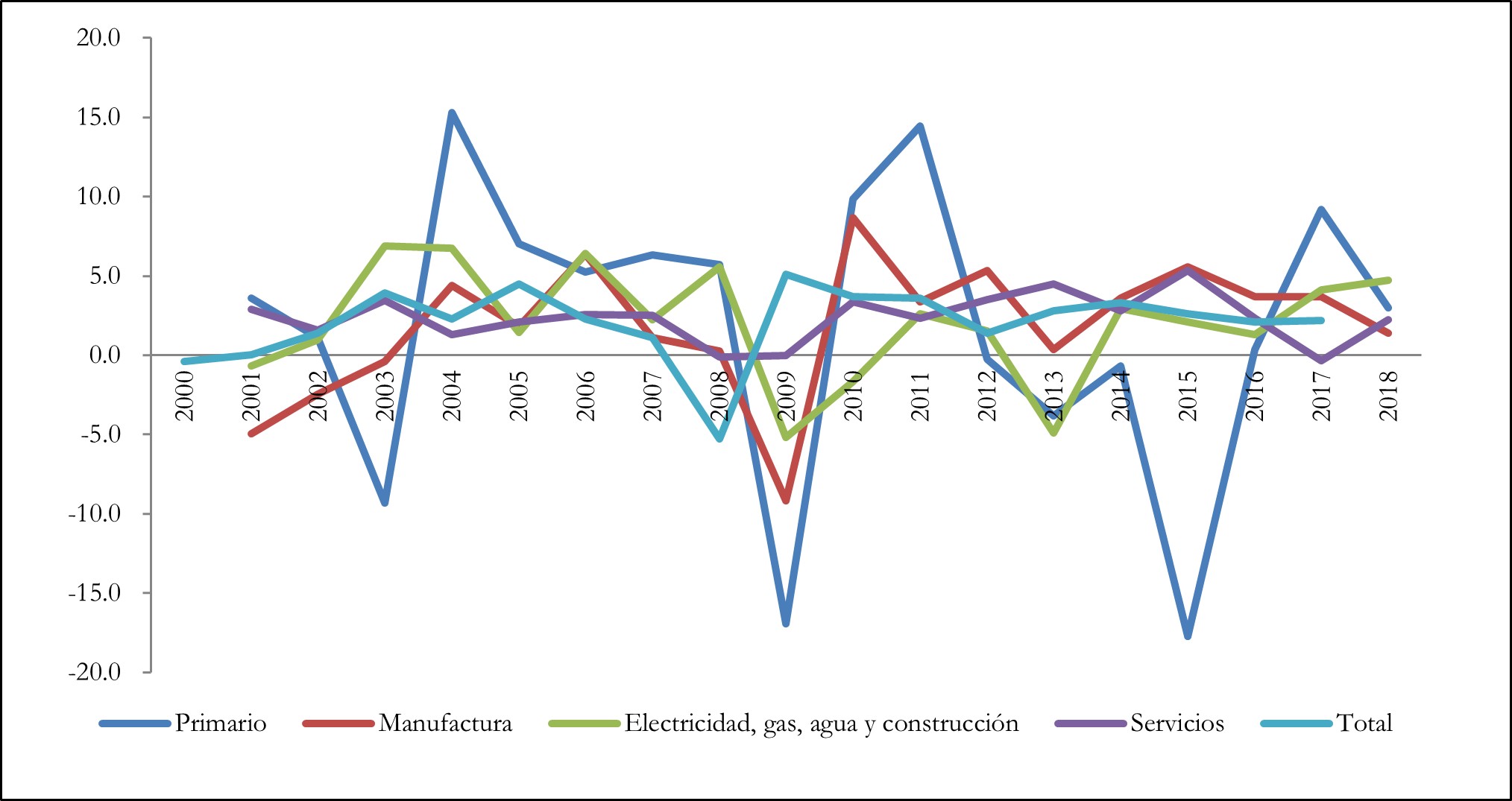
A nivel sectorial, la Figura 1 presenta las tasas de crecimiento del producto y de los grandes sectores económicos,
evidenciando que el sector servicios creció a un ritmo superior al del sector manufacturero,
con tasas promedio del 2,3% y 1,8%, respectivamente. Además, la participación del
sector servicios en el PIB fue del 47,1%, mientras que el sector manufacturero representó
el 35,5%. Sin embargo, el coeficiente de correlación entre el sector manufacturero
y el PIB total (95,8%) fue considerablemente mayor que el del sector servicios (42,4%).
Lo anterior indica que el crecimiento del sector servicios no está directamente alineado
con el crecimiento total de la economía mexicana. Aunque los servicios crecen y tienen
una participación significativa en el PIB, el crecimiento total de la economía sigue
dependiendo principalmente del desempeño del sector industrial.
Es importante destacar que el crecimiento de la actividad industrial depende, en gran
medida, del grado de integración de cada sector con la economía global y del uso de
insumos y factores en el proceso productivo. En México, las empresas más orientadas
a la exportación son aquellas de alta tecnología, caracterizadas por el uso intensivo
de insumos intermedios importados, fuerza laboral calificada y capital tecnificado.
Un caso destacado es la industria automotriz, que en 1999 ocupaba la undécima posición
a nivel mundial y, para 2018, ascendió al sexto lugar ().
Figura 1Tasas de crecimiento del producto y grandes sectores económicos (dólares constantes,
año 2010) Fuente: elaborado con datos del Banco Mundial y de la OCDE
De acuerdo con la Base de Datos Mundial de Input-Output (WIOD, por sus siglas en inglés),
la estructura y el crecimiento del empleo en México entre 2000 y 2014 se caracterizan
por la fuerte presencia del sector servicios, que representó el 51,8% del empleo total
y registró una tasa de crecimiento promedio anual del 2,06%. En contraste, el sector
industrial experimentó un crecimiento negativo del empleo, con una tasa promedio anual
de -0,14%, a pesar de que el empleo en la economía en su conjunto creció a una tasa
del 1,5% en ese período.
Los datos también revelan que la correlación entre el empleo industrial y el empleo
total (82%) es mayor que la correlación entre el empleo del sector servicios y el
empleo total (74,8%). Esto sugiere que, aunque el sector servicios tiene una mayor
participación en el empleo total, el empleo industrial sigue siendo más determinante
para la dinámica del mercado laboral en México.
Los hechos estilizados indican que, en México, el sector servicios destaca tanto en
participación como en crecimiento dentro del PIB y el empleo total. Sin embargo, la
trayectoria de estas variables para la economía en su conjunto se asemeja más a la
del sector industrial. Esto sugiere que la terciarización en México no ha logrado
que el crecimiento del sector servicios tenga un impacto significativo en el crecimiento
global de la economía.
Existen razones para considerar que el crecimiento económico depende en mayor medida
del sector industrial. Como se ha señalado, esto puede deberse a su papel como transmisor
de efectos dentro de la estructura productiva. A través de sus encadenamientos, el
sector industrial propaga sus efectos hacia un mayor número de ramas económicas. En
contraste, el impacto del crecimiento del sector servicios parece estar más concentrado
dentro de su propio grupo de actividades, sin generar una activación significativa
en otros sectores ni en la economía en su conjunto.
3. El modelo IP y el ACTIP
El modelo de Input-Output (IP) permite analizar la propagación de los efectos generados
por cambios en la demanda final. A partir de estos cambios, se evalúan distintos tipos
de multiplicadores: directos, indirectos y totales, así como los efectos entre regiones
y grupos de sectores. El multiplicador se define como una medida de transferencia
de una variable exógena hacia la producción, en función de la estructura productiva,
entendida como el conjunto de relaciones intersectoriales de compra y venta de insumos
intermedios que cada sector utiliza en su proceso productivo.
El modelo IP explica el producto de cada sector como el resultado de un proceso iterativo
de interacciones entre sectores, basado en el uso de insumos intermedios necesarios
para satisfacer una unidad de demanda final. Así, cuando la demanda final aumenta,
el nivel de producción también se incrementa, aunque no en proporción directa. Según
el modelo, cada unidad de producto en un sector depende tanto de la proporción de
insumos intermedios utilizados dentro del propio sector como de los insumos provenientes
de otros sectores, además de la demanda final de bienes por parte de los agentes económicos.
Formalmente, el modelo establece el producto de cada sector de la siguiente manera:
(1)
donde el vector f contiene los montos de demanda final de cada sector, la matriz (I-A)-1 representa la matriz de multiplicadores técnicos, ya que el arreglo numérico de A contiene los coeficientes de insumo. La matriz de multiplicadores cumple con la condición
Hawkins – Simon (); por lo que, al multiplicar por algún vector con algún tipo de coeficientes como
el consumo, las exportaciones, el empleo, los gastos de Investigación y Desarrollo
o la emisión de gases, se pueden definir multiplicadores específicos para estas variables
exógenas dentro del modelo IP.
Cuando los multiplicadores incluyen elementos derivados de la oferta, es decir, los
contabilizados en las cuentas de valor agregado, estos tienden a aproximarse a uno,
ya que todos los coeficientes se refieren a una unidad producida. En este sentido,
los valores de los multiplicadores del valor agregado son el vector renglón unitario
definido i'en la ecuación 2, que refleja el vector de precios unitarios o la ecuación de equilibrio ().
(2)
donde v es el vector de coeficientes de valor agregado, compuesto por los pagos a los factores
productivos (capital y trabajo) y los impuestos netos (impuestos menos subsidios).
La matriz de multiplicadores ha sido ampliamente utilizada en el análisis de impacto
y en la identificación de la importancia relativa de los sectores dentro de la estructura
productiva. Entre los estudios pioneros sobre los efectos de propagación, destaca
el trabajo de , quien analizó los vínculos entre grupos de sectores y descompuso los multiplicadores
totales en efectos internos, inducidos y externos. Este enfoque permite identificar
el efecto total como la combinación de estos componentes, facilitando el estudio de
la propagación de los multiplicadores de variables exógenas dentro de la estructura
productiva.
Si se considera una estructura productiva organizada en dos grupos de sectores – el
grupo 1 que contiene al primario, manufacturero, electricidad, gas, agua y construcción
(R) y el grupo 2 por el sector servicios (S) –, la matriz de multiplicadores internos
del valor agregado para el grupo 1 (ecuación 3) y del grupo 2 (ecuación 4) se definen como sigue:
(3)
(4)
La matriz R y S son cuadradas de tamaño equivalente al número de sectores dentro de cada grupo y
contienen los coeficientes técnicos, y son matrices diagonales de los coeficientes de valor agregado de cada grupo.
Ahora bien, los efectos inducidos pueden clasificarse en dos tipos; por un lado, cuando
las transacciones intergrupales afectan a las transacciones internas de un grupo;
y por otro, cuando las transacciones internas de un grupo influyen en la estructura
de las transacciones intergrupales. Definiendo S1como las ventas de insumos del grupo 1 al grupo 2, y R1 como las ventas de insumos intermedios del grupo 2 sobre el grupo 1, los efectos
inducidos se definen como efectos de compra del grupo 1 sobre el mismo grupo (ecuación 5) y el efecto interno sobre la venta al grupo 2 (ecuación 6), del mismo modo, se definen los efectos inducidos del grupo 2 (ecuaciones 7 y 8).
(5)
(6)
(7)
(8)
Los efectos externos se miden como la combinación de los efectos internos de un grupo
sobre las compras de los insumos intermedios del otro grupo (las matrices B2 y T2 ). Dependiendo del orden de ellos se pueden definir los efectos externos del grupo.
De esta manera, los efectos externos quedan definidos como sigue:
(9)
(10)
donde K es la matriz de efectos externos del grupo 1 y la matriz F es la matriz de efectos externos del grupo 2.
Aunque la metodología del modelo IP ha sido útil para analizar la complejidad del
proceso productivo, no sólo con los multiplicadores, sino también con la identificación
de los encadenamientos, su aplicación en el estudio del cambio estructural ha enfrentado
limitaciones. En principio porque el modelo IP asume rendimientos constantes a escala,
lo que deriva de la homogeneidad de las tablas IP () y en seguida por la discusión de las propuestas metodológicas realizadas por el
propio Leontief y de estudios posteriores sobre la dinámica del modelo (; ; ; ; ).
Las reflexiones sobre la evolución del cambio estructural en el uso de factores e
insumos dentro del modelo IP han señalado que el crecimiento económico de los sectores
sigue distintos regímenes. Las estructuras productivas pueden ser intensivas en factores,
en insumos o en ambos simultáneamente (). Sin embargo, el modelo IP no ha logrado demostrar esta relación ().
Este trabajo emplea el Análisis del Crecimiento de las Tablas de Input-Output (ACTIP),
propuesto por , el cual interpreta la tabla IP como una representación de precios y cantidades,
considerando el producto interno de los sectores como un vector continuo y monótono
de valores. Dado que se basa en una estructura semi-convexa y lineal, este enfoque
elimina la noción de relación marginal de sustitución y establece que el uso de factores
e insumos se da en proporciones fijas, lo que se representa mediante una función en
forma de "L". Bajo este enfoque, al comparar la variación en el uso de factores e
insumos en distintos períodos, se observa una relación inversa: si el uso de un insumo
aumenta, el de otro disminuye en la misma magnitud (; ).
De acuerdo con la tabla IP, cada unidad de producto se mide como la suma de los coeficientes
de insumo y los coeficientes de valor agregado. Por lo tanto, esta estructura implica
que el modelo cumple con rendimientos constantes (Ecuación 2). Bajo este supuesto, el análisis del cambio estructural solo indicaría que el producto
se modifica manteniendo constante la relación de factores e insumos utilizados por
unidad de producto.
En efecto, se trata de explicar cómo cambió la composición del producto de cada sector
en sus proporciones de factores e insumos empleados. Bajo el análisis neoclásico,
las funciones de proporciones fijas pueden estar en equilibrio, y un cambio en la
cantidad ofrecida puede deberse a una modificación en la utilización de los factores
e insumos, a las variaciones en los costos de ellos, o en los precios del bien. El
efecto total del cambio puede considerarse de manera similar a lo que propuso Slutsky
para el caso de la demanda; esto es, el efecto total se compone de un efecto técnico
de sustitución y por un efecto costo de los factores e insumos, el primero, se ha
demostrado que, para funciones de producción de proporciones fijas, la sustitución
de factores e insumos es nula ().
El segundo efecto, parte de una situación hipotética, donde el cambio se incorpora
a cada unidad de producto que se genera en el presente, de tal manera que, si el cambio
es positivo, en el presente se estaría produciendo más que una unidad del pasado.
Esta situación hipotética, se deriva de los rendimientos constantes y se define como:
(11)
donde el supra índice indica que son los coeficientes referidos al presente (t), mientras que es la matriz diagonal del cambio del valor del producto, que puede ser expresado
por su tasa de crecimiento, así los supra índices de la derecha de la ecuación 11 (1+∆), muestran los rendimientos constantes a escala. De esta manera, se puede definir
el vector renglón de la tasa de crecimiento del producto de cada sector como sigue:
(12)
La ecuación 12 muestra las contribuciones que hacen al crecimiento económico los insumos y factores
descritos en la tabla IP. La ecuación 12 mantiene las mismas propiedades, sin importar que se desagreguen a los insumos en
nacionales e importados, y a los factores en capital, trabajo e impuestos netos. Desde
la ecuación 12, se deduce que el crecimiento puede ser explicado por tres vías, por una inclinación
de las contribuciones de los factores productivos (v*), por una mayor participación de la utilización de los insumos intermedios (A*) y finalmente por una proporción equilibrada de ambos factores ().
La diferencia del crecimiento entre los sectores no sólo es por el tamaño de su tasa,
sino por la aportación que hacen los componentes de la producción. Podemos considerar
que el crecimiento de un sector sigue una senda constante, lo cual significa que,
es igual de intensiva entre insumos y factores; por lo tanto, el conjunto de interrelaciones
como la utilización de factores productivos determinan la variación del producto.
De igual manera, se puede hablar de una senda de crecimiento intensiva en insumos
o en factores; no obstante, al interior de cada una de ellas pueden existir distintas
combinaciones.
Por ejemplo, una senda de crecimiento puede ser intensiva en insumos intermedios nacionales
o importados, y aunque de manera general significa que la aportación de los factores
fue más pequeña, también puede ser que la aportación de los factores fue nula o negativa;
lo que permite identificar si la aportación de capital o de trabajo influyó en mayor
medida sobre la aportación de los factores.
Sin importar si la aportación de capital o de trabajo destaca sobre el total, cuando
la aportación de los factores es negativa, el cambio en la utilización de insumos
traslada a la producción hacia otro punto donde la curva de utilización de factores
presenta rendimientos decrecientes. En efecto, cuando el crecimiento es real, la explicación
por la variación de los precios queda fuera del análisis; de esta manera, cuando no
aportan los factores al crecimiento se puede considerar que hay capacidad ociosa en
el proceso productivo que permite la utilización de ellos sin que tenga efectos sobre
el crecimiento.
Ahora bien, si la senda de crecimiento de un sector es intensiva en factores, sea
por capital o por trabajo, la aportación de los insumos puede ser también positiva,
negativa o nula. En caso de ser negativa, indicaría que la utilización de insumos
no ha sido empleada eficientemente, representando su utilización en un punto sobre
la curva donde hay rendimientos decrecientes, mientras que, si es nula la aportación
de los insumos, pudiera indicar que existen reservas de insumos que no habían sido
empleadas.
4. Multiplicadores y sendas de crecimiento en la estructura productiva mexicana
Las tablas IP de la OCDE utilizadas en este estudio están desagregadas en 44 sectores
económicos y corresponden a la Revisión 3 de la Clasificación Industrial Internacional
Estándar de todas las Actividades Económicas (ISIC Rev.3, por sus siglas en inglés).
Se han considerado 25 ramas dentro del grupo 1, que incluye al sector primario, manufacturero,
electricidad, gas, agua y construcción, y 19 ramas en el grupo 2, correspondiente
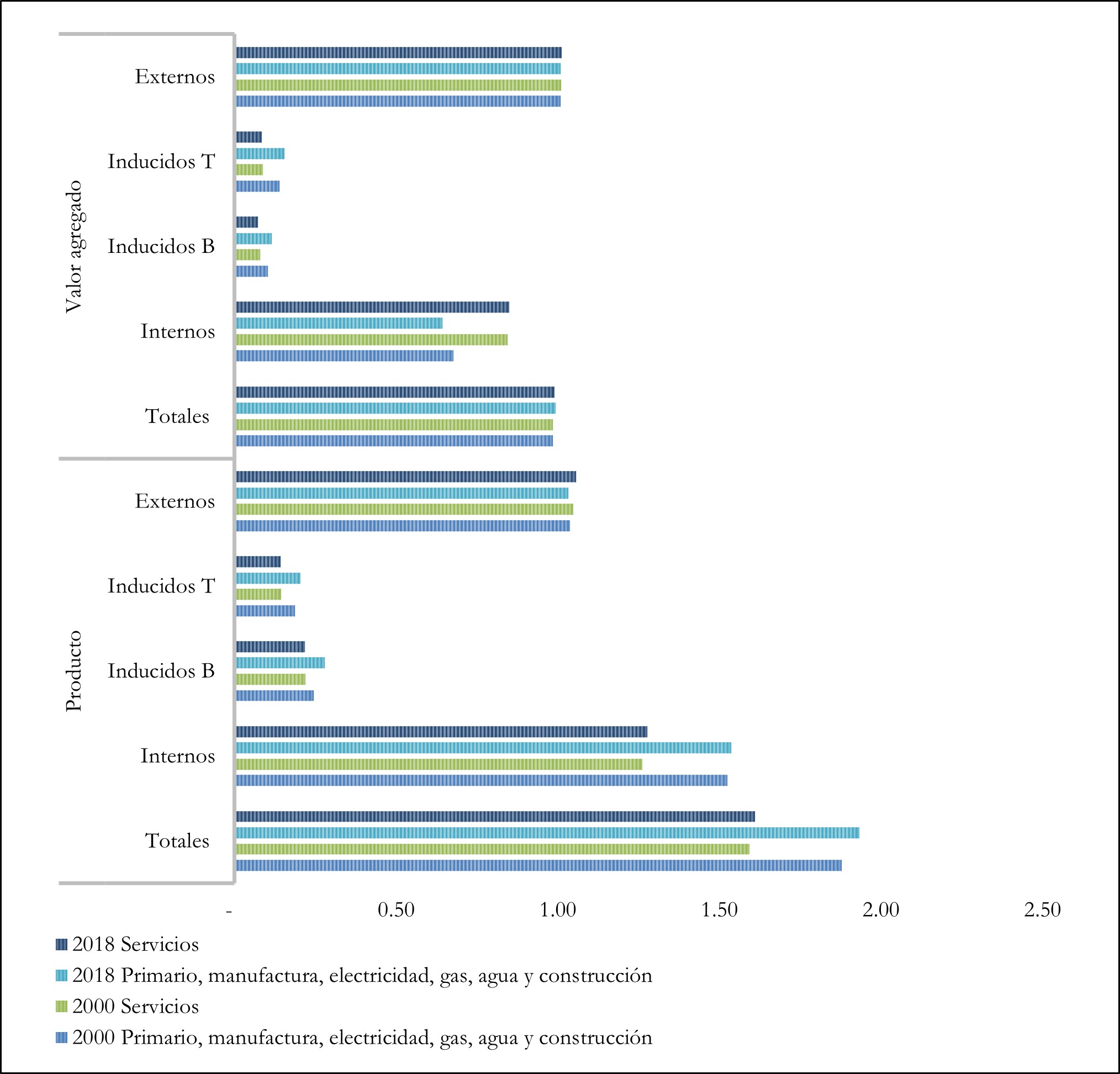
al sector servicios. La Figura 2 presenta los resultados promedio de la descomposición
de los multiplicadores del producto y del valor agregado para cada grupo de sectores
en los años 2000 y 2018 en México.
La Figura 2 muestra que el multiplicador promedio del producto total e interno del sector industrial
fue mayor en 2000 y 2018 en comparación con el del sector servicios, mientras que
el efecto externo en ambos grupos se mantiene en niveles similares. Los efectos inducidos
por la compra del sector servicios, derivados del proceso productivo del grupo 1,
son mayores que los efectos inducidos por la venta del sector servicios al grupo 1
(0,22 y 0,14, respectivamente).
Asimismo, la Figura 2 revela que los efectos inducidos dentro del grupo 1, tanto por compra como por venta
de insumos, son más significativos que los generados por el grupo 2. Los resultados
de los multiplicadores y su descomposición indican que la estructura productiva de
México mantuvo el mismo patrón durante el período analizado. Sin embargo, hubo un
ligero aumento en el multiplicador total e interno del producto del sector servicios,
aunque este crecimiento no se expandió hacia las actividades primarias y manufactureras,
sino que permaneció concentrado dentro del mismo sector. De hecho, los efectos inducidos
en 2018 fueron menores que en 2000 (-0,01). En cuanto a los multiplicadores totales
del valor agregado, se observa un incremento en ambos grupos, lo que sugiere una reducción
en el impacto de los impuestos netos. En el grupo 1, los efectos inducidos aumentaron
mientras que los efectos internos disminuyeron, mientras que en los servicios ocurrió
lo contrario: los efectos internos crecieron y los inducidos se redujeron.
Los resultados desagregados por sector, presentados en la Tabla A1 del Anexo, muestran que entre 2000 y 2018 los multiplicadores totales del producto crecieron
en ciertas ramas del sector primario, como Pesca y acuicultura, Minas y canteras,
y Producción energética. En el sector manufacturero, se registró un aumento en las
ramas de Coque y productos refinados del petróleo, Químicos, Productos farmacéuticos
y Otros minerales no metálicos. En contraste, dentro del sector servicios, solo el
Transporte aéreo presentó un crecimiento en el multiplicador total del producto. Los
efectos internos y los inducidos se mantuvieron en las mismas ramas del sector primario,
mientras que en la manufactura solo destacaron Coque y productos refinados del petróleo,
Químicos y farmacéuticos. En los servicios, las Tecnologías de la Información y Otros
servicios de comunicación conservaron su relevancia.
Los multiplicadores totales del valor agregado aumentaron en el sector primario en
las ramas de Pesca y acuicultura y Minas y canteras (productos no energéticos). En
la manufactura, el crecimiento se dio en Coque y productos refinados del petróleo,
Otros minerales no metálicos y Metales básicos, mientras que en los servicios sobresalieron
Transporte aéreo y Transporte terrestre y por oleoductos. En cuanto a los efectos
internos del valor agregado, no se observaron incrementos notables en el sector primario
ni en la manufactura, pero en los servicios destacaron Suministro de agua y gestión
de residuos, Actividades editoriales y radiodifusión, y Actividades profesionales.
Por otro lado, en los efectos inducidos por compras y ventas, se identificaron crecimientos
en Pesca y acuicultura y Minas y canteras dentro del sector primario; en Coque y productos
refinados del petróleo y Químicos y farmacéuticos en la manufactura, y en Almacenamiento
y apoyo al transporte, Alojamiento y comidas, y Tecnologías de la Información en los
servicios.
Figura 2Descomposición de mulitplicadores del producto y del valor agregado por grupo de sectores Fuente: elaboración propia con datos de las tablas de Input-Output publicadas por
la OCDE
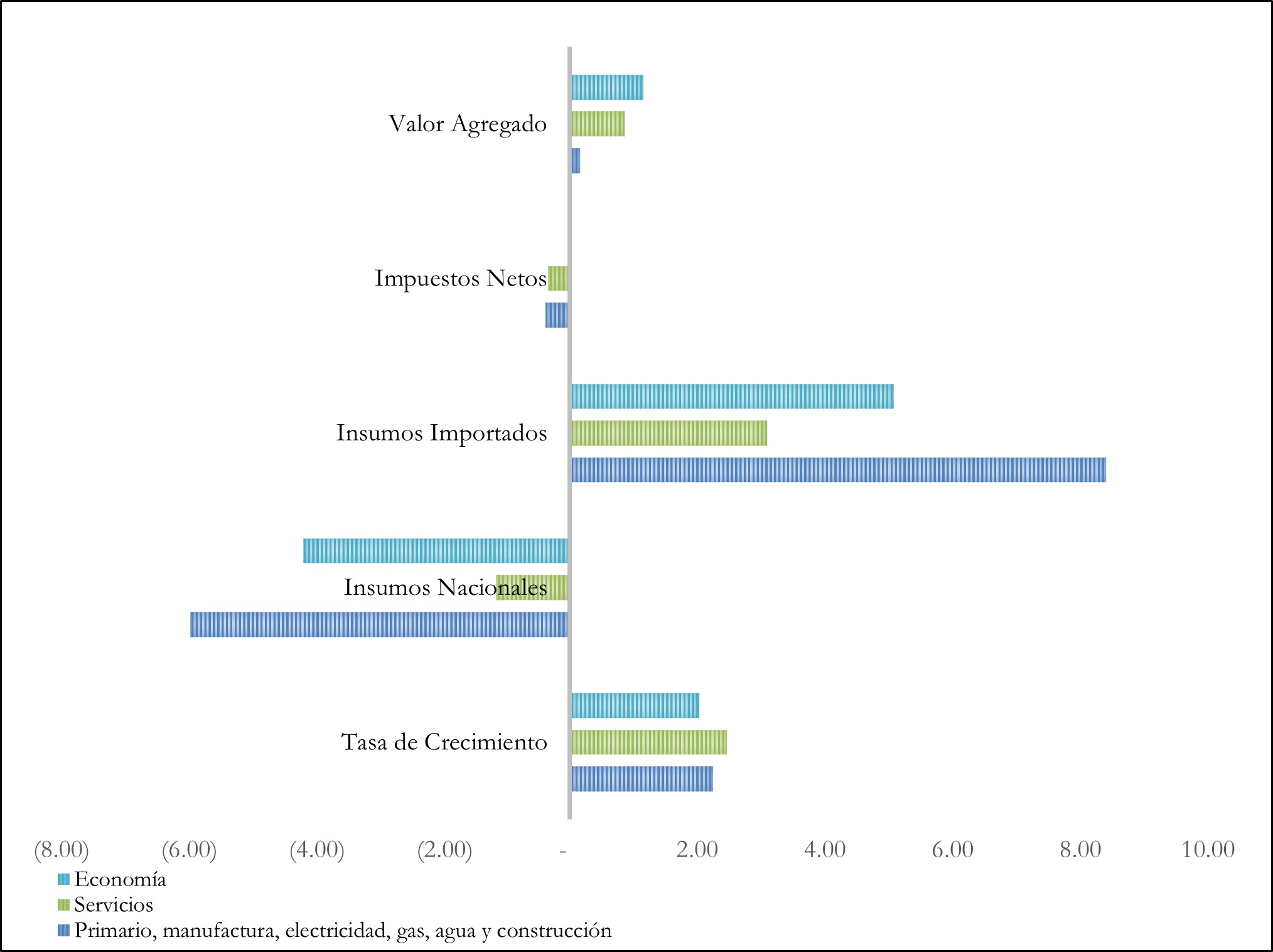
Tal como se observa en la Figura 3, entre 2000 y 2018 el crecimiento promedio real de la economía mexicana fue del 2,03%.
Durante este período, tanto en el agregado de la economía como en sus sectores, la
contribución de los insumos intermedios importados al crecimiento fue mayor que la
de los factores productivos. El crecimiento del sector servicios superó al del grupo
1, al igual que la contribución de los factores productivos dentro del sector servicios
en comparación con el grupo 1.
Figura 3Contribuciones al crecimiento de los insumos y factores 2000 - 2018 Fuente: elaboración propia con datos de las tablas Input-Output publicadas por la
OCDE
El análisis desagregado de las contribuciones al crecimiento revela que la mayoría
de los sectores siguieron una senda de crecimiento intensiva en insumos intermedios
importados. En el sector primario, solo tres de las cinco ramas presentaron una aportación
positiva de los factores, mientras que Minas y canteras (productos energéticos) contribuyó
positivamente a los impuestos netos. En la manufactura, todas las actividades dependen
de insumos intermedios importados. No obstante, dentro de este sector, ramas de baja
tecnología (como Alimentos, bebidas y tabaco), de media tecnología (como Productos
de caucho y plástico) y de alta tecnología (como Equipo eléctrico y Vehículos de motor)
registraron aportaciones positivas de los factores. Solo cuatro ramas manufactureras,
entre ellas Equipos electrónicos y Vehículos de motor, presentaron contribuciones
positivas en impuestos netos (Tabla A2 del Anexo).
Las ramas de Suministro de agua, Alcantarillado, Gestión de residuos y Construcción
son intensivas en factores. En el sector servicios, casi la mitad de las actividades
(7 de 19) son intensivas en factores, tres en insumos nacionales y ocho en insumos
intermedios importados. Además, en nueve ramas del sector servicios, los impuestos
netos contribuyeron positivamente al crecimiento.
De acuerdo con los resultados anteriores, se destacan los siguientes aspectos del
proceso de terciarización de la economía mexicana:
1) Los multiplicadores del producto son mayores en el sector industrial, lo que se
mantiene en la descomposición de los multiplicadores. Es decir, los efectos de inducción
y los efectos internos del grupo industrial superan a los del sector servicios. Si
bien los multiplicadores totales y su descomposición aumentaron entre 2000 y 2018,
este crecimiento fue limitado. Estos resultados confirman que el sector industrial
tiene un papel más relevante que el sector servicios en la expansión del producto
total de la economía.
2) En cuanto a los multiplicadores del valor agregado, que reflejan el impacto en
el crecimiento a través del pago a los factores productivos, los multiplicadores totales,
los inducidos y los externos son similares en ambos grupos. La única diferencia significativa
se observa en los efectos internos, que son mayores en el sector servicios que en
el industrial. Estos resultados sugieren que el Estado ha tenido una incidencia limitada
en el crecimiento, ya que su efecto es reducido y su participación disminuyó entre
2000 y 2018.
3) El Estado ha impulsado la incorporación de México a las Cadenas Globales de Valor
(CGV) mediante la desregulación de mercados y la implementación de políticas fiscales
favorables para la inversión extranjera. Esto ha provocado una reducción en el multiplicador
de los impuestos netos y en su contribución al crecimiento. En el modelo exportador
predominante, la actividad productiva interna ha representado un obstáculo para el
crecimiento económico. Como resultado, la economía mexicana sigue una senda de crecimiento
intensiva en insumos importados. En el sector servicios, la contribución de los factores
productivos se aproxima a la de los insumos importados, e incluso supera al tamaño
de la contribución de los factores que tiene el sector industrial.
5. Discusión: multiplicadores y crecimiento
Los multiplicadores en el modelo de IP permiten medir la capacidad de expansión de
un sector ante cambios en la demanda final. Si bien el tamaño del multiplicador es
un factor clave, también lo es la posición que ocupa el sector dentro de la estructura
productiva. Esta posición depende de su grado de interacción con otros sectores y
de la tecnología que emplea en sus procesos de producción. Ambos factores—tamaño y
posición—son esenciales para evaluar la importancia de un sector dentro de la economía.
La posición del sector en la estructura productiva puede analizarse mediante la descomposición
del tamaño del multiplicador (; ).
Desde esta perspectiva, el crecimiento económico se explica por los estímulos de la
demanda en sectores con altos multiplicadores. Sin embargo, no todos los sectores
crecen al mismo ritmo. Existen sectores clave en la economía cuya expansión, aunque
sea mínima, genera un efecto multiplicador significativo sobre el producto total (). La industria es el sector que más impulsa el crecimiento debido a las externalidades
que genera, su impacto en la productividad y su papel en el fomento del cambio tecnológico
(; ). Por ello, se espera que el multiplicador del sector industrial sea mayor en comparación
con otros sectores y que, dependiendo del nivel de desarrollo de la economía y de
su productividad, pueda generar una mayor transferencia de valor entre sectores.
La fuerte presencia del sector servicios en la economía mexicana no es consecuencia
de un aumento en la productividad del sector industrial, sino del modelo de apertura
comercial basado en la importación de insumos especializados. La integración de México
en las Cadenas Globales de Valor (CGV) ha limitado la transferencia de valor del sector
industrial hacia ciertos segmentos de los servicios, como las tecnologías de la información
y la comunicación (). Además, la apertura comercial permitió la entrada de productos manufacturados de
bajo costo, especialmente provenientes de China, lo que aumentó la presión competitiva
sobre la industria nacional. Como resultado, muchas fábricas menos competitivas cerraron
o se deslocalizaron, lo que fortaleció otros sectores, como el comercio y los servicios,
que no están expuestos a la misma competencia internacional directa ().
Si bien el sector servicios en México ha registrado un crecimiento acelerado y un
aumento en el empleo, su impacto en el crecimiento total de la economía ha sido limitado
debido a que los efectos de sus multiplicadores permanecen concentrados dentro del
mismo sector. En el contexto actual del comercio internacional, los nuevos patrones
de producción y empleo determinan las perspectivas de desarrollo y competitividad
del país (). No obstante, para aprovechar estas oportunidades económicas y sociales, es fundamental
que la política económica se oriente hacia sectores donde México tenga ventajas comparativas,
fomentando la inversión y el desarrollo en industrias menos vulnerables a la competencia
con países como China.
Un modelo de crecimiento que presenta una senda de crecimiento basada en insumos importados
resulta poco favorable para el desarrollo de una economía exportadora, ya que una
parte significativa del ingreso generado se destina a la compra de insumos externos,
en lugar de estimular las remuneraciones al capital o al trabajo. Por el contrario,
el crecimiento sería más beneficioso si estuviera sustentado en insumos intermedios
nacionales, ya que ello indicaría que la producción de bienes para exportación se
basa en recursos locales, fortaleciendo el mercado interno y aumentando la remuneración
a los factores productivos.
Una senda de crecimiento más equilibrada es aquella en la que la contribución de los
factores productivos y de los insumos es similar. En una economía abierta, se obtienen
mayores beneficios cuando la participación de los insumos nacionales supera la de
los importados. El valor agregado generado por los factores productivos tiene un impacto
directo en la demanda final. Por ejemplo, si el crecimiento es intensivo en capital,
el aumento del ingreso del capital incentiva a la inversión, lo que a su vez impulsa
el crecimiento del producto. Si el crecimiento es intensivo en trabajo, el aumento
de los salarios fomenta el consumo, lo que también estimula la producción. Ambos escenarios
favorecen el crecimiento económico, pero la mejor condición es aquella en la que la
contribución del capital y del trabajo es equilibrada, ya que esto garantiza tanto
la inversión como la demanda interna.
De hecho, la trayectoria de crecimiento de una economía puede ser moldeada por los
instrumentos de política económica implementados por el Estado. Algunos países de
Asia lograron un desarrollo sostenido gracias a la figura del "Estado desarrollador",
un modelo en el que el Estado ejerce un papel central en la planificación económica,
con una fuerte capacidad política, burocrática y empresarial. Este enfoque se basa
en la gestión estratégica de la estructura productiva y en la intervención directa
en sectores clave para impulsar el desarrollo (; ).
6. Conclusiones
Este estudio ha demostrado que los multiplicadores del sector servicios son menores
que los del sector industrial. El análisis de la estructura productiva de la economía
revela que, aunque los altos multiplicadores del producto en la industria generan
cierto grado de transferencia de valor hacia el sector servicios, esta transferencia
es limitada. Aún más reducida es la capacidad del sector servicios para transferir
valor al resto de las ramas productivas, lo que explica por qué su dinamismo tiene
un impacto limitado en el crecimiento del producto.
El crecimiento promedio de la economía mexicana y sus sectores ha seguido una senda
intensiva en insumos intermedios importados. El crecimiento del sector servicios no
contribuye significativamente al crecimiento económico debido a que sus efectos permanecen
concentrados dentro del propio sector. No obstante, el crecimiento experimentado por
los servicios puede atribuirse a las aportaciones de los factores productivos que
inciden en la demanda de estos mismos servicios.
En México, la diversificación de las exportaciones no ha impulsado el crecimiento
económico, sino que ha incentivado una mayor participación de importaciones de alta
tecnología y bienes de capital, elementos estrechamente ligados al desempeño productivo
(). El análisis de la estructura económica sugiere que, debido a esta dependencia con
el exterior, el tejido productivo mexicano es altamente vulnerable a la dinámica de
la economía internacional.
Para fortalecer el desarrollo económico, es fundamental implementar políticas industriales
que promuevan la producción interna de insumos destinados al sector exportador. El
incremento en el uso de insumos nacionales debe lograrse reduciendo la dependencia
de insumos importados, pero también es necesario que esta transición tenga un impacto
positivo en la aportación de los factores productivos. Esto garantizaría condiciones
de demanda adecuadas y la continuidad del proceso productivo. En este sentido, es
crucial aumentar el valor del contenido nacional en las exportaciones. Actualmente,
México tiene la oportunidad de fortalecer su contenido nacional y mejorar su posición
en las Cadenas Globales de Valor, gracias al Tratado entre México, Estados Unidos
y Canadá (T-MEC) y a las reformas en materia de valor de contenido regional.
A diferencia del modelo de orientación interna, que dio lugar a un Estado corporativista
(), México necesita un Estado que promueva el desarrollo y que, con base en la experiencia
histórica, recupere y adapte los beneficios de aquellas políticas industriales de
orientación interna. Estas estrategias podrían aplicarse al sector servicios para
mejorar la productividad de toda la economía y generar empleos de mayor calidad (). En otras palabras, si la desindustrialización en México es una consecuencia del
modelo económico vigente, es posible que un conjunto de instrumentos de política económica
bien diseñados pueda revertir esta tendencia y promover un proceso de desarrollo sostenible.
Agradecimientos
Agradecemos el trabajo realizado por los revisores anónimos, por sus valiosas observaciones
y sugerencias para la mejora del trabajo. También agradecemos el trabajo realizado
por el Comité Editorial de la Revista.
Contribución de los autores
Conceptualización, M.A.M.M. y O.A.G.G.; Metodología, M.A.M.M.; Software, O.A.G.G.;
Adquisición de datos, M.A.M.M.M y O.A.G.G.; Análisis e interpretación, M.A.M.M.M y
O.A.G.G.; Redacción-Preparación del borrador, M.A.M.M. Redacción-Revisión y Edición,
M.A.M.M. Todos los autores leyeron y están de acuerdo con la versión publicada del
manuscrito.
Calderón, C. & Hernández, L. (2016). Cambio estructural y desindustrialización en
México. Estudios Fronterizos, XII(23), 153-190. https://doi.org/10.21670/ref.2211095
3
Carrasco, C.A. & Tovar-García, E.D. (2021). Trade and growth in developing countries:
the role of export composition, import composition and export diversification. Economic Change Restructuring, 54, 919-94. https://doi.org/10.1007/s10644-020-09291-8
4
Chang, H. (2006). Industrial policy in East Asia –lesson for Europe. European Investment Bank (EIB), Economics Department, 11(2), 139-148.
5
Dasgupta, S. & Singh, A. (2007). Manufacturing, Services and Premature Deindustrialization
in Developing Countries: A Kaldorian Analysis. In Mavrotas, G., Shorrocks, A. (eds)
Advancing Development. Studies in Development Economics and Policy. Palgrave Macmillan. https://doi.org/10.1057/9780230801462_23
6
De la Garza, E. (1994). Corporativismo, Teoría y Transformación. Revista de Ciencias Sociales y Humanidades, 14(34), 11-28.
7
de Mesnard, L. (2006). Measuring structural change in the I‐O production function
by biproportional methods: A theorem of price invariance, Papers in Regional Science, 85(3) 459-469. https://doi.org/10.1111/j.1435-5957.2006.000060.x.
8
García, M. R. & Álvarez, B. A. (2022). El sector automotriz mexicano y la región de
América del Norte. Resultados y perspectivas de la política de mayor integración negociada
en el T-MEC, Norteamérica, 18(1), 145-167. https://doi.org/10.22201/cisan.24487228e.2023.1.508
Hernández, J. (2023). La industria aeronáutica mexicana: Un análisis de la composición
del comercio exterior de 2000-2020. Economía Teoría Y Práctica, 31(59), 131-162. https://doi.org/10.24275/etypuam/ne/592023/hernandez
11
Hirschman, A. (1958). The Strategy of Economic Development, Yale University Press.
12
Holub, H.-W., Schnabl, H., & Tappeiner, G. (1985). Qualitative Input-Output Analysis
with Variable Filter. Journal of Institutional and Theoretical Economics, 141(2), 282-300. http://www.jstor.org/stable/40750836
13
Huang, Y., Haseeb, M, Khan, J., & Hossain E. (2022). “Structural changes and economic
landscape of the Indian economy: 2000-2019”. En Review of Development Economics, 27(1), 395-422. https://doi.org/10.1111/rode.12948
14
Huerta, G. A. (2014). La industria manufacturera mexicana vista en el contexto de
industrialización de China e India. Economía Informa, 384, 41-69. https://doi.org/10.1016/S0185-0849(14)70410-4
15
Kaldor, N. (1966), Causes of the Slow Rate of Economic Growth of the United Kingdom: An Inaugural Lecture, Cambridge University Press.
16
Jorgenson, W. & Griliches Z. (1967). The Explanation of Productivity Change. The Review of Economic Studies, 34(3), 249-283 https://doi.org/10.2307/2296675
Miller, R. & Blair, P. (2009). Input-Output Analysis. Foundations and Extentions. Cambridge University Press, Segunda Edición.
22
Miyazawa, K. (1966). Internal and external matrix multipliers in the input-output
model. Hitotsubashi Journal of Economics, 7, 38-55. https://www.jstor.org/stable/43295653
23
Morales, J. (2010). Inversión extranjera directa y desarrollo en América Latina. Revista Problemas del Desarrollo, 41(163), 141-156.
24
Moreno B. J. C. (2016). Política macro e industrial para un cambio estructural y crecimiento:
gran pendiente de la economía mexicana. Revista Problemas del Desarrollo, 185(47), 57-68.
25
Moreno B. J. C. & Ros B. J. (2009). Desarrollo y crecimiento en la economía mexicana. Una perspectiva histórica. Fundo de Cultura Económica.
26
Palma, G. (2019). Desindustrialización, desindustrialización “prematura” y “síndrome
holandés”. El Trimestre Económico, 86(344) 901–966. https://doi.org/10.20430/ete.v86i344.970
27
Peneder, M. & Streicher, G. (2018). De-industrialization and comparative advantage
in the global value chain. Economic Systems Research, 30(1), 85-104. https://doi.org/10.1080/09535314.2017.1320274
28
Reinecke, G. & Posthuma, A. (2019). The link between economic and social upgrading
in global supply chains: Experiences from the Southern Cone. International Labour Review, 158(4), 677-703. https://doi.org/10.1111/ilr.12148
29
Romero, T. J.A. & Berasaluce, J. I. (2019). Estado Desarrollador. Casos Exitosos Y Lecciones Para México. Colegio de México.
Rowthorn, R. & Ramaswamy, R. (1999). Growth, Trade, and Deindustrialization. IMF Staff Papers 46(1), 18-41.
32
Schoonbeek, L. (1990). The Size of the Balanced Growth Rate in the Dynamic Leontief
Model. Economic Systems Research, 2(4), 345-350. https://doi.org/10.1080/09535319000000024
33
Solow, R. (1956). A Contribution to The Theory of Economy Growth. The Quartely Journal of Economics, 70(1), 65-94. https://doi.org/10.2307/1884513
34
Steenge, A. (1990). Instability Problems in the Dynamic Leontief Model: an Economic
Explanation. Economic Systems Research, 2(4), 357-362. https://doi.org/10.1080/09535319000000026
35
Szyld, D. (1985). Conditions for the existence of a balanced growth solution for the
Leontief dynamic input– output model. Econometrica, 53(6), 1411–1419. https://doi.org/10.2307/1913215
36
Tian, K., Dietzenbacher, E. & Jong-A-Pin, R. (2019). Measuring Industrial Upgrading:
Applying Factor Analysis in a Global Value Chain Framework. Economic Systems Research, 31(4), 642-664. https://doi.org/10.1080/09535314.2019.1610728
37
Vidal, E. & González, A., (2024). A review of Mexico’s participation in global value
chains. OECD Economics Department Working Papers, 1802, OECD Publishing. https://doi.org/10.1787/1ab1e52e-en
38
Young, A. (1928). Increasing Returns and Economic Progress. The Economic Journal, 38, 152, 527-542. https://doi.org/10.2307/2224097
Tabla A1Diferencias de multiplicadores en la estructura económica de México 2000-2018 Fuente:
Elaboración propia con base en las Tablas IP publicadas por la OCDE
Sectores
Producto
Valor agregado
Totales
Internos
Inducidos Industria
Inducidos Servicios
Externos
Totales
Internos
Inducidos Industria
Inducidos Servicios
Externos
Agricultura, Forestal y Pesca
0,05
0,10
0,04
0,03
0,01
-0,01
-0,05
0,02
0,02
0,00
Pesquera y acuícola
0,33
0,04
0,03
0,03
0,01
0,01
-0,03
0,02
0,02
0,00
Minas y canteras, productos para la producción de energía
0,34
0,11
0,05
0,04
-0,02
0,02
-0,03
0,01
0,03
-0,00
Minas y canteras, productos no energéticos
-0,07
0,05
0,00
-0,03
-0,04
0,00
-0,00
-0,00
-0,00
-0,00
Actividades de servicios de apoyo a la minería
0,02
0,18
0,04
0,02
0,00
-0,00
-0,04
0,01
0,01
0,00
Alimentos bebidas y tabaco
0,00
0,04
0,08
0,06
0,01
-0,02
-0,10
0,02
0,03
0,00
Textil, prendas de vestir, cuero y productos relacionados
-0,10
0,10
0,11
0,08
0,01
-0,03
-0,14
0,02
0,05
0,00
Madera y productos de madera y corcho
0,02
0,40
0,15
0,09
0,02
-0,06
-0,20
0,03
0,06
0,00
Productos de papel e impresión
-0,07
0,04
0,08
0,05
0,01
0,02
-0,05
0,02
0,03
0,00
Coque y productos refinados del petróleo
0,51
-0,05
-0,04
-0,08
-0,03
0,06
0,11
0,01
-0,05
-0,01
Químicos y productos químicos
0,28
-0,16
0,05
0,05
0,01
0,03
-0,02
0,02
0,03
0,00
Productos farmacéuticos, químicos medicinales y botánicos
0,23
-0,31
0,02
0,04
0,00
0,01
-0,01
0,02
0,03
0,00
Productos de caucho y plástico
0,02
0,16
0,10
0,07
0,01
-0,00
-0,10
0,02
0,05
0,00
Otros productos minerales no metálicos
0,13
-0,00
0,05
0,05
0,01
0,03
-0,01
0,02
0,02
0,00
Metales básicos
-0,01
0,13
0,11
0,09
0,03
0,01
-0,09
0,01
0,05
0,00
Fabricación de productos metálicos
-0,05
0,12
0,09
0,06
0,02
0,02
-0,07
0,01
0,03
0,00
Equipos informáticos, electrónicos y ópticos
0,06
-0,47
0,17
0,27
0,06
0,09
-0,06
0,05
0,14
0,01
Equipo eléctrico
-0,10
-0,25
0,05
0,05
0,01
0,05
0,01
0,02
0,03
0,00
Maquinaria y equipo
-0,11
-0,33
0,06
0,10
0,02
0,05
-0,00
0,03
0,05
0,00
Vehículos de motor, remolques y semirremolques
-0,14
-0,20
0,05
0,04
0,01
0,11
0,07
0,02
0,02
0,00
Otro equipo de transporte
-0,04
-0,20
0,04
0,03
0,01
0,09
0,06
0,02
0,02
0,00
Fabricación, reparación e instalación de maquinaria y equipo
0,05
0,33
0,17
0,10
0,01
-0,00
-0,17
0,02
0,06
0,00
Suministro de electricidad, gas, vapor y aire acondicionado
0,07
0,16
0,01
-0,03
-0,02
0,02
0,02
-0,00
-0,02
-0,00
Suministro de agua; alcantarillado, gestión de residuos y actividades de remediación
-0,01
0,02
0,10
0,14
0,03
0,00
-0,10
0,02
0,07
0,01
Construcción
-0,09
-0,14
0,01
0,01
-0,01
0,02
-0,06
0,01
0,00
-0,00
Comercio al por mayor y al por menor; reparación de vehículos de motor
-0,06
0,04
-0,04
0,09
-0,00
0,01
0,02
-0,01
-0,01
0,00
Transporte terrestre y transporte por oleoductos
0,13
0,08
-0,03
0,23
0,00
-0,01
-0,03
0,01
-0,02
0,00
Transporte acuático
0,07
-0,00
0,16
0,40
0,06
0,04
-0,05
0,06
0,01
0,01
Transporte aéreo
0,21
0,13
-0,26
0,29
-0,01
0,05
0,14
-0,09
0,01
-0,00
Actividades de almacenamiento y apoyo al transporte
0,07
0,11
-0,03
0,23
0,01
-0,00
-0,01
-0,00
-0,02
0,00
Actividades postales y de mensajería
0,10
0,11
0,14
0,14
0,02
-0,05
-0,13
0,05
0,05
0,01
Actividades de alojamiento y servicio de comidas.
0,03
0,01
-0,04
0,48
0,00
0,02
0,01
0,01
0,01
0,01
Actividades editoriales, audiovisuales y de radiodifusión
-0,14
0,20
0,13
0,28
0,05
0,00
-0,08
0,03
-0,01
0,01
Telecomunicaciones
0,04
0,05
-0,09
0,26
0,00
0,03
0,05
-0,02
-0,01
0,00
Tecnologías de Información y otros servicios de comunicación
0,07
-0,11
-0,04
0,07
-0,00
0,02
0,05
-0,01
-0,01
-0,00
Actividades financieras y de seguros
-0,11
-0,01
-0,06
0,11
-0,00
0,03
0,06
-0,02
-0,02
-0,00
Actividades inmobiliarias
-0,05
0,03
-0,01
0,08
0,00
-0,00
-0,01
0,00
0,00
0,00
Actividades profesionales, científicas y técnicas
-0,09
0,05
-0,15
0,15
-0,02
0,04
0,10
-0,05
-0,02
-0,00
Servicios administrativos y de apoyo
-0,03
0,09
-0,09
0,14
-0,01
0,01
0,03
-0,02
-0,02
0,00
Administración pública y defensa; seguridad social obligatoria
0,09
0,08
0,11
0,17
0,02
-0,01
-0,10
0,07
0,06
0,01
Educación
0,01
0,10
0,00
0,06
0,00
0,00
-0,01
0,00
0,00
0,00
Actividades de salud humana y trabajo social
0,04
0,03
0,11
0,23
0,03
-0,01
-0,10
0,06
0,03
0,01
Arte, entretenimiento y recreación
-0,04
0,41
-0,52
0,05
-0,07
0,06
0,25
-0,18
-0,11
-0,01
Otras actividades de servicios
0,01
0,04
-0,09
0,19
0,00
0,01
0,03
-0,02
-0,02
0,00
Fuente: Elaboración propia con base en las Tablas IP publicadas por la OCDE
Tabla A2Aportaciones de insumos y factores al crecimiento del producto en México entre 2000
– 2018 (porcentaje) Fuente: Elaboración propia con base en las Tablas IP publicadas
por la OCDE
Sector
México
Insumos nacionales
Insumos importados
Imp. netos
Valor Agreg.
Crecimiento
Agricultura, Forestal y Pesca
-1,67
3,35
-0,12
0,77
2,33
Pesquera y acuícola
8,22
7,86
-2,38
-11,42
2,28
Minas y canteras, productos para la producción de energía
12,45
6,88
0,19
-17,87
1,66
Minas y canteras, productos no energéticos
-4,90
2,54
-1,59
10,00
6,04
Actividades de servicios de apoyo a la minería
-7,85
6,75
-0,56
4,94
3,28
Alimentos bebidas y tabaco
-1,69
2,96
-0,07
1,35
2,55
Textil, prendas de vestir, cuero y productos relacionados
-10,05
4,54
-0,27
3,31
-2,48
Madera y productos de madera y corcho
-9,76
5,95
-0,12
2,57
-1,37
Productos de papel e impresión
-7,07
4,70
0,00
3,40
1,03
Coque y productos refinados del petróleo
-13,87
23,96
-1,42
-3,53
5,14
Químicos y productos químicos
-13,38
16,00
-0,37
-1,64
0,62
Productos farmacéuticos, químicos medicinales y botánicos
-13,71
15,33
0,01
-0,38
1,24
Productos de caucho y plástico
-7,25
7,94
-0,13
1,27
1,83
Otros productos minerales no metálicos
5,10
1,57
-1,48
-4,73
0,46
Metales básicos
5,55
1,61
-0,60
-2,16
4,40
Fabricación de productos metálicos
-5,48
6,48
-0,33
1,50
2,17
Equipos informáticos, electrónicos y ópticos
-21,08
25,04
0,27
-5,34
-1,11
Equipo eléctrico
-12,26
11,48
-0,22
1,85
0,85
Maquinaria y equipo
-9,73
10,15
0,08
3,24
3,73
Vehículos de motor, remolques y semirremolques
-8,50
10,05
1,01
2,32
4,88
Otro equipo de transporte
-5,51
10,13
0,18
2,14
6,93
Fabricación, reparación e instalación de maquinaria y equipo
-5,97
11,02
0,03
-4,10
0,98
Suministro de electricidad, gas, vapor y aire acondicionado
-10,47
8,84
-0,91
5,79
3,25
Suministro de agua; alcantarillado, gestión de residuos y actividades de remediación
-2,36
1,75
-0,52
4,85
3,74
Construcción
-7,28
3,23
-0,02
5,91
1,84
Comercio al por mayor y al por menor; reparación de vehículos de motor
-0,33
-0,44
0,05
3,54
2,83
Transporte terrestre y transporte por oleoductos
-3,62
8,06
-3,24
0,65
1,85
Transporte acuático
5,58
1,80
-0,59
-4,43
2,37
Transporte aéreo
4,17
7,68
-4,64
-2,20
5,00
Actividades de almacenamiento y apoyo al transporte
-5,02
8,20
-0,13
1,15
4,20
Actividades postales y de mensajería
7,74
2,85
-0,60
-5,68
4,30
Actividades de alojamiento y servicio de comidas.
-4,05
3,07
0,07
1,71
0,80
Actividades editoriales, audiovisuales y de radiodifusión
-6,19
2,54
0,59
5,07
2,01
Telecomunicaciones
-7,22
9,00
-0,06
0,30
2,03
Tecnologías de Información y otros servicios de comunicación
-8,14
8,91
0,32
0,65
1,74
Actividades financieras y de seguros
-2,24
-1,54
0,61
9,55
6,38
Actividades inmobiliarias
-2,53
0,05
0,16
3,14
0,81
Actividades profesionales, científicas y técnicas
-3,05
0,65
-0,08
4,76
2,28
Servicios administrativos y de apoyo
-0,58
0,48
0,02
1,56
1,48
Administración pública y defensa; seguridad social obligatoria
4,69
2,09
0,26
-3,88
3,17
Educación
-0,28
0,87
-0,05
2,22
2,77
Actividades de salud humana y trabajo social
0,16
3,99
0,44
-0,97
3,63
Arte, entretenimiento y recreación
-2,64
2,03
0,29
1,55
1,23
Otras actividades de servicios
0,57
1,48
-0,22
-1,43
0,41
Economía total
-4,2
5,1
0,0
1,2
2,0
Fuente: Elaboración propia con base en las Tablas IP publicadas por la OCDE