Iranian Islamic art refers to the works of culture and civilization of the Iranian Muslim nation in the Islamic era. In its thinking and epistemological nature, it has a different language from simile and purification and is associated with a rich philosophy called "decoration" based on spiritual manifestations. Therefore, in creating works based on a simile and purification attitude, the existence of truth has never been neglected and the art world has been considered as manifestations of truth. This research is a descriptive and analytical research. Through documents, libraries and field observations, various data were collected by examining the principles and components of simile and purification with emphasis on Ibn Arabi's point of view and analyzing of how the Muslim artist used and his goals of using the combination of the two components in the philosophy of decoration. The results show that "simile and purification", as a mystical approach, has led to the formation of a special language in the structure of Iranian art; therefore, in the philosophy of decoration, the mystic artist has used it as a tool to manifest the beauty and perfection of God in forms through the embodiment of unity.
Keywords:
Simile, Purificatoin, Geometric motifs, Dome of Taj Al-Molk
Pourmahmoud: A STUDY ON SIMILE AND PURIFICATION IN THE “PHILOSOPHY OF DECORATION” OF IRANIAN ISLAMIC
ART FROM IBN ARABI’S POINT OF VIEW
a) Research questions
What is the relationship between simile and purification with decorative bricklaying
motifs of Taj Al-Molk dome patterns in the Seljuk period and how is it manifested
in this Iranian Islamic art?
Based on Ibn Arabi's view on the combination of simile and purification and its adaptation
to the geometric decorations of Iranian-Islamic bricklaying, can the result of the
action of the Iranian-Islamic artist be considered as the result of a combination
of two concepts of simile and purification? What symbolic concepts do its content
attributes in decorative motifs of Iranian-Islamic works contain? and what are its
references to the emergence of this based on the goals of the Seljuk artist?
b) Research hypotheses
Part of the nature of Iranian art is decorative, which signifies the religious and
mystical culture as its infrastructure. Therefore, Iranian arts have common features
in which in some of them, including decorative bricklaying motifs of Iranian Islamic
patterns in the Seljuk period, simile and purification have been manifested to consensus
and in the form of allegory, and can be interpreters of concepts that create a relationship
between form and content. Therefore, Iranian artists have expressed all their thoughts
and ideas in their art in a new way in the field of symbolism and use simile and purification
in their philosophy of decoration as a tool for the emergence of the essence and attributes
of the Divinity and the unity of existence to introduce his/her art as the basis and
expression of sacred art.
Simile and purification, with emphasis on Muḥyiddin ibn Arabi's view on the epistemology
of these two words, are a true knowledge based on the sum of simile and purification,
and according to Islamic mysticism and the idea of the holy, the whole creation of
God has been designed based on geometry. It seems that the motifs of Taj Al-Molk’s
geometric patterns in assimilated and purified expression in the philosophy of Iranian-Islamic
art decoration was the result of consensus of both concepts and was not chosen randomly.
It also seems that the aspect of decoration and pure beauty did not have any function,
but their use was rooted in the artist's goals of expressing deep mystical, religious
and allegorical concepts of the idea of the holy that had been used due to their proportion
with concepts such as the divinity of the essence of God, light and sky, which have
a special place in Islamic mysticism. Perhaps it can be said that behind the concepts
of simile and purification of geometric decorations, there are different attributes
and concepts that are rooted in the beliefs of Iranian Islamic peoples and sometimes
appeared as natural and symbolic elements. Aamong them, sacred mystical concepts and
mysteries hidden in numbers in geometric motifs can clarify their practicality in
simile and purification to some extent and create a "sacred decoration" which is a material home for the emergence of the idea of the holy in Iranian-Islamic
art.
c) Review of Literature
In reviewing the background of this research, studies and researches of the researcher
in written sources and evidence, it was found that a book or article on expressing
the concepts of bricklaying patterns of a Muslim architect has not been studied and
researched from the epistemological perspective of simile and purification with emphasis
on Muḥyiddin Ibn Arabi. Therefore, according to the conducted research, it can be
said that in the field of matching Ibn Arabi's mystical ideas and thoughts with other
cases such as the pictorial atmosphere of Islamic art, in the book "Wisdom and Art in Ibn Arabi’s Mysticism" (), Hekmat has tried to present Muḥyiddin Ibn's view in three sections of anthropology,
wisdom and art, the main topics of which are about the status of human existence,
interpretation of wisdom and finally special attention to the concept of what art
is in accordance with Ibn Arabi's ideas on beauty and love, the imaginal world and
creativity. In the book "Fani and Baghi" (), Akhgar interprets the tradition of Iranian painting in a historical and cultural
context with a case attitude relying on theories in the field of humanities and philosophy,
and then examines the concept of imagination. In this way, he uses the opinions of
Western philosophers and Islamic sages, including Sheikh Ishraq and Ibn Arabi. Regarding
the matter of simile and purification among the divine religions, a book has been
written by Nasr, entitled "The Ideals and Realities of Islam" (), which deals with this issue in the religion of Islam. In this book, Nasr states
that "both the outward and inward dimensions of the Abrahamic tradition in Islam religion
are manifested and reaches perfection in the concept of monotheism". An article entitled
"Mosahebate Nor Ba Nor" () has been published by Bani Ardalan in the book “Majal Ah”, which deals with the interpretation of light in the Qur'an. By referring to Ibn
Arabi's views, he puts the concept of simile and purification in accordance with the
themes of sight and insight. It is worth noting that many of them were studied as
primary sources of this research. But in the field of understanding simile and purification
in the "philosophy of decoration" of Iranian Islamic art, Muḥyiddin ibn Arabi’s point
of view on the brick patterns of the Seljuk period has not been mentioned among previous
researches.
INTRODUCTION
The Seljuk period (5th to 6th century AH) is one of the most influential periods in
Islamic art, especially architecture. In this era, due to the peace and political
stability of the Seljuk territory, artists had better conditions and were able to
create several works and various developments and innovations such as the use of various
moulding techniques, the use of tiles and bricks in this period, caused architectural
decorations. It makes Seljuk era more diverse and extensive than the early period
of Islamic architecture. (; ). The hadith "God is beautiful and loves beauty" (in Arabic: ان الله جميل و يحب الجمال) indicates the absolute beauty of God. In the Holy Qur'an, we read: "He is Allah, the Creator, the Maker, and the Former. To Him belong the Best Names" (in Arabic: هو الله الخالق البار ء المصور له الاسماءالحسنی). God is the source of goodness and beauty; So the artwork, as a creature of the
artist, indicates the existence of the Glorious God and His beauties by showing beauty,
because it deals with beauty (). This crystallization of God's absolute beauty in Iranian-Islamic art, while narrating,
is full of ornaments and its aesthetics based on the principle of decoration and beauty
is the main manifestation of this art.
One of the most important architectural decorations in the Seljuk period is the brickworking
of the Taj Al-Molk dome, which in terms of its unique species and brick layouts, is
one of the most beautiful and richly decorated elements of brickwork. Since the manifestation
of divine beauty has been the main subject of Iranian Islamic art and architecture
throughout history and one of the ways to create it is with the help of decoration,
so the connection between decoration and beauty is undeniable. The link of this connection
lies in the consensus of simile and purification to ensure the emergence of the Divinity
(God), which, as a means of manifesting monism and divine perfection and beauty, has
had a transcendental reflection in the decorations of the architectural works of this
period. Therefore, studying and understanding the relationship between simile and
purification in the philosophy of decoration is necessary for knowing Iranian art,
which has appeared in different historical periods with different features and forms
and is manifested in the form of decorations in art.
Behind these decorations, there are different concepts that have their roots in religious
and mythological beliefs, culture and politics of these tribes. These concepts have
been represented in a naturalistic and symbolic way and have gradually continued as
a motif in the Islamic period. According to some thinkers, some of our realized artistic
examples are either expressions of wisdom such as mosque architecture or direct expression
of mysticism or a process as a result of which Islamic ideas come into existance as
a result of the years of Iranian experience. Thus, the body of works of the Islamic
era is in fact an objective manifestation of the hidden role of works synonymous with
"content and the inner". These two roles, while independent, are completely compatible
with each other (;; ).
Religion, as one of the historical foundations of human beings, is the same as beliefs
and the way of life, and human has never been able to live without religion and art.
On the other hand, art is not a mere abstract thing, but a reality that has appeared
and manifested in all aspects of life and completely intertwined with human life.
In fact, Iranian art has long been closely related to the spiritual customs derived
from its religion, and the religious reality of the artist has been the most important
factor in shaping art. Art becomes the language of the artist's deep wisdom and the
manifestation of his/her most beautiful spiritual and mystical feelings. Iranian architecture
is a process of science and art, taste, trust, faith and special skills and is one
of the greatest manifestations of the emergence of reality in Islamic and religious
art. Relying on spiritual teachings, it has been able to manifest pure Islamic wisdom
with the language of symbol and gesture in the material body of the external world.
Islamic art begins with existence and ontology. In this respect, the artist is similar
to a philosopher or mystic who is not content with mere reflection of the world and
refers to the world of general facts (;; ).
SIMILE AND PURIFICATION IN RATIONAL PHILOSOPHIES (ILM AL-KALĀM) AND ISLAMIC MYSTICISM
Simile and purification are two terms in the sciences of hadith, Kalam and Islamic
mysticism. They are one of the important and historical issues of human rational and
theological thinking after proving the Divine Essence, acknowledging the impossibility
of reaching its essence (reaching the completeness or integrity of something), giving
a brief idea and concept of the Divinity. They are two terms in Islamic rational philosophies
about the attributes of God. "In a term, simile means the comparison of one thing
with another thing of a different kind; and purification means to take something away
from something" (Zuzani 1966, 213-214). In the term of Ilm al-Kalām, simile is assimilating
God in essence or attributes to creatures and attributing the attributes of creation
to the Creator in such a way that, for example, the essence of God, like human beings,
has body, flesh, blood, hands, feet, eyes, ears and other organs; He shakes hands
with the servants and He can be seen; The attributes of God are like the attributes
of human; His knowledge and will are like the knowledge and will of human and His
words are of letters and sounds. On this basis, this action is called simile and the
simulators are called tenor. The people of simile believe that God has a place and
He sits on the throne and steps on a chair and has heads, hands, and organs and created
man in his own form. But among the thinkers of Ilm al-Kalām and Islamic mysticism,
simile is the embodiment of God. Purification is the consideration of God as purified
from any human attribute and simile, attributing the characteristics of people to
the Creator (). Purification is the belief in the purity of God from creatures and the denial of
the attributes of creatures from the Creator. The speakers call it purified because
they believe that God is the One that has neither body nor appearance, form, and limit,
but He, as mentioned in The Qur'an, is a being who is nothing like Him, and in the
term, He is purified from defects and possible attributes (; ). Simile and purification is one of the most important and complex topics in mysticism,
and one of the central issues of the mystical school of Muḥyiddin ibn Arabi. They
are neither pure similes nor pure purification; In other words, they are both simile
and purification; Because they have not completely rejected both the purification
and the simile, but have tried to bring the two together. The consensus and union
between these two words has been proved analytically in Ibn Arabi's writings, and
as he considers the simile to be a limitation of God, he also calls purification the
conditioning agent of the essence of the Glorious Truth. He states that "in the eyes
of the people of truth and in front of God, purification is the concretized essence
of limitation and delimitation, and in the eyes of God and whoever does so is ignorant
or rude" (). Ibn Arabi uses purification and simile both in the common verbal sense and in the
specific sense of the term. In the specific sense of the term, purification means
unboundedness (release and abandon), and simile means limitation. Regarding this meaning,
from Ibn Arabi's point of view, purification is mixed with simile, and for this reason,
he considers correct knowledge to be knowledge that is comprehensive between purification
and simile. Therefore, from his point of view and the followers of his school, purification
and simile are complementary to each other, that is, it is not possible to imagine
and realize one without the other, and the essence of God is absolutely needless,
and the world of being, in the manifestation of the name of Truth, are all a multitude
of divine names and attributes. He states that "the Divinity is a special manifestation
in every creation; so He is the Apparent (the Manifest) in every idea or concept and
He is the Concealed (the Hidden) from every apprehension, so He is the manifestation
of the hidden name; therefore, His relation to what has appeared from the form of
the external world is the soul’s relation to the form, and whoever abandons the religion
of simile and denies it, he/she also restricts and limits the Divinity. Therefore,
only those who consider the world as the form and identity of the Truth gain true
knowledge because they can consider the phenomena of existence with a metaphorical
view as the external name and consider the hidden of the Truth as the soul of the
world based on the purification approach. This ontological view of Ibn Arabi is a
clear example of the monotheistic verse of Sura al-Hadid that "He is the First and the Last, the Manifest and the Hidden" (verse 3), so from his point of view, purification means the manifestation of God
for Himself and in His essence; which is outside the domain of cognition, because
it is a domain in which no one has a way except God. On the other hand, simile includes
His manifestation in the forms of external creatures and states of existence, and
true knowledge is the sum of these two words, which has been done by the Prophet of
Islam (PBUH). In other words, the Divinity (the Haqq) is manifested in the forms of
the world and the manifestation in the state of names and attributes (; ; ). Ibn Arabi says that the best representative of the Divinity is His word, because
in the Holy Qur'an, simile and purification are included but in the text of each other.
He considers the best example in this regard in the verse 11 of Sura al-Shura "Nothing is like Him, and He is the All-hearing, the All-seeing" (In Arabic: لَيْسَ كَمِثْلِهِ شَيْءٌ ۖ وَهُوَ السَّمِيعُ الْبَصِي).
This verse contains two parts, each of which is somehow gathered between purification
and simile as follow: this verse, while proving a "similitude" for the Divinity (if we do not consider it redundant ک in كَمِثْلِهِ), that it is a "simile", but denies the existence of like for "like Him" and thus
through the first, the existence of "like him", which is "purification", is denied.
Moreover, while the Divinity is described by all-hearing and all-seeing (simile),
but all hearing and seeing (according to the use of He: in Arabic هُو) is limited
to the Divinity and is denied from others (Purification). Other verses such as verse
84 of Sura Az-Zukhruf “It is He who is God in the sky, and God on the earth, and He is the All-Wise, the
All-Knowing” (in Arabic: وَهُوَ الَّذِي فِي السَّمَاءِ إِلَٰهٌ وَفِي الْأَرْضِ إِلَٰهٌ ۚ وَهُوَ الْحَكِيمُ
الْعَلِيم) also indicate the combination of purification and simile. It confirms that the Divinity,
while being Transcendent from the material and abstract, is present in both with the
position of divinity. It can be said that the Iranian-Islamic artist, with emphasis
on the themes of Islam, contrary to the pictorial tradition of other Abrahamic religions,
neither depicts the role of God in a purified way, nor deifies the image of the Truth
in a purely metaphorical view. Rather, by using the allegorical attitude that is the
result of the consensus of concepts of simile and purification, he/she conveys the
spiritual spirit to the constituent elements of his/her work and refers only to the
beauties of real existence, God's creation and His names and attributes.
In a purified view, he/she protects himself/herself from the challenge to God's creation.
In a metaphorical view, he/she considers the beauty of the world to provide a place
for the emergence of his/her artistic creativity in unity and harmony with Islamic
themes. By eliminating the presence of his/her individuality, he/she avoids challenging
the essence of the Divinity and does not imitate and represent the concretized existence
and creates a beautiful work of art consciously and carefully with the awareness of
the unique divine creation in the state of combining the themes of simile and purification.
For this reason, as Burkhart says, "Islamic art, in the light of this awareness, has
a special purity and sobriety and an non-individual quality, and this makes the Muslim
artist always remind himself/herself of his/her creator" (). These two words are rooted in the Qur'an more than anything else. In the Holy Qur'an,
the Divine Truth calls Himself with attributes such as "the Hearing, the All-Seeing
and the All-Knowing" (The Holy Quran, Sura al-Shura / 11, al-Nisa /58, al-Nisa /148,
al-Baqara /244, Saba /50, Al-Imran /38, Fatir /31 al-Mulk /19) that are compatible
with the attributes of the servants; or introduces Himself as superior to other creatures
due to comparative attributes such as "the most merciful of the merciful (in Arabic: أَرْحَمُ الرَّاحِمِينَ) (The Holy Quran, Sura al-Mu'minun/ 14, Al-Saffat/125) and “the best of creators” (in Arabic: أَحْسَنُ الْخَالِقِين) (The Holy Quran: Sura al-A'raf/ 151, Yusuf/ 64, Yusuf/92, al-Anbiya/ 83). On the
other hand, there are phrases that depict the corporality of God Almighty such as
"the hand of Allah is above their hands. (in Arabic: يَدُ اللَّهِ فَوْقَ أَيْدِيهِمْ) The Holy Quran: Sura Fath/10). Also, in contrast to the metaphorical aspect, there
are many verses that deny any resemblance of God to other creatures. For example,
in Surah al-Shura, verse 11, the Almighty God mentions: "Nothing is like Him" (in
Arabic: لَيْسَ كَمِثْلِه شيء) (). Researchers in rational philosophy and Islamic mysticism believe that the truth
speech in this regard is neither a mere purification nor a complete simile, but the
truth is the sum of these two terms. In this sense, in theological discussions, God,
in His attributes, is both similar to creatures and purified from them, and the perfections
that exist in creatures also exist in God. But it should be noted that this does not
mean that the perfection of creatures with all the attributes is exactly in God, because
the attributes in the creature are associated with a kind of defect and limitation,
but in God, the same attribute is without defect and limitation. On the other hand,
in the view of Muslim mystics, especially Ibn Arabi, God has neither complete objectivity
with creatures nor completely separate from them; Rather, the creatures are the manifestation
and expression of the names and attributes of God Almighty. Therefore, Ibn Arabi,
based on his own epistemological and ontological principles, while confirming the
appearance of the verses that prove the attributes of being corporality to God, never
considers the essence of truth to be limited to these attributes and the aspects of
imperfection and possibility hidden in it. Rather, he tries to mix the metaphorical
attitude in the position of multiplicity of names and attributes with purification
in the position of unity of the essence of truth in the form of manifestation states
(; ; ).
SIMILE AND PURIFICATION IN THE PHILOSOPHY OF DECORATION OF BRICKLAYING IN TAJ AL-MOLK’S
DOME
Taj Al-Molk dome, called the earthen dome by ordinary people, is the first dome built
by Taj Al-Molk Khosrow Firooz Shirazi in the northernmost part of one of the most
important and oldest Islamic buildings in Isfahan named Jāmeh Mosque (also known as
the Atiq Mosque and the Friday Mosque). It is one of the most beautiful domes of mosques
in the Islamic land with an artistic and ideal position and is a mirror of the magnificent
reflection of decorations in the form of brickwork and moulding with geometric, plant
and written motifs that reflect the rich history of the Seljuk period ().
In Islamic art, The Idea of the Holy is the manifestation of the superior worlds in the psychic domain of existence and
its source is the spiritual world. Artist is the one who is able to create art through
ascension to the spiritual world on the one hand and knowledge of the sacred world
on the other hand. All world phenomena apparently have a truth that refers to the
divine names, and artists describe the worlds that mystics express in the form of
the manifestation level of the divine names. The most important factor in sacred art
is the content of the work and how it is used. In other words, what prevails in the
mind of the artist is the inner state and content of the motifs. Islamic art includes
various features and aspects of symbols, each of which expresses a specific feature.
This approach reproduces the nature of Islamic art in a special role with a semiotic
method (; ; ; ). In fact, philosophy is a kind of worldview that emerges rationally and its goal
is to systematize in the field of thought. Iranian-Islamic art is a translation of
Iranian-Islamic philosophy that has a close relationship with that worldview and thought,
part of which is manifested in the decorations of Iranian Islamic art by the artist
But since the visual representation of living beings was forbidden in Islamic law
and was considered a danger to idolatry, and due to the relative limitations of other
arts such as painting, sculpture, music, and sometimes, even, their prohibition, Iranian
artists tended to developed different styles in abstract fields. In addition to functional
features, they used various geometric patterns and shapes in their works as a metaphorical
and symbolic language of their special and distinct concepts and worldview. The idea
of post-Islamic Iranian culture tends to be more abstract due to monotheistic values
and mystical tendencies, affects the decorative arts and leads to integration of traditional
Iranian-Islamic arts, which signifies common culture as the foundation of this art.
One of the common features in these arts is that they are phantom and imaginative,
which is associated with cognition, spirituality and morality, so it is a rational,
moral, tasteful and decorative art. Therefore, it can be stated that the philosophy
of decoration in Iranian-Islamic art is sacred and is a translation of concepts that
are basically the language of mysticism for infinite embodiment. It is a combination
of both theoretical and practical philosophy. The main issues in theoretical philosophy
is question about existence, the discovery of the necessary being, the oneness of
the creator of the universe and the knowledge of the divine essence. Practical philosophy
shows insight and understanding of those concepts in the form of beautiful art using
the element of decoration, gives it a material form and brings that invisible unity
and oneness to the stage of manifestation in material forms. The philosophy of decoration
is the relation of explanation between form and content. With the preference and superiority
of the purified and content attitude over the metaphorical attitude and the material
aspect of the work, decorative motifs appear in its form in an abstract and geometric
format, in a way that leads the artist to his/her lofty goal, which is the manifestation
of the essence of truth and the unity of existence, based on the unity in multiplicity
and multiplicity in unity, by coordinating the structure of the components in a single
whole, and the artist and his/her superiority emphasize more on the content of the
work rather than its material form.
Imagination is the origin of art and artistic beauty, and the world of imagination
creates art in the mind of the artist. Because achieving beauty in Iranian-Islamic
works of art is an inseparable element of the mind of the Iranian artist, so imagination
appears in the form of simile and purification and mainly in a busy state in different
dimensions. Thus, these two terms appear in the philosophy of decoration as a fundamental
principle in post-Islamic Iranian art. The literal meaning of decoration is adornment,
something that adorns and beautifies, all of which emphasize the value of the material.
Jones says "Islamic architecture is not the architecture of form, and its themes are
designed more in the form of decorations". But decoration in the bricklaying art of
the Seljuk period, especially in the Taj Al-Molk building, with a separate meaning
from adornment and beauty, shows the meaning of refinement and structural harmony
and coordination of components with a single whole. Along with its beauty, it shows
a special order and harmony in the art of this dome. "Simile and purification", as a mystical approach, has led to the formation of a special language in the structure
of Iranian art, therefore, in the philosophy of decoration, the mystic artist has
used it as a tool to design the beauty of God in forms through the embodiment of unity
and expressed his/her immediate and intuitive perception of his/her inner journey
by using simile and purification in his/her art without relying on concepts in order
to beauty and decipher it to be understood by everyone. Since mere imitation of the
appearance of nature has no suitable place in Islamic culture, brick laying decorations
of this dome are a kind of imitation and inspiration of the geometry and interior
of nature, which has been manifested in various forms in this art. It is rooted in
ancient beliefs and Islamic thought and is to a large extent the pre-Islamic historical
identity of Iran. Artist is a mystic whose unity of existence minimizes his/her distance
from his/her Creator. Ala ud-Daula Simnani, a mystic of the seventh and eighth centuries
AH, composes in this regard. He writes: "This is not me, if it is me, it is you / if it is a shirt on me, it is you" ().
GEOMETRIC PATTERNS IN IRANIAN ISLAMIC ART
Islamic art is the art derived from the religious truths of Islam, which in terms
of form, it can be a continuation of evolved artistic forms throughout the history
of Islamic civilization, and according to Burckhardt, this art is basically derived
from monotheism ().
Basically, non-decorative arts have no place in post-Islamic Iranian culture, and
the foundation of beauty in our artworks is based on decoration. Decoration is a common
philosophy among Iranian Islamic arts that understands the concept of originality
of existence and is a tool to convey spiritual messages and semantic beliefs of the
artist. It has a sacred nature that is inspired by nature on decorated surfaces and
is one of the most fundamental and effective unifying components in Iranian-Islamic
art. The designer of decorative motifs in Iranian Islamic art only used plant, geometric
and linear motifs. Thus, what appears in the decorative motifs of Iranian Islamic
art is a religious and philosophical form that expresses the highest religious concepts
and allusions of the spiritual world. Motifs are combined to recreate spiritual concepts
in material forms and become more general and unified patterns. In the hierarchy of
levels dimensions, patterns are contributed to the joining of each level to another,
and everything is limited to what lies ahead (). To explain the wisdom of using these motifs, it can be stated that the universe
was created by a wise Creator, all of whom have a certain order, justice, harmony,
proportion and rhythm, and finally they are a kind of multiplicity in unity, which
refers to the existence unity of the essence of Supreme Being. Islamic art, in fact,
is the limitation of order and the revelation of the laws, that is the crystallization
manifested in geometric forms. When this unity in decoration wants to appear symbolically,
all points are placed towards a central point or axis, and the principles of geometry,
which are evident in all Islamic arts, are linked to cosmic and philosophical concepts.
One of its uses is to put together and repeat simple patterns that can be expanded
to infinity. Decorative and geometric motifs are used as a unifying mediator between
material and the spiritual world to express the artist's ideas. ().
Case study
The school of Isfahan, which is the culmination of a mixture of Shiite philosophical
and mystical thought, was created due to the special attention of Safavid period to
art and architecture for the emergence of these ideas in the architecture of this
school (). One of the most important architectural decorations in the Seljuk period (5th to
6th century AH) is the brickwork of the Taj Al-Molk dome. This dome is unique in terms
of brick layouts and uses very beautiful and decorative elements of brickwork.
Due to the multiplicity of decorative forms in this mosque and dome, this study focuses
only on the analysis of two patterns with geometric patterns of the dome decorations
on the south wing in the southwest corner and the decoration of the north wing design
on the northwest corner of the dome. From the author's point of view, it can express
significant issues about mysticism and understanding the causes of the presence of
simile and purification in the philosophy of Islamic Iranian art decoration, their
relationship with each other and the artist's goals. Therefore, the images of the
patterns have been photographed by the author. Its designs have been carefully analyzed,
studied and represented by the author.
Figure 1.Overview of the dome of Taj Al-Molk Source: Author
ANALYSIS OF THE BRICKLAYING DECORATIONS OF THE SOUTHERN WING DESIGN IN THE SOUTHWEST
CORNER OF THE TAJ AL-MOLK DOME
One of the most beautiful decorations of the brick geometric patterns of this building
has been engraved in the design of the south wing in the southwest corner of the dome,
formed by a skillful combination of carved brick pieces. It expresses a Seljuk artist’s
thinking based on his/her inherent attributes such as perfectionism. It shows a kind
of idealism and creation of aesthetics of unity and shows that the artist intends
to depict the divine light and embodiment of the spiritual world (as a symbol of infinity,
divine light and enlightenment, the vastness of the world and the greatness of creation)
in his/her mind in this architectural space. These attributes have been represented
and manifested in these motifs with the help of simile and purification. In these
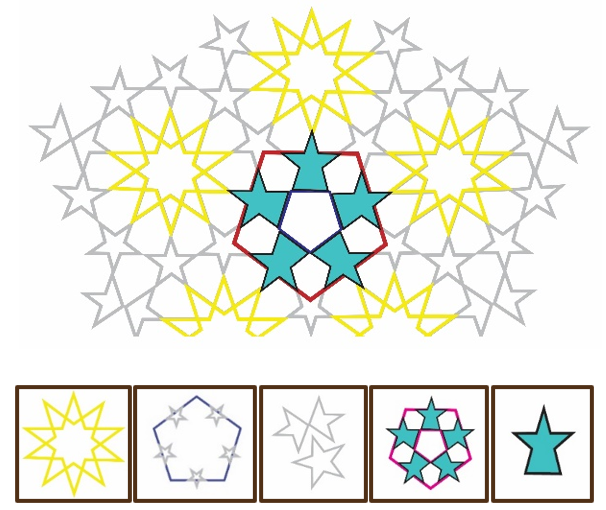
motifs, he/she depicted three main suns with a full motif consisting of a ten-pointed
star and a ten-pointed shamsa in its center and two suns with a half motif on the
lower left and right of the image. He also depicted the pentagram white shamsa or
stars (which is a metaphor of light and purity) in a state of rotation around them
with order, harmony, rhythm and symmetry. It shows the arrangement of the art of unique
and omnipotent creator in the material art of mystic artist (Fig. 2). Under the highest sun and in the central part, there is the image of the five stars
of a different form from the other star, six motifs combined with each other, exceeds
the multiplicity, and creates a larger pentagonal geometric motif in the whole unit
together.
Figure 2.Analysis of the bricklaying decorations of the southern wing design in the southwest
corner of the Taj Al-Molk dom
The total number of these motifs is 7 geometric forms, the combination of which with
five surrounding stars and the creation of another pentagon shows a geometric form
of 7 other motifs. It seems that this expression of unity in multiplicity can refer
to the holiness of the number seven in and the religion of Islam. These motifs can indicate the creation of the world in
six stages and its completion in the seventh stage of creation referring to verses
3 of Surah Yunus “Indeed your Lord is Allah, who created the heavens and the earth in six days, and
then settled on the Throne, directing the command” (in Arabic: إن رَبَكُمْ الئة الذي خلق السّمَاوَات والأزضن في ستة أيام ثم اسْتوَئ عَلى القزش شيدبتز
الأمر) The Qur'an also mentions the purposes of the creation of the sun in verses 5 of Surah
Yunus “It is He who made the sun a radiance” (in Arabic: هُوَ الَّذِي جَعَلَ الشَّمْسَ ضِيَاءً), in verse 97 of Surah al-An'am “It is He who made the stars for you” (in Arabic: وَهُوَ الَّذِي جَعَلَ لَكُمُ النُّجُوم), in verse 16 of Surah al-Nahl “and the landmarks [as well]—and by the stars they are guided” (in Arabic: ۚ وَبِالنَّجْمِ هُم يَهْتَدُو نَ وَعَلَامَاتٍ), and in verse 15-19 of Surah Nuh “Have you not seen how Allah has created the seven
heavens in layers, and has made therein the moon for a light and the sun for a lamp?...”
(in Arabic: أل تَرَؤا كَيْف خَلَقَ الله ستنع ستماؤات طباقا ؛ وجعل الْقَمَرَ فيهن نُورًا وَجَعَلَ
الّشن سِرَاجًا) Due to the value of its epistemological concepts, these motifs was placed by unity
in the center of the work and the suns were imagined around them in a dependent and
circular manner, as if they rotate freely around each other (Fig. 3).
Figure 3.Analysis of pattern, multiplicity in unity and seven geometric forms Source: Author
In some verses of the Holy Quran, God mentions the guiding role of the stars for human
beings in the darkness of the sea and land, and according to the abundance of star
designs in this design, they can be compared to the guiding star of Muslims. Star
motifs can also be a symbol of the Yemani star, which in the wisdoms of some Islamic
mystics is a symbol of the whole soul. (; ). According to Islamic mystics, shamsa or the sun is also a symbol of the light from
divine manifestations, the truth of God's light and the essence of oneness, which
also refers to unity, and it is a purification and simile of the rotation of the world
wheel, light, divine order and justice, as well as unity in multiplicity as the most
prominent position of unveiling of the soul. In this regard, Iranian Muslim artists
express the concept of unity in multiplicity and multiplicity in unity using this
design in many of their works. In some sources, shamsa is also used as a symbol of
prophet. (; ; ). On the other hand, the use of these two motifs in the decoration of this design
can be considered as a kind of obedience of the artist to the one Creator of the world,
who says: “Indeed We have adorned the lowest heaven with the finery of the stars” (). That is, where God used the stars to decorate the sky, the Seljuk artist also used
a star motif in his/her decorations in accordance with this tradition and the idea
of the holy. In other words, the motif of the Iranian star is a symbol of sun cross
because shamsa is most similar in appearance to the sun. (). It should be noted that the sun cross is one of the most ancient Iranian motifs
that have been used in the philosophy of Iranian Islamic artists in various forms
including the sun and the multi-pointed star after the Islamic period. “The motif
of shamsa is a symbol of light resulted from the manifestations of holiness and truth
of the light of God and oneness in the eyes of Islamic mystics and Sufis. According
to Sufis, since light is the consideration of the manifestation of the Truth and the
existence of the Truth in itself, the motifs of shamsa and star can be a simile of
this divine light which is considered as the foundation of mysticism and wisdom of
the East" (). The geometric motif of shamsa or pentagram star (five-pointed star) in the decoration
philosophy of this design refers to "sacred numbers and geometry" in the mind of the
Iranian-Islamic artist, which originates from his/her spiritual and religious beliefs
and has many meanings. For example, number 5 is usually associated with human life
and the five senses.
This number is involved in general astronomical processes. In ancient times, the solar
year was divided into 5 periods of 72 days, which later changed into a 365-day year.
In the Islamic tradition, in addition to the five pillars of the religion including
"Shahada, Salah (prayer), fasting, Zakat, Hajj," Muslims have five daily prayers.
Sharia (Islamic law) is divided into 5 categories: mandatory, recommended, neutral,
abhorred, and prohibited. During the times of war, booty is divided into 5 categories
to pay one-fifth of the acquired wealth (khums). Ahl al-Kisa, or the People of the Cloak, are the family member of Islamic prophet Muhammad; his
daughter Fatimah; his cousin and son-in-law Ali; and his two grandsons Hassan and
Husayn. They are also called Aal al-Aba (Arabic: ٱلْعَبَاء آلʾĀl al-ʿAbāʾ) and in Persian Panj-Tan (Persian: پنج تن), meaning 'the Five'. They were the most important Shiite personalities and highly
respected among Sunnis. No set of the mysterious letters (muqaṭṭaʿāt, Arabic: حُرُوف مُقَطَّعَاتḥurūf muqaṭṭaʿāt, "disjoined letters" or "disconnected letters") of the Holy Qur'an is more than five
letters (). The use of the geometric motif of the shamsa or the ten-pointed star in the decorations
of this design has the same characteristic of the sacredness of numbers and geometry.
In the book “The Brethren of Purity (Arabic: إخو ن الصفا,) romanized: Ikhwān Al-Ṣafā; also, The Brethren of Sincerity)”, the authorities of the kings has been mentioned ten times, for each of which there
are ten characteristics. Khajeh Abdullah Ansari has found ten verses for each of the
ten times of behaviour (Bakhtiar 1960, 97-102). As this design has been examined,
we have seen that the geometric motif of shamsa has a special place in its decorations
and different types including five-pointed and ten-pointed stars have been used extensively.
Considering the position of these motifs in this design, it can be inferred that this
method of decoration was not chosen randomly by the artist and did not have a purely
functional aspect of decoration and beauty, but its usage was rooted in deep doctrinal,
mystical, religious and figurative concepts of the idea of the holy, which had been
used in the form allegory (the combination of simile and purification) due to the
proportion of the motifs of shamsa and star with concepts such as the divinity of
the essence of the Almighty, light and sky (they have a special place in Islamic mysticism
and the idea of the holy). Since the concepts and the sacred mystical secrets hidden
in the numbers, along with the decoration of these geometric motifs, clarify further
their practical features in this design, so it can be called "sacred decoration" or "holy decoration". Because, according to Islamic mysticism and the idea of the holy, the whole creation
of God designed based on geometry. Therefore, these decorations can be considered
as an objective symbol of multiplicity in unity (a metaphorical attitude in the position
of multiplicity of attributes such as unity, order, justice, harmony, coordination
and balance, etc., with purification in the divinity of the essence of truth and the
state of manifestation of the unity of truth in a hierarchical manner). The Iranian
artist expresses the principle of connection between the material world and the world
of meaning by using these decorative motifs. Art work is nothing but something that
expresses this fact. Artist is a mystic who discovers the hijab and a world emerges
in his/her mind. Since traditional art is associated with the divine command, the
idea of the holy is hidden at the heart of this art, and like religion, it is both
truth and presence (). The emphasis on his/her monotheistic attitude has expressed by choosing geometric,
Islamic, imaginary motifs and the least use of human motifs and the unity of motifs
at one point. Emphasis on justice, as one of the foundations of aesthetics in Islamic
art and mathematics, was the same as the expression of justice in nature that manifests
the exact relations in nature. Therefore, showing the geometric order by using similarity
and repetition of the geometric and mathematical patterns, establishing a connection
between the whole and part to reach a whole unit, and creating a sense of calm shows
the artist's unity creation, unity and infinite manifestation in the decorations (purification
of God’s sacred essence). Order, symmetry and proportion, as one of the most important
infrastructures of the philosophy of sacred decoration and a unifying factor, are
the complements of centralism and emphasizes the axes that balance the space, make
the viewer happy, facilitate the understanding of beauty, and creates a static atmosphere.
It can be clearly stated that the artist uses the eternal pattern, not the tangible
forms, in these themes as if his/her phantasm (imaginal forms) join the apparitional
figure of the celestial world and manifests "unity in multiplicity and multiplicity in unity", which is manifested more in harmony in Iranian art (purified from oneness and glorification
of the essence of the Most Sacred). According to Islamic mysticism, it is the uniqueness
of the existence of God (; ).
ANALYSIS OF THE BRICKLAYING DECORATIONS OF THE NORTHERN WING DESIGN IN THE NORTHWEST
CORNER OF THE TAJ AL-MOLK DOME
One of the most beautiful decorations of the geometric brick decorations of this building
is engraved in the design of the north wing in the northwest corner of the dome by
a Seljuk artist, which has been formed with amazing harmony in the pieces of carved
bricks. It shows a spiritual and mystical view. This design reflects a kind of aesthetic
unity in this dome with its perfectionist rhythm, balance and proportions, as if represents
the embodiment of these elements in the creation of the world wonderfully. The motif
used in this design is "cross or crucifix" which is itself has a valuable place in the culture of Iranian and Islamic art and
has many concepts hidden behind its motif (Fig. 4).
Figure 4.Analysis of the bricklaying decorations of the northern wing design in the northwest
corner of the Taj al-Molk dome
Cruciform motifs are one of the beautiful motifs used before Islam and the Islamic
period. This motif is very simple, concise and abstract and has been used in pre-Islamic
times to decorate various arts. These motifs have a special place in the architectural
decorations of the Islamic period. The thoughtful artists of the Islamic era realized
the importance of symbolism and aesthetics of these motifs from the very beginning
and accordingly, by using them, they turned them into one of the main decorative elements
of the Islamic period. Cross or crucifix is a gentle word that is in the form of two
intersecting and perpendicular lines and in a complete and broken form. In the Islamic
period, it is a sign and position of unity and the manifestation of the four main
directions and angels overseeing the four seasons. In literature and Mysticism, it
is also a manifestation of nature and attributes of the Glory. Cross with four arms
and sometimes in combination with blessed names and prayers such as Allah, Muhammad
and Ali have been used for decorating the handicrafts of Iranians after Islam. On
nights, when the sky is clear, cloudless and dust-free, as we stare at the sky, we
see glimmering of stars in the form of a cross or Becrux (). Therefore, it can be acknowledged that the Seljuk artist depicted the idea of illuminating
the stars on his/her design and considered it as a metaphor of the supernatural world.
This motif consists of two equal-sized line segments that are perpendicular to each
other at their center points. These line segments do not emphasize on a specific direction
and do not create a feeling of stretching in a specific direction. But most of all,
their intersection is intended (). In fact, it has a center and four axes (five parts) and four corner spaces are
also involved in its formation. Therefore, the numbers that come out of it are 4 (four
directions or the same axes of the cross), 5 (four axes of the cross plus the center
of the cross) and 9 (center sign, four main axes and four corners) which is called
the nine-part pattern of the cross. Finally, the design motifs are taken from numbers
that have found their way to the objective domain. In Islamic thought, the four arms
of the cross are similes and symbols of: the four pillars of the universe, integrity,
universality, earth, order, evolution, size, four seasons, justice, main directions
(the peak of this feature is in the four corners of the Kaaba), the existence of the
four elements of water, earth, air and fire (all of which are darkness and a person
is under these darkness and when he/she appeals to the Truth, he/she can get rid of
it) (), introduction of the four veils in Islam (world, soul, the people and the devil),
the light of knowledge will not enter the heart until these four veils are taken from
the heart, and whoever removes these four veils, take Taharat or Ghusl (Islamic ritual bath of the whole body from the head to the feet) and is in permanent
purity or Taharat ().
There are 4 obligatory prostrations in the Qur'an, mentioning the name of the Prophet
as the last messenger of God 4 times in the Qur'an, beginning 4 chapters in the Qur'an
with the command "Qul" (in Arabic: قُل) means say, and so on. In fact, the artist borrowed the crucifix pattern. He/she
has used it to enumerate the divine attributes. It seems that the science of geometry
is a powerful tool in the hands of Muslim artists who, by using similes and purification,
create proportions, balance and harmony, beauty and order of the Creator's creation
in his/her art, which shows the belief in the sanctity of his/her art and the choice
of a symbolic language with spiritual characteristics to create his/her work. Geometrically,
the cross is the creator of the circle, or sphere, which is the most perfect shape
and a symbol of the lightness and general mobility of the soul of the shapes (). Cross that points to the four corners of the world symbolizes “great peace”, brotherhood
and unity among all the people around the world (). It unites all these meanings in its center. The selection of those meanings has
appeared in the form of a goal by the Seljuk artist in accordance with the motif of
this design. The correlation of the bricklaying motifs of this design with the concepts
of simile and purification induces and evokes the intrinsic meanings (oneness), attributes
(the Glory, the Beauty and the Great), the Acts of God (justice and balance) and various
aspects of monotheism that cause the sanctification of forms of these patterns. Because
"it is not possible to reflect the various aspects of monotheism, except through the
absurding (impossibility) or transformation of the parts in a whole, multiplicity
in unity, and consequently the reference to monotheism."
The central point of the cross also has superior semantic features alone. At this
point all contradictions are resolved. This point is equal to the divine position
and in the term of Islamic mysticism, this divine position is achieved through the
community and unity of opposing elements. This center is the intersection of the greater
and the lesser worlds, the point of settlement and compromise, the source of departure
and return, and the intersection of the two horizontal and vertical axes (corporal
and spiritual, material and spiritual). The movement from the center to the circumference
of the circle is the manifestation of the journey in the world of determination and
diversity, while the movement towards the center is spiritual and a symbol of absolute
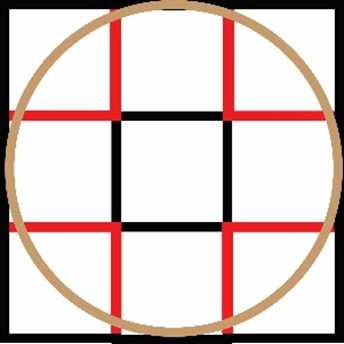
unity (). According to Titus Burckhardt, the crucifix implies the concept of the circle-
rotation imagination of the sun in its original form. This design is dynamic octagon
in geometry created from the center, forming a cross between a square encompassed
or engraved in a circle. (Fig. 5).
Figure 5.Analysis of a nine-part cross pattern among a square encompassed or engraved in a
circle Source: Author
Ardalan also states that the cross has a nine-part pattern like magic circle. Magic
circle is between the action of a circle and a square, and while it begins with unity,
it moves through manifestation and returns to unity. It is a cosmic design that is
represented in various ways throughout human cultures. In Islam, the concept of magic
circle refers to a simile of divine names and attributes. In his description of the
Ascension, the Prophet mentions a huge pearl dome that was placed on a square with
four columns in the corner, and on these four pillars, four-squared symbol of Quran
"In the name of God, the Most Merciful, the Most Compassionate" was written and four streams of blessings flowed from it. The dome was located on
a square and its border was octagonal, the symbol of the eight angels, the word of
the throne. This Magic circle is a symbol of celestial garden (RozeRezvan) and a transcendental relationship with the Quranic verse 3 of Sura al-Hadid "He is the First and the Last, the Manifest and the Hidden, and He has knowledge of
all things" ().
In general, one of the most important features of the brickwork decorations of these
two patterns is the use of the elements of order, proportion, balance, symmetry, rhythm
and harmony, which, in Islamic art, are dimensions that express the invocation of
mystical behavior of the artist. It reminds passing from multiplicity to unity and
unity to multiplicity. As Ibn Arabi has described it in this way in his book “Alfotohat Al-makiyeh”, “Existence, which is the Reality (God), in the sense that it is itself, is neither
whole, nor part, nor general, nor specific, nor unique in unity beyond its essence,
nor multiplicity, but according to levels and authorities, these things accompanies
it. This existence becomes absolute, constrained, whole, part, general, specific,
unique and plural, without any change in its essence and reality” (Ibn Arabi, 1914:
4). The geometric patterns of these patterns also include the concepts and evaluations
of positive, negative and symmetrical space which is the consensus of simile and purification
of the attributes of God's justice and equality, and none of them has superiority
over the other and shows the basis of its monotheistic and purposeful thoughts. The
holy light and the divine ray equally shine the whole universe and the creatures.
Burckhardt says that "the balance and proportion of the decorations in a building
is a reflection of the unity and harmony of the divine life-giving ray on the creatures."
(). The concept of symmetry compared to other decorative elements of Islamic art and
architecture has a very prominent place in these two patterns and its function refers
to the mirror aesthetics in Islamic architecture and symbolizes eternity and infinity
by repeating symmetrical designs and shows a sense of harmony, balance and unity (Papadopoulo,
1989: 62). Mulla Sadra says: "All the entities (essences) are the mirrors of the existence
of the Supreme Being and the places of the Self-Discloser manifestation of His holy
truth, and the nature of each mirror, because it is a mirror, shows the form which
has manifested in it" (). According to Nasr, in the sacred architecture of Islam, unity indirectly fills
the presence in the architectural spaces and places human as the successor of God
directly in the presence of the Glory of Oneness. (). It seems that the use of simile and purification in the decorations of this design
can be a strong proof of the relative presence between the consensus of the two in
the philosophy of decoration in the mind of the Seljuk artist who used and manifested
them to achieve his/her goal. It is believed that by using it, the artist turns the
divine manifestation into a center of spirituality and value by bringing divine names
and attributes in the light of spiritual and sacred dimensions. He/she imagines a
material form for God that carries a moral, doctrinal and mystical structure. According
to Burckhardt, the origin of the beauty of objects is the attributes of divine beauty
and perfection, and Islamic art is essentially a manifestation of general truth. An
object is perfect or beautiful to the extent that it reflects one of the divine attributes
with the help of simile. " we cannot recognize perfection in anything unless we know
how that thing can be the mirror of the manifestation of God (metaphorical attitude)".
Mulla Sadra considers the attributes of God the same as His essence and no attribute.
There is no existential distinction from another attribute, rather, all, while having
a conceptual distinction, have an existential unity. That is, His essence has no existential
distinction from attributes. In such a way that each of them is a separate person
and also no attribute has an existential distinction from the other attribute, but
all of them, while having a conceptual distinction, have existential unity () (Consensus of metaphorical and purified attitude). Ibn Sina's words in the seventh
book of “Shafa” also emphasize that "everything possible is composed of being and nature". It can
certainty be stated that the Seljuk artist, trying to use the consensus of metaphorical
and purified attitude and the relative superiority of purification to simile, has
used multiplicity of motifs in the manifestation and emergence of the principle of
the Necessary Existence in unity. It indicates the manifestation of divine truth in
the form of one of divine names; Its most important theoretical basis is the theory
of belief in the fundamentality of existence and ideality of quiddity (Meysamy, 2018: 37 and 38; ). Therefore, the decorations of these two patterns indicate that the artist was inspired
by the Holy Quran and influenced by his/her religion and beliefs. Since the most important
spiritual principle in the Qur'an is monotheism, considering the single worldview,
he/she has established his/her relationship with his/her art in the purified attitude
of the decorative motifs of this dome based on monotheism, gives exoteric form to
the philosophy of unity in multiplicity and multiplicity in unity as one of the main
foundations of the rich Islamic art culture and combines with his/her art, finds a
decorative and purposeful nature, knows that the basis of his/her existence is to
move towards the one divine essence and the principle of monotheism, tries to show
the divine attributes and truth in the brick by brick of this dome using decipherment
and purified attitude and gives the philosophy of decoration an apparent meaning.
The relation of simile and purification with the philosophy of decoration in geometric
motifs
Balance, harmony, symmetry, justice, order to manifest the divine essence and create
material and spiritual beauty (Purified attitude)
Manifestation of the status of unity of the essence of truth in the form of ranks
or levels, discovery of beloved and finding the origin of creation to measure oneself
(Purified attitude)
Personality development of artist, closeness to the one God and the creation of the
levels of divine existence (Purified attitude)
Presenting the glory of the Absolute Truth and the beauties of nature, that is the
sacred material existence and the sanctification of the material world, which is immortalized
in Iranian Islamic art (metaphorical attitude)
Manifestation of the attributes, names and words of God in material forms, give originality
to schemas, denying any chaos and desire for abstraction based on special worldview
of Iranian-Islamic artist (metaphorical attitude)
Following mathematical principles in proportions and revealing the sanctity of material
forms in art with the help of geometry and the symbol of the holiness of spirituality,
creating multiplicity in unity and unity in multiplicity (metaphorical attitude)
Table 1Results of the study of the relation of simile and purification with the philosophy
of sacred decoration in geometric motifs
CONCLUSIONS
“The idea of the holy” is a celestial origin, and visual art is a form of this origin that is experienced
as a symbolic language of the artist's spiritual beliefs in material form. "Simile and purification" is one of the concepts in theology and mysticism. As an approach in theoretical mysticism,
these two concepts have led to the formation of a language in Iranian art based on
sanctity and monotheism and is inspired by Islamic sources such as monotheism, justice
and so on, to which the aesthetics of Islamic art is focused. Since the secret of
purification is in the inner name of the Truth and the secret of simile is the properties
of the exoteric name of the Truth, so the decline of the Truth from the inner and
the forms of the world is not possible. Since this concept is most explicitly expressed
in the Qur'an, the Muslim artist imitates the spiritual concepts of Islamic law and
the Qur'an to create a work of art. In Ibn Arabi's view, the Qur'an and the Islamic
attitude are the result of a consensus of metaphorical and purified concepts; Therefore,
it can be concluded that Iranian Islamic art is also a special language of truth that
is rooted in the theoretical foundations of his/her wisdom, and in the field of the
artist's action, it becomes an expressive expression to represent the two-dimensional
world in the appearance of a single light that manifests the truths by divine creation.
Simile is the basis of all imaginal forms in art; therefore, the essence of God is
manifested in forms by metaphor, trope, and personification. Purification means pure
and refined in which all creatures are placed in a longitudinal relation to God and
become god-like and purified in the course of evolution to reach the whole God. If
the artist is always present and observant in his/her work, he/she tries to use the
phenomena of the universe in allegorical and cryptic language in connection with the
origin of the universe in order to express the truths of the spiritual world in the
hierarchy of existence and divine manifestation. The allegory of this word in the
mystical attitude is like a drop to reach the sea and move from the multiplicity of
the possible world to the unity of truth. Therefore, his/her art is sacred and the
manifestations of its motifs are embodied far from the laws of the material world.
According to the metaphorical attitude, his/her insight originates from the beauties
of creation and what is superior to him/her becomes the purified attitude and the
content of the work, which has linked to the metaphorical attitude in the material
world and is manifested in the consensus of the two allegorically. Nasr states that
art is the result of opening the eyes of the artist and reaching the status of intuition
(). The relationship between the discovery and intuition of the artist is revealed
and his/her art is transformed into an esoteric interpretation or beloved discovery
(transition from outward to inward). In explaining the concepts of simile and purification,
unity is manifested in multiplicity, and the infinite forms and images of world returns
multiplicity to divine truth. Therefore, art, based on the special epistemological
and ontological foundations of the artist, like Ibn Arabi's view, while confirming
the appearance of verses that prove the corporal attributes of God, never limited
the essence of truth to these attributes and aspects of hidden imperfection and possibility.
Rather, he/she tries to combine the metaphorical attitude in the position of the multiplicity
of names and attributes with the purification in the position of the unity of the
essence of truth, in the form of manifestation in his/her art.
In fact, in the philosophy of decoration, simile and purification is an esoteric approach
and manifestation of the spiritual world in Iranian Islamic art, which is manifested
in the form of decorative motifs and material domain. They express the true essence
and always try to connect the material world to the world of idea. Satisfaction of
the inner desire of the artist is based on the discovery and intuition of connecting
with the sacred domain of the Divinity. Beautiful geometric appearance in the decorations
of Islamic Iranian art motifs are manifested by repeating and merging motifs such
as shamsa, stars, etc. apart from material beauty, mystical expression, spirituality
and holiness in these pure forms with the help of homogenity, repeating geometric
and mathematical patterns, establishment of a connection between the whole and the
part in reaching a single whole of "unity in multiplicity and multiplicity in unity",
creating a feeling of peace, unity and infinite manifestation of the artist (to represent
purified attitude of oneness and purity of the essence of the Most Sacred, that is
manifested in Iranian art in harmony and coordination. According to Islamic mysticism,
it is the monopoly of the existence of God, which includes all other things in terms
of goal and encompassing, and there is nothing beyond His control, and all is in color
and a manifestation of God Himself. Because language is incapable of describing Him,
the artist uses allegorical language (simile and purification) in the decorative forms
of his/her philosophy. This language is the best means of communicating the fundamental
truths of the divine essence and is a gateway from the divine presence through which
the earthly human enters into his/her inner journey and removes the veil of these
material forms to bring the divine light and holy spirituality into his/her existence.
He/She faces the greatness and unity of God, and his/her art be a re-creation of the
truths that are the abrogation of creation. Therefore, with the studied example, what
is proved is that the Iranian Islamic artist is placed as a mediator between the sacred
art and the audience, who make the means of developing divine grace in the body of
the material world possible by spiritual growth and acquiring moral virtues with the
help of simile and purification. By gaining knowledge of the truth and the idea of
the holy from the universe, he/she restore the holiness in the course of divine wisdom
in his/her art using the philosophy of sacred decoration. Since "decoration" means
purification and separation of the individual from his/her individuality and "simile
and purification", as a mystical approach, has led to the formation of a special language
in the structure of Islamic Iranian art; Therefore, in the philosophy of decoration,
the mystic artist has used this philosophy as a tool to manifest the beauty of God
in forms through the embodiment of unity and his/her immediate and intuitive perception
of his/her inner journey, without relying only on material concepts or aesthetic perception,
but, in order to manifest the idea of the holy, he/she pretends with symbolism and
irony in simile and purification, and decodes and expresses the most exalted truths
of creation and the objective concept of true unity in a mental state, in material,
abstract and geometric motifs to be understood by all. In all its aspects, his/her
art is based on the monotheism of wisdom and on the grace emitted by the speech of
revelation. In fact, in his/her art, the Iranian-Islamic artist combines the two principles
of beauty and spirituality with "simile and purification" in the "philosophy of sacred decoration" and manifests the "sacred art".
REFERENCES
1
Akhgar, Majid, Fani and Baghi (Critical Introduction to the Study of Iranian Painting), Artist Profession, 2012.
2
Ansari, Khawaja Abdullah, Kashfal-Asrar wa 'Iddat al-Abrar, Assisted by Ali Asghar Hekmat, Tehran: Amirkabir, 1964.
3
Ansari, Mojtaba. Decoration in Iranian Architecture and Art (Islamic Period with Emphasis on Mosques), Art Lecturer Magazine, 1(1), p. 59- 71, 2002.
4
Ardalan, Nader and Bakhtiar, Laleh, Sense of unity; Mystical tradition in Iranian architecture, translated by Hamid Shahrokh, Isfahan:
Khak, 2001.
5
Ardestani Rostami, Hamid Reza, Purification and simile construction of the knowledge of God in the preface of Shahnameh. Textual critisism of Persian Literature, NO. 33 (1), p. 91- 106, 2017.
6
Avani, Gholamreza, Spiritual Wisdom and Art, Tehran: Geros, 1996.
7
Baghdadi, Abdul Qahir, The difference between the differences, research by Muḥyiddin Abdul Hamid, Beirut: Dar al-Ma'rifah, 1982.
8
Bakhtortash, Nusratullah, Gardune Khorshid ya Garduna Mehr, Atai, Tehran, 1977.
9
Bani Ardalan, Ismail MajaleMahm, Sore Mehr, 2012.
10
Bolkhari Ghahi, Hassan, Mystical Principles of Islamic Art and Architecture. Tehran: Islamic Advertisement Organization of Soureh Mehr Art Center, 2011.
11
Burckhardt, Titus, Sacred Art, Translated by Mohammad Avini, Tehran: Barg, 1991.
12
Cattelli, Margarita and Hambis, Louis, Seljuk and Kharazmi art. Jacob Azand. Tehran: Molly Publication,1997.
13
Elias, Jamal, Treatise of Sheikh Ala ud-Daula Simnani, Religious Thought, No. 13(1), p. 3-26, 1996.
14
Esfandiari, Apena, Swastika The Symbol of Universal Man. Journal of RESEARCH ON CULTURE AND ART, 1, p. 5-19, 2009.
15
Fahimifar, Asghar, A Study of the Theories of Art Creation and Their Relation to Inspiration, Intuition
and Truth. Art Quarterly, 70, p. 108- 117, 2006.
16
Fahimifar, Asghar, Searching in the Aesthetics of Islamic Art. Tehran: Culture and Art. No. 2, p. 73- 82, 2009.
17
Ghaem, Gisoo, The Message of Cross Motif on Potsherds. Journal of Soffe. 19(1-2), p. 31-46, 2010.
18
Goharin, Seyed Sadegh, Description of Sufi Terms, Volume 3, First Edition, Tehran:
Zavar, 1989.
19
Guénon, René, Lings, Martin, Burckhardt, Titus, Hermes and the language of mysticism. Amin Aslani. Tehran: Jeyhoon, 2007.
20
Hekmat, Nasrullah, Wisdom and Art in Ibn Arabi’s Mysticism, Tehran, Academy of Arts, 2010.
Hosseini, Seyed Hashem, Decorative and Conceptual Application of the Sun in Sheikh
Safiuddin Ardabili Collection, Quarterly Journal of Islamic Art Studies. No. 14, p.
7-24, 2011.
23
Ibn Arabi, Mohammad Ibn Ali, Fusus Al-Hakam, translated and edited by Mohammad Ali Movahed and Samad Movahed, first edition,
Tehran, Karnameh, 2006.
24
Ibn Arabi, Mohammad Ibn Ali, Fusus Al-Hakam, translated by Mohammad Khajavi, first edition, Tehran, Molly, 2008.
25
Ibn Arabi, Mohammad Ibn Ali, Fusus Al-Hakam, translated by Ali Shalchian Nazer, first edition, Tehran: Elham, 2014.
26
Khayat, Abdolrahim ibn Mohammad, Al-entesar va Al-rad Ali ibn Al-ravandi Al-molhed, volume 1, Beirut, 1975.
27
Khazaee, Mohammad, The motif of the lion shown Imam Ali (as), Book of the Month of Art, No. 31-32, p. 37-39,2001.
28
Kiani, Muhammad Yusuf, History of Iranian Architecture in the Islamic Period. Tehran: Samat, 2000.
29
Laleh. Bakhtiar, Sufi. London: Thames and Hudson, 1960.
30
Mahdavi Nejad, Mohammad Javad, Islamic Art in the Challenge of Contemporary Concepts and New Horizons, Journal of Fine Arts, No. 12, p. 2-2, 2002.
31
Masaeli, Sedigheh, Hidden map as an achievement of religious beliefs in traditional Iranian desert housing. Fine Arts, No. 3, p. 27-8, 2009.
32
Moradi Nasab, Hossein; Bemanian, Mohammad Reza; Etesam, Iraj, Re-reading the purification and simile idea in the architectural body of Isfahan school
mosques (Case study; Imam Mosque of Isfahan), Identity of the city, 12 (2), p. 19-28, 2018.
33
Mulla Sadra, Sadr al-Din Mohammad Shirazi, The Transcendent Philosophy of the Four
Journeys of the Intellect. 3 vols. Beirut: Heritage Foundation, 1981.
34
Mulla Sadra, Sadr al-Din Mohammad Shirazi, The Transcendent Philosophy of the Four
Journeys of the Intellect. Volume II. Tehran: Sadra Islamic Wisdom Foundation Publishing,
2001.
35
Nasr, Sayed Hossein, Islamic Tradition in Iranian Architecture in Immortality and Art. Sayed Mohammad Avini, Tehran: Barg, 1991.
36
Nasr, Sayed Hossein, The Need for Sacred Science. Translated by Hossein Miandari. Tehran: Taha Cultural Institute, 2000.
37
Nasr, Sayed Hossein, Knowledge and the Idea of the Holy, Translated by Farzad Haji Mirzaei. Tehran: Farzan, 2001.
38
Nasr, Seyed Hossein Ideals and Realities of Islam, translated by Shahabuddin Abbasi, Sahrwardi Research and Publication Office, 2004.
Rahnavard, Zahra, The Wisdom of Islamic Art. Tehran: Samat, 1999.
41
Rasekh Talkhdash, Roghayeh, Manifestation of Holy Imagination in Pottery and Ceramic Motifs of the Islamic Era, Naghshmayeh Magazine, First Year, No. 2, p. 61- 74, 2008.
42
Rezaei, E, Relfection on the Fundamental Thoughts behind the Construction of Four-Porch
Mosques the Architecture of Saljuqi Dynasty. Journal of Kimia ye Honar. 2(7), p. 97-104, 2013.
43
Sadri, Minayi, Form and meaning in religious art. Book of the Month of Art, No. 125, p. 68-75, 2008.
44
Saffari Ahmadabad, Somayeh; Ismail Bani, Ardalan; Sharifzadeh, Mohammad Reza; Dadashi,
Iraj, A study of the concept of simile and purification from the point of view of
Muḥyiddin Ibn Arabi and its adaptation to the painting space of Iran (9th and 10th
centuries AH), Tehran: Journal of Islamic Art Studies, No. 2, p. 90-115, 2018.
45
Sajjadi, Seyed Jafar, Dictionary of Mystical Terms and Expressions, Tehran: Tahoori, 1991.
46
Schimmel, Annemarie, The Secret of Numbers, translated by Fatemeh Tawfiqi, Qom: University of Religions and Denominations, 2009.
47
Schuon, Frithjof, Basics of Spiritual Art, Tehran: Islamic Advertisement Organization Art Center, 1993.
48
Shahrestani, Mohammad bin Abdul Karim, 1986. Al-malal va Al-nahl, Volume One, Beirut,
Mohammad Seyed Kilani.
49
The holy Quran.
50
Yasini, Seyedeh Razieh, The evolution of Islamic iconography in Iran from purification to simile, Tehran: Negareh Magazine, No. 38, p.4-22, 2016.
Notes
[1] Alī ibn Muḥammad ibn al-ʿArabī al-Ḥātimī al-Ṭā’ī (1165 – 1240), nicknamed "Ibn Arabi",
"Muḥyiddin" and "al-Shaykh al-Akbar"; He is a prominent mystic of the Islamic world.