The study examined the influence of knowledge management practices on various operational performance constructs, including product and service quality, cost management, and delivery speed, among SMEs in Nigeria. A descriptive research design was employed to collect data from a stratified sample of 393 SME respondents across various sectors via structured questionnaires. Data analysis was done using Partial Least Squares Structural Equation Modeling (PLS-SEM). Results reveal that knowledge application (β = 0.175, t = 2.531, p < 0.05) and knowledge sharing (β = 0.221, t = 3.169, p < 0.05) have a positive and significant influence on product and service quality. Knowledge capturing (β = 0.110), storing (β = 0.125), and creation (β = -0.031) were all insignificant. For cost management, knowledge capturing was the only significant one (β = 0.163, t = 2.012, p < 0.05). In contrast, knowledge application (β = 0.190), sharing (β = 0.169), and storing (β = 0.154) were all found to have a positive and significant impact on delivery speed. The results emphasise the strategic need for knowledge application, sharing, and storage to enhance the operational performance of SMEs. This study also encourages further investigation into other factors that affect the cost efficiency of SMEs in emerging economies.
Keywords:
Knowledge management practices, Operational performance, SMEs, Service and product quality, Cost management, Delivery speed
Odesola, Adebisi, Adetan, Rahamon, and Oladimeji-Araoye: Exploring the Link between Knowledge Management Practices and Operational Performance:
Empirical Evidence from Nigerian SMEs
1. Introduction
Small and Medium-sized Enterprises (SMEs) represent the bedrock of most economies.
However, they persistently face a fundamental performance paradox: they are crucial
for economic dynamism but operate under severe resource and capability constraints.
In Nigeria, this paradox is acute. SMEs contribute nearly half of the national GDP
and employ over three-quarters of the workforce (NBS, 2019), yet their failure rate
remains alarmingly high. Traditional strategies for competitive advantage, often reliant
on financial capital and economies of scale, are frequently inaccessible to them.
This reality forces a critical re-evaluation of the sources of sustainable performance,
shifting the focus from tangible to intangible assets.
In this landscape, the effective management of knowledge is posited as a critical
differentiator. Grounded in the Knowledge-Based View (KBV) of the firm, which conceptualizes
knowledge as the primary resource for sustainable competitive advantage (), and complemented by Dynamic Capabilities theory, which explains how firms reconfigure
resources to address rapidly changing environments (), Knowledge Management Practices (KMPs) offer a pathway to operational excellence.
For SMEs, superior operational performance, as manifested in enhanced product quality,
cost efficiency, delivery speed, and process flexibility (), is not merely a strategic goal but a prerequisite for survival. KMPs, the structured
processes of knowledge acquisition, sharing, storage, and application, constitute
a dynamic capability that allows SMEs to optimize their limited resources, innovate
processes, and navigate the volatile markets characteristic of emerging economies.
While the theoretical link between KMP and performance is well-established in the
context of large corporations, its empirical validation within the SME sector, particularly
in emerging economies, remains fragmented and inconclusive. A review of the extant
literature reveals three critical disjunctures. First, a significant theoretical-empirical
misalignment exists. While KBV provides a robust foundation, many empirical studies
in SME contexts are either atheoretical or employ multiple mediating variables that
obscure the direct mechanisms linking KMP to operational outcomes (e.g., ; ). It dilutes the understanding of how specific practices directly translate into
tangible operational improvements, such as faster delivery or lower costs. Second,
there is a pronounced contextual gap. Seminal findings from studies on IT firms (), the public sector (), or service corporations in Saudi Arabia () are of limited applicability to the typical SME. The unique structural, cultural,
and resource realities of SMEs, such as flatter hierarchies, reliance on tacit knowledge,
and acute resource scarcity, create a distinct context that moderates the effectiveness
of KMPs.
Furthermore, the specific institutional voids and competitive intensity of emerging
economies, such as Nigeria, remain critically underexplored. Third, and most pertinent
to this study, is a methodological and focus gap. Prior research is often hampered
by limited generalizability due to small, non-representative samples () or a reliance on descriptive statistics that preclude causal inference (). Moreover, many studies conflate operational performance with broad financial or
overall organisational performance (e.g., ; ), failing to provide the granular, actionable insights into the levers of operational
efficiency that SME managers desperately need. It leaves a clear void: a rigorous,
contextually grounded, and operationally focused examination of the KMP-performance
nexus in SMEs.
This study aims to address these gaps by answering the following research question:
To what extent, and through what specific mechanisms, do knowledge management practices
directly impact the operational performance of SMEs in an emerging economy? Our work
makes several distinct contributions that advance the field. First, in terms of theoretical
precision, we return to the core tenets of the Knowledge-Based View to establish a
parsimonious model that tests the direct effects of key KMP dimensions such as acquisition,
sharing, storage, and application on specific operational performance metrics. It
provides a clearer theoretical line of sight from practice to outcome. Second, by
focusing exclusively on Nigerian SMEs, we ground our investigation in a high-stakes,
under-researched environment, offering evidence that is both locally relevant and
theoretically informative for other emerging economies. Third, regarding methodological
rigor, we employ a robust, mixed-methods approach, combining a sizable, stratified
random sample with advanced variance-based structural equation modelling (PLS-SEM).
It allows us to model complex relationships with greater statistical power and predictive
accuracy, thereby overcoming the methodological limitations of prior studies. Finally,
in terms of actionable insights, by disaggregating operational performance into its
core components — such as quality, cost, delivery, and flexibility — we move beyond
generic performance claims. Our findings will provide SME managers with a precise
blueprint for prioritizing KMP investments that yield the most significant operational
returns.
In the sections that follow, we detail our theoretical framework and hypotheses, methodology,
and results. We conclude by discussing the implications of our findings for both theory
and practice, and by outlining a trajectory for future research that aims to further
unlock the performance potential of SMEs through strategic knowledge management.
2. Literature Review
2.1. Conceptual Review
2.1.1. Knowledge Management Practices (KMP)
Knowledge Management Practices (KMP) encompass the systematic processes through which
organizations create, store, share, and apply knowledge to improve decision-making
and performance outcomes (). These practices are typically categorized into knowledge acquisition, knowledge
sharing, knowledge storage, and knowledge application ().
Knowledge acquisition involves sourcing knowledge from internal expertise, external
markets, and technological innovations ().
Knowledge sharing enables the dissemination of knowledge across teams and departments,
fostering collaboration and efficiency (; ).
Knowledge storage preserves organizational knowledge in databases, manuals, and collective
memory for future retrieval ().
Knowledge application translates knowledge into actionable strategies that optimize
operations and drive business outcomes ().
Through these dimensions, KMP contribute to building dynamic capabilities that allow
firms to adapt to changing environments. For SMEs, KMPs are especially critical, as
they help overcome resource constraints by enhancing responsiveness, innovation, and
resilience.
2.1.2. Operational Performance
Operational performance refers to a firm's ability to effectively utilize resources
to meet customer expectations and achieve its strategic goals. It is commonly measured
by product quality, cost efficiency, flexibility, and delivery speed (; ; ).
Product quality reflects the consistency and reliability of outputs (; ; ).
Cost efficiency measures the minimization of operational costs without compromising
output quality (; ; ).
Flexibility encompasses the ability to adapt to market or technological changes (; ; ).
KMP provides the knowledge resources that directly support these performance dimensions.
Firms that integrate knowledge effectively are more capable of reducing inefficiencies,
enhancing workflow processes, and improving responsiveness to dynamic market demands.
2.2. Empirical Review
A growing body of literature has examined the relationship between KMP and performance
outcomes, though with varying emphasis and methodological rigor. The Knowledge-Based
View (KBV) posits that knowledge is a critical organizational resource for achieving
a competitive advantage (). Empirical studies show that knowledge sharing improves innovation, decision-making,
and cost efficiency, thereby strengthening operational performance (; ). Knowledge acquisition and application are found to enhance firms’ adaptability
to market fluctuations, sustaining competitiveness and performance (). In manufacturing contexts, KMP have been linked to improved product quality and
process efficiency (Liao & Wu, 2010). In service firms, they support customer responsiveness
and service delivery (Kianto, Vanhala, & Heilmann, 2016). Evidence from SMEs highlights
the role of KMP in enabling flexibility and innovation despite limited resources (Alegre,
Sengupta, & Lapiedra, 2013). Studies in emerging economies further suggest that knowledge
practices are vital for operational resilience, particularly when firms face unstable
institutional and market environments (Nguyen, 2010; Kamukama, Ahiauzu, & Ntayi, 2011).
Nonetheless, gaps persist. First, many prior studies emphasize financial or strategic
outcomes (e.g., profitability, competitiveness) rather than direct operational indicators.
Second, reliance on secondary data and small sample sizes constrains the generalizability
of findings. Third, industry concentration in high-tech or manufacturing sectors often
limits insights into SMEs in diverse contexts, such as developing economies. Finally,
while some studies reference dynamic capabilities, few explicitly integrate this perspective
in explaining how KMP translates into operational performance under resource constraints.
These gaps underscore the need for focused inquiry into how KMP influence operational
performance in SMEs, particularly within emerging economies such as Nigeria, where
firms face environmental turbulence and resource limitations.
3. Hypothesis Development
3.1. Knowledge Management Practices (KMPs) and Quality of Services and Products
Knowledge management practices (KMPs) help improve service and product quality among
SMEs. A host of studies indicates that KMP significantly enhances organisational performance
in terms of service and product quality. Dimensions of KMPs, such as capturing, storing,
sharing, creating, and applying, are very significant contributors to the enhancement
of organisational performance and ultimately towards the quality of services and products
(; ; ). KMPs have also been shown to impact innovation and performance enhancement by improving
the quality of products and services (; ; ). Synergising KMP with TQM has also shown a direct and positive influence on the
performance of organisations in terms of increasing the quality of products and services
(). KMPs lead to gains in operational performance that also benefit the quality of
products and services (; ). The totality of these studies presents a strong argument that KMP is a key driver
of improved service and product quality for SMEs. Therefore, we hypothesize that:
H1: Knowledge Management Practices (KMPs) have a positive influence on the Service and
Product Quality of SMEs.
3.2. Knowledge Management Practices (KMPs) and Cost Management
The literature review suggests that effective knowledge management facilitates cost
control and cost-saving measures in organisational working processes, particularly
among SMEs. Findings from various studies have established that KMPs, such as knowledge
capturing, storing, sharing, creation, and application, help organisations to eliminate
inefficiencies in their operations, thereby reducing costs and improving their cost
management (). Similarly, some researchers have identified the impact of knowledge management
processes in companies belonging to the service sector on the more effective allocation
of resources and cost reduction (). KMPs would lead to improved organisational performance through process improvement
and decision-making that can be applied to cost management strategies (; ). Furthermore, scholars have acknowledged the positive impact of KMPs on the effectiveness
of operations and cost management in other industries, such as mobile service firms
() and the technology sector (). Linking KMPs with Total Quality Management has been invaluable in enhancing operational
effectiveness and cost management (). Similarly, other researchers have also found that the implementation of KMPs in
manufacturing firms leads to the optimisation of resources, minimisation of waste,
and better cost management (). Hence, these studies collectively affirm that KMPs significantly enhance cost management
capabilities in SMEs by promoting knowledge sharing, improving decision-making processes,
and streamlining operational procedures. Thus, this study hypothesises that:
H2: Knowledge Management Practices (KMPs) exert a positive influence on the cost management
of SMEs.
3.3. Knowledge Management Practices and Delivery Speed
Multiple studies support the notion that KMPs increase organisational responsiveness
and operational power, which are critical to enhancing delivery speed. KMPs encompass
knowledge integration and knowledge capturing, as well as knowledge creation and knowledge
sharing, which streamline processes, enabling a quick response to customer demands
and reducing lead times, thereby enhancing delivery speed (; ). Research in the service industry confirmed the systematic roles of KMPs in increasing
the overall delivery speed in these organisations while also satisfying customer expectations
(). KMPs, which promote knowledge sharing and collaboration, are suggested to reduce
any delays during decision-making processes and enhance response time for speedy deliveries
(). Further findings revealed that KMPs drive operational speed across different industries,
such as the fast provision of services in mobile service industries () and technology-based companies (). The integration of KMPs with TQM has improved organisational agility, resulting
in faster product development and service delivery (). Besides that, studies have confirmed the importance of KMPs in enabling manufacturing
companies to respond to changes in demand patterns quickly, thereby improving delivery
times (). The outcomes of the studies provide conclusive evidence for the hypothesis that
KMPs enhance delivery speed for SMEs by improving operational efficiency, affording
faster decision-making, and enhancing communication. It is, therefore, hypothesised
that:
H3: Knowledge Management Practices (KMPs) have a positive influence on the delivery
speed of SMEs.
4. Methodology
4.1. Research Design
This study employed a quantitative, cross-sectional survey design to examine the relationships
between knowledge management practices and the operational performance of SMEs. This
design is appropriate for testing hypothesized relationships between latent constructs
across a sample at a single point in time (Creswell, 2014). The study utilized Partial
Least Squares Structural Equation Modeling (PLS-SEM), a variance-based technique suited
for predictive research and theory development with complex models (Hair et al., 2019).
4.2. Study Area
The research was conducted in Southwestern Nigeria, a region comprising six states:
Ekiti, Lagos, Ogun, Ondo, Osun, and Oyo. This region serves as a strategic locus for
this study due to its status as Nigeria's primary commercial hub, hosting a diverse
and dense concentration of SMEs across various sectors, including manufacturing, services,
and technology. The geographic and economic heterogeneity of the region ensures that
the sample captures a broad spectrum of operational contexts, thereby enhancing the
generalizability of the findings within the Nigerian context.
4.3. Population and Sampling
The target population consisted of the universe of formally registered SMEs in Southwestern
Nigeria, which totaled 23,289 according to the National Bureau of Statistics (NBS,
2019). A state-wise breakdown of this population is provided in Table 1.
Table 1Population of SMEs in Southwestern Nigeria
S/N
State
Number of SMEs
1
Ekiti
928
2
Lagos
8,395
3
Ogun
2,465
4
Ondo
2,363
5
Osun
3,007
6
Oyo
6,131
Total
23,289
The sample size was determined using Slovin’s formula with a 95% confidence level
(margin of error, *e* = 0.05): *n* = N / (1 + Ne²) = 23,289 / (1 + 23,289 × 0.0025) = 393
A proportional stratified random sampling technique was employed to ensure representation
from each state. The allocation of the 393-sample size across the states is detailed
in Table 2.
Table 2Sample Size Allocation by State
S/N
State
Population
Percentage
Sample Allocation
1
Ekiti
928
3.98
16
2
Lagos
8,395
36.05
142
3
Ogun
2,465
10.58
42
4
Ondo
2,363
10.15
40
5
Osun
3,007
12.91
51
6
Oyo
6,131
26.33
102
Total
23,289
100
393
4.4. Data Collection Instrument
Data were collected using a structured questionnaire. The instrument was adapted from
established scales in the literature to ensure content validity (DeVellis, 2016).
Key constructs were measured as follows:
Knowledge Management Practices: A multi-dimensional scale measuring knowledge acquisition, sharing, storage, and
application was adapted from , , and .
Operational Performance: Metrics for product/service quality, cost management, and delivery speed were adapted
from , , and .
All items, including demographic questions, were measured on a five-point Likert scale
ranging from 1 (“Very Little Extent”) to 5 (“Very Large Extent”). The instrument was
pretested with a small sample of SME owners, and Cronbach's alpha coefficients for
all constructs exceeded the recommended threshold of 0.70, indicating good internal
consistency reliability (Nunnally, 1978).
4.5. Data Collection Procedure
Data collection was conducted over eight months (January–August 2024). To ensure broad
coverage, the research team employed a multi-mode administration strategy. Within
each state, questionnaires were distributed physically to accessible SMEs and supplemented
with an identical online version (hosted on Google Forms) to reach SMEs in remote
locations. A team of trained research assistants coordinated the distribution and
collection of the samples. The target respondents were SME owners or senior managers,
deemed the most knowledgeable informants regarding organizational practices and performance.
Of the 393 questionnaires distributed, 380 were completed and deemed usable for analysis,
yielding a response rate of 96.7%.
4.6. Data Analysis
The data analysis followed a two-step approach using SmartPLS 4 software. First, the
measurement model was assessed for reliability and validity. It involved evaluating
internal consistency (Composite Reliability), convergent validity (Average Variance
Extracted, AVE), and discriminant validity (Fornell-Larcker criterion). Second, the
structural model was evaluated to test the research hypotheses. It involved examining
the path coefficients, their significance levels (determined via a bootstrapping procedure
with 5,000 subsamples), and the model's predictive relevance (as indicated by R² values).
PLS-SEM was selected for its ability to model latent constructs and test complex relationships
simultaneously without imposing strict distributional assumptions (Hair et al., 2019).
4.7. Ethical Considerations
This study adhered to fundamental ethical principles for social science research.
While formal institutional review board approval was not a mandatory requirement for
this type of survey-based research in the study context, all procedures were conducted
in accordance with the ethical standards outlined in the Declaration of Helsinki.
Participation was entirely voluntary, and informed consent was obtained from all respondents.
The cover page of the questionnaire clearly stated the research purpose and assured
participants of the confidentiality of their responses. It informed them of their
right to withdraw at any point without penalty. Anonymity was protected by ensuring
that no personally identifiable information was collected or stored. All data was
stored securely on a password-protected server and will be destroyed after the mandatory
retention period has expired.
A team of trained research assistants coordinated the distribution and collection
of the samples. The target respondents were SME owners or senior managers, deemed
the most knowledgeable informants regarding organizational practices and performance.
Of the 393 questionnaires distributed, 380 were completed and deemed usable for analysis,
yielding a response rate of 96.7%.
5. Results
Demographic Statistics
The demographic profile of the respondents (Table 3) provides a clear picture of the SME operators in the study. The sample is predominantly
male (55%) and falls within the economically active age bracket of 20-59 years (83.3%).
A significant majority (76.1%) hold a post-secondary education (OND/NCE or higher),
and most (68.8%) possess moderate business experience, ranging from 1 to 9 years.
This profile is crucial as it confirms that the respondents are likely knowledgeable
and capable of providing informed insights on organizational practices, such as knowledge
management, thereby enhancing the credibility of the data collected.
Table 3Demographic Characteristics of the Respondents
Demographic Variable
Frequency
Percentage (%)
Gender
Female
180
45.0%
Male
220
55.0%
Age
Less than 20 years
42
10.5%
20-39 yrs
213
53.3%
40-59 yrs
120
30.0%
60 years and above
25
6.3%
How many years have you spent in the business
Less than 1 year
45
11.3%
1-4 years
144
36.0%
5-9 years
131
32.8%
10-14 years
67
16.8%
15 years and above
13
3.3%
Academic qualifications
SSCE level
55
13.8%
OND/NCE
125
31.3%
HND/BSc Degree
179
44.8%
MSc and MA Degree
41
10.3%
Descriptive Analysis of Knowledge Management Practices and Operational Performance
An analysis of the respondents' perceptions reveals a generally positive view of Knowledge
Management Practices (KMPs) and their role in enhancing operational performance (Tables 4 and 5). However, a deeper examination of the mean scores and standard deviations uncovers
critical nuances. Overall, respondents reported strong engagement with KMPs, with
mean scores across all constructs ranging from 3.63 to 3.88 (Table 4). Notably, items related to the active use of knowledge such as applying knowledge
to drive innovation (Mean = 3.85, SD = 0.88) and sharing knowledge to enhance collaboration
(Mean = 3.82, SD = 0.95) received higher agreement than those related to the foundational
infrastructure for knowledge, such as the ease of retrieving stored knowledge (Mean
= 3.63, SD = 1.09). This pattern of variation is particularly insightful. The higher
standard deviations (SD > 1.00) observed for items related to cost management and
foundational knowledge storage indicate a lack of consensus among respondents. For
instance, the statement "Knowledge management practices help improve the quality of
service..." showed significant dispersion (SD = 0.96). The benefits of KMPs are not
uniformly experienced across all SMEs. This discrepancy can likely be attributed to
contextual factors, such as organizational culture; in firms where a culture of application
and reward is weak, the link between possessing knowledge and achieving tangible improvements
becomes inconsistent and contested.
Conversely, items concerning the direct, tactical benefits of KMPs showed stronger
consensus (lower SD). Statements like "The ability to quickly retrieve and apply knowledge
reduces delays..." (Mean = 3.91, SD = 0.82) and "The knowledge shared within my organization
contributes to better decision-making..." (Mean = 3.88, SD = 0.80) had lower variation.
The value of KMPs for enhancing operational agility and problem-solving is more universally
recognized than their role in broader strategic outcomes, such as cost management,
which appears to be more dependent on other mediating variables. A similar trend is
observed in operational performance perceptions (Table 5), where applying knowledge to meet customer needs (Mean = 3.90) scored higher than
the general statement that KMPs improve service quality (Mean = 3.54). It further
reinforces the notion that the direct application of knowledge is more readily perceived
and valued than its abstract management.
In summary, while KMPs are viewed positively, the significant variations in perceptions,
particularly regarding foundational practices and cost-related outcomes, underscore
that their implementation and effectiveness are not uniform. This lack of consistency
points strongly to the influence of underlying organizational factors, such as culture
and structure, which moderate the relationship between KMPs and performance.
Table 4Perception of Knowledge Management Practices
Knowledge Management Practices Constructs
Very Little Extent
Little Extent
Not at all
Large Extent
Very Large Extent
Mean ± Std. Deviation
Knowledge Storing
I find it easy to retrieve stored knowledge when I need it.
19 (4.8)
52 (13.0)
69 (17.3)
179 (44.8)
81 (20.3)
3.63 ± 1.09
I prefer storing my knowledge in digital formats over physical formats.
8 (2.0)
56 (14.0)
89 (22.3)
172 (43.0)
75 (18.8)
3.63 ± 1.01
I regularly back up my digital knowledge storage.
12 (3.0)
47 (11.8)
89 (22.3)
175 (43.8)
77 (19.3)
3.64 ± 1.02
I feel that my digital knowledge storage is well-organized.
6 (1.5)
40 (10.0)
82 (20.5)
188 (47.0)
84 (21.0)
3.76 ± 0.95
Knowledge storage practices in organisations are regularly reviewed and updated.
9 (2.3)
48 (12.0)
67 (16.8)
206 (51.5)
70 (17.5)
3.70 ± 0.97
Knowledge Capturing
My organization encourages capturing knowledge during projects, meetings, or training
sessions.
9 (2.3)
38 (9.5)
81 (20.3)
191 (47.8)
81 (20.3)
3.74 ± 0.96
There are effective processes in place for capturing knowledge within my organization.
10 (2.5)
46 (11.5)
70 (17.5)
200 (50.0)
74 (18.5)
3.70 ± 0.98
Captured knowledge is easily accessible to everyone in the organization.
4 (1.0)
37 (9.3)
72 (18.0)
217 (54.3)
70 (17.5)
3.78 ± 0.88
My organization utilizes technology to support the knowledge-capturing process.
11 (2.8)
37 (9.3)
70 (17.5)
201 (50.2)
81 (20.3)
3.76 ± 0.97
I feel that the knowledge captured in my organization is well-organized and useful
6 (1.5)
32 (8.0)
71 (17.8)
218 (54.5)
73 (18.3)
3.80 ± 0.88
Knowledge Sharing
My organization encourages knowledge sharing among employees.
14 (3.5)
47 (11.8)
64 (16.0)
203 (50.7)
72 (18.0)
3.68 ± 1.01
There are established systems or processes in my organization for effective knowledge
sharing.
6 (1.5)
33 (8.3)
76 (19.0)
189 (47.3)
96 (24.0)
3.84 ± 0.93
I regularly share knowledge with my colleagues at work.
5 (1.3)
30 (7.5)
61 (15.3)
218 (54.5)
86 (21.5)
3.88 ± 0.88
Knowledge sharing in my organization enhances collaboration and teamwork.
6 (1.5)
41 (10.3)
63 (15.8)
198 (49.5)
92 (23.0)
3.82 ± 0.95
I feel that knowledge sharing is recognized and rewarded in my organization.
8 (2.0)
32 (8.0)
65 (16.3)
211 (52.8)
84 (21.0)
3.83 ± 0.92
Knowledge Creation
My organization fosters an environment conducive to the creation of new knowledge.
10 (2.5)
47 (11.8)
96 (24.0)
167 (41.8)
80 (20.0)
3.65 ± 1.01
There are formal processes in place at my organization to support knowledge creation.
7 (1.8)
39 (9.8)
58 (14.5)
209 (52.3)
87 (21.8)
3.82 ± 0.94
I collaborate with colleagues to create new knowledge within my organization.
7 (1.8)
44 (11.0)
80 (20.0)
190 (47.5)
79 (19.8)
3.73 ± 0.96
Innovation is encouraged and supported in my organization.
9 (2.3)
35 (8.8)
71 (17.8)
197 (49.3)
88 (22.0)
3.80 ± 0.96
I have access to the resources and tools needed to create new knowledge in my workplace.
6 (1.5)
35 (8.8)
76 (19.0)
204 (51.0)
79 (19.8)
3.79 ± 0.91
Knowledge Application
My organization encourages the application of knowledge gained through training or
education.
4 (1.0)
47 (11.8)
92 (23.0)
181 (45.3)
76 (19.0)
3.70 ± 0.94
There are established processes within my organization for applying new knowledge
to projects and tasks.
5 (1.3)
38 (9.5)
71 (17.8)
206 (51.5)
80 (20.0)
3.80 ± 0.91
I regularly apply the knowledge shared by colleagues or team members in my work.
5 (1.3)
33 (8.3)
77 (19.3)
200 (50.0)
85 (21.3)
3.82 ± 0.90
My organization values and rewards the effective application of knowledge.
5 (1.3)
35 (8.8)
64 (16.0)
210 (52.5)
86 (21.5)
3.84 ± 0.90
I believe that the knowledge applied in my organization drives innovation and improvement.
7 (1.8)
23 (5.8)
78 (19.5)
208 (52.0)
84 (21.0)
3.85 ± 0.88
Table 5Respondents’ Perception of Operational Performance
Operational Performance Constructs
Very Little Extent
Little Extent
Not at all
Large Extent
Very Large Extent
Mean ± Std. Deviation
Quality of Service and Products
Knowledge management practices help improve the quality of service provided to customers.
6 (1.5)
61 (15.3)
100 (25.0)
179 (44.8)
54 (13.5)
3.54 ± 0.96
The knowledge shared within my organization contributes to better decision-making
and problem-solving.
1 (0.3)
31 (7.8)
54 (13.5)
242 (60.5)
72 (18.0)
3.88 ± 0.80
Effective knowledge management has led to fewer errors and higher service consistency.
5 (1.3)
76 (19.0)
55 (13.8)
198 (49.5)
66 (16.5)
3.61 ± 1.01
Customer feedback is effectively captured and integrated into our knowledge management
system to improve service quality.
1 (0.3)
44 (11.0)
59 (14.8)
170 (42.5)
126 (31.5)
3.94 ± 0.96
Knowledge management enables us to quickly adapt to customer needs and preferences,
thereby enhancing service quality.
1 (0.3)
37 (9.3)
55 (13.8)
215 (53.8)
92 (23.0)
3.90 ± 0.87
Cost Management
Knowledge management practices help reduce operational costs in my organization.
12 (3.0)
39 (9.8)
60 (15.0)
189 (47.3)
100 (25.0)
3.81 ± 1.01
The efficient use of knowledge in our organization helps eliminate waste and reduce
unnecessary expenses.
10 (2.5)
43 (10.8)
78 (19.5)
171 (42.8)
98 (24.5)
3.76 ± 1.02
Sharing knowledge across departments leads to more cost-effective solutions and processes.
9 (2.3)
47 (11.8)
76 (19.0)
167 (41.8)
101 (25.3)
3.76 ± 1.03
Knowledge management helps in optimizing resource allocation, thereby controlling
costs.
19 (4.8)
63 (15.8)
56 (14.00)
157 (39.30)
105 (26.30)
3.67 ± 1.16
The ability to leverage existing knowledge prevents duplication of effort, reducing
overall costs.
10 (2.50)
49 (12.30)
53 (13.30)
180 (45.00)
108 (27.00)
3.82 ± 1.04
Delivery Speed
Knowledge management practices in my organization have improved the speed of service
delivery
6 (1.50)
49 (12.30)
68 (17.00)
181 (45.30)
96 (24.00)
3.78 ± 1.00
Access to relevant knowledge enables faster decision-making and task execution.
1 (0.30)
37 (9.30)
80 (20.00)
194 (48.50)
88 (22.00)
3.83 ± 0.89
Knowledge management systems help streamline processes, resulting in quicker delivery
times.
3 (0.80)
43 (10.80)
76 (19.00)
194 (48.50)
84 (21.00)
3.78 ± 0.92
The ability to quickly retrieve and apply knowledge reduces delays in service or product
delivery
1 (0.30)
28 (7.00)
64 (16.00)
222 (55.50)
85 (21.30)
3.91 ± 0.82
Knowledge management practices enable our organization to respond more rapidly to
market changes and customer demands.
4 (1.00)
40 (10.00)
62 (15.50)
199 (49.80)
95 (23.80)
3.85 ± 0.93
Model Quality Criteria
The reliability and validity of the constructs were assessed, as shown in Tables 6 and 7. Reliability assessment ensures measurement consistency. Table 6 presents Cronbach’s
alpha, composite reliability (rho_c), and average variance extracted (AVE) for each
construct. Cronbach’s alpha values ranged from 0.759 to 0.825, exceeding the 0.7 threshold,
indicating acceptable internal consistency. Composite reliability values (0.838 to
0.876) confirm construct reliability, surpassing the 0.7 threshold. AVE values (0.509
to 0.585) confirm convergent validity, as over half of the variance in observed variables
is explained by the constructs. Discriminant validity was assessed using the Fornell-Larcker
criterion (Table 7). The square root of the AVE for each construct exceeded its correlations with other
constructs, confirming their distinctiveness. For example, APP’s AVE square root (0.750)
is greater than its correlation with CAP (0.670). A similar pattern was observed for
other constructs (CAP, CGMT, CRE, DS, QUA, SHR, STR), ensuring uniqueness. In summary,
the reliability and validity analysis confirms that the constructs exhibit strong
internal consistency, adequate convergent validity, and satisfactory discriminant
validity, ensuring a sound measurement model.
Table 6Reliability and Validity of the Constructs
Cronbach's alpha
Composite reliability (rho_c)
Average variance extracted (AVE)
APP
0.806
0.865
0.562
CAP
0.769
0.844
0.520
CMGT
0.825
0.876
0.585
CRE
0.804
0.863
0.558
DS
0.768
0.843
0.519
QUA
0.772
0.846
0.525
SHR
0.782
0.851
0.533
STR
0.759
0.838
0.509
Table 7Showing the Fornell-Lacker criterion
APP
CAP
CGMT
CRE
DS
QUA
SHR
STR
APP
0.750
CAP
0.670
0.721
CGMT
0.220
0.273
0.765
CRE
0.676
0.670
0.247
0.747
DS
0.513
0.439
0.464
0.720
QUA
0.467
0.456
0.396
0.725
SHR
0.714
0.737
0.259
0.706
0.524
0.493
0.730
STR
0.642
0.689
0.205
0.628
0.498
0.449
0.698
0.714
Note APP = Application, CAP = Capturing, CRE = Creation, SHR = Sharing, STR = Storing,
QUA = Quality of service and product, DS = Delivery Speed and CMGT = Cost management.
Influence of Knowledge Management Practices on Product and Service Quality
The influence of knowledge management practices (KMPs) on service and product quality
was analysed using path analysis, with results presented in Table 8 and Figure 1. The model explained 28.5% of the variance (R² = 0.285), with an adjusted R² of 0.276,
indicating a stable level of explained variance. Among KMPs, the application of knowledge
(APP) had a significant positive influence on quality (β = 0.175, t = 2.531, p < 0.01),
suggesting that increased application leads to improved service and product quality.
Knowledge sharing (SHR) also had a positive impact (β = 0.221, t = 3.169, p < 0.01),
highlighting the role of shared knowledge in enhancing quality. However, knowledge
capturing (CAP) (β = 0.110, t = 1.386, p > 0.05) and knowledge storing (STR) (β =
0.125, t = 1.939, p > 0.05) were not statistically significant, with storing approaching
significance. Knowledge creation (CRE) had a negative but non-significant effect (β
= -0.031, t = 0.431, p > 0.05), indicating it did not contribute meaningfully to quality
improvement in this model. In summary, the application and sharing of knowledge are
key drivers of service and product quality. The model accounts for a moderate portion
of quality outcomes, emphasizing the need for targeted knowledge management strategies
to enhance organizational performance.
Table 8Coefficients and Path Analysis of the Influence of KMPs on Quality of Service and
Product
Paths
Coefficient (β)
STDEV
T statistics
P values
APP -> QUA
0.175
0.069
2.531
0.011
CAP -> QUA
0.110
0.079
1.386
0.166
CRE -> QUA
-0.031
0.071
0.431
0.666
SHR -> QUA
0.221
0.070
3.169
0.002
STR -> QUA
0.125
0.065
1.939
0.053
R-square
R-square adjusted
QUA
0.285
0.276
Note APP = Application, CAP = Capturing, CRE = Creation, SHR = Sharing, STR = Storing and
QUA = Quality of service and product.
Figure 1Path Analysis of the influence of knowledge management practices (KMPs) on the quality
of service and product
Analysis of the Impact of KMPs on Cost Management
Table 9 and Figure 2 present the results on the impact of Knowledge Management Practices (KMPs) on cost
management among SMEs. The model explains 8.6% of the variance (R² = 0.086, Adj. R²
= 0.074), suggesting that other factors significantly influence cost management. Among
the KMPs, only knowledge capturing (CAP) showed a significant positive effect on cost
management (β = 0.163, t = 2.012, p = 0.044), indicating that SMEs who promote knowledge
capturing tend to manage costs more effectively. However, knowledge application (APP),
knowledge creation, knowledge sharing (SHR), and knowledge storing (STR) were all
non-significant, with p-values above 0.05, meaning they did not contribute meaningfully
to cost management outcomes. While the overall model explains a limited portion of
cost management variance, the results highlight the role of knowledge sharing in improving
cost efficiency. The findings suggest that sharing knowledge within SMEs may lead
to better cost management, while further research is needed to identify other key
factors influencing cost management in this context.
Table 9Coefficients and Path Analysis of the Impact of KMPs on Cost Management
Figure 2Path analysis of the Impact of KMPs on Cost Management
The Impact of KMPs on Delivery Speed among SMEs
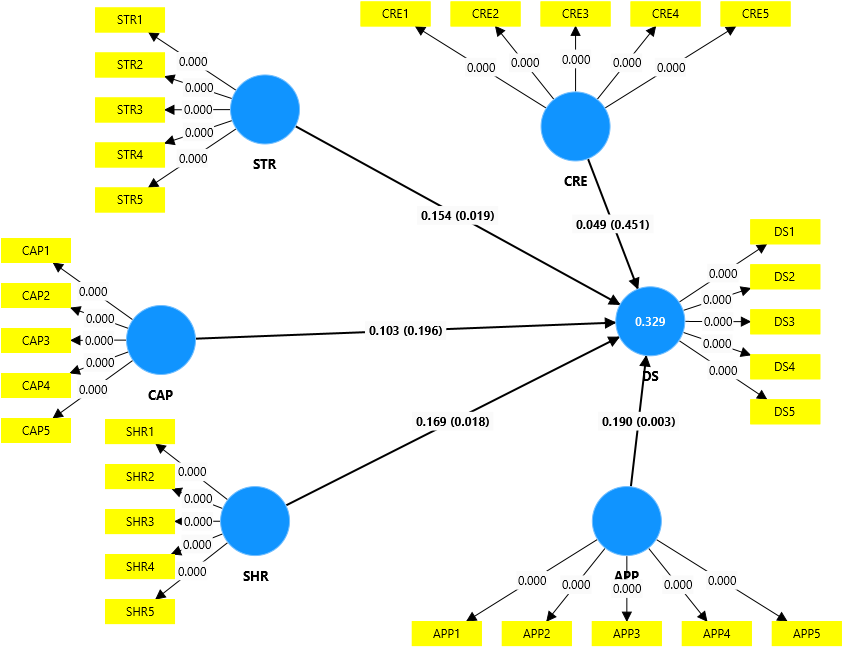
The path analysis examined the impact of Knowledge Management Practices (KMPs) on
delivery speed among SMEs as presented in Table 10 and Figure 3. The model explains 33.7% of the variance (R² = 0.337, Adj. R² = 0.329), indicating
strong explanatory power. Application (APP) of KMPs significantly improves delivery
speed (β = 0.190, t = 2.964, p < 0.01), suggesting that effective knowledge management
enhances operational efficiency. Knowledge sharing (SHR) also positively influences
delivery speed (β = 0.169, t = 2.364, p < 0.05), underscoring the importance of shared
knowledge in accelerating service delivery. Additionally, Knowledge storing (STR)
positively impacts delivery speed (β = 0.154, t = 2.341, p < 0.05), implying that
organized knowledge systems contribute to faster operations. However, Knowledge capturing
(CAP) and Knowledge creation (CRE) were not significant predictors of delivery speed
(p > 0.05), suggesting that while valuable, they may not directly influence delivery
efficiency. In conclusion, application, sharing, and storing of knowledge are key
drivers of faster delivery in SMEs. The model underscores the importance of structured
knowledge management practices in enhancing operational performance and delivery speed.
Table 10Coefficients and Path Analysis of the Impact of KMPs on the Delivery Speed of SMEs
Figure 3Path Analysis of the impact of KMPs on the delivery speed of SMEs
6. Discussion
This study sought to dissect the nuanced relationship between specific knowledge management
practices (KMPs) and the operational performance of SMEs in Southwestern Nigeria.
The findings reveal a complex and differentiated picture, challenging the notion of
a uniformly positive relationship and underscoring the critical role of organizational
context in determining KMP efficacy. Our discussion moves beyond what we found to
explore why these patterns emerged, integrating the crucial enablers of organizational
culture, structure, and leadership suggested by the reviewers.
6.1. The Primacy of Action-Oriented over Foundational KMPs
A central finding of this research is the consistent and significant impact of knowledge
application and sharing on quality and delivery speed. It aligns with the core tenets
of the Dynamic Capabilities Theory, which posits that a firm's ability to reconfigure
resources is paramount for competitive advantage (). In the volatile environment of Nigerian SMEs, the practices of applying and sharing
knowledge represent this dynamic reconfiguration in action. Knowledge application
(β = 0.190, p < 0.01 for delivery speed) directly translates learned insights into
process improvements. In contrast, knowledge sharing (β = 0.221, p < 0.01 for quality)
ensures that best practices are disseminated, reducing errors and enhancing coherence.
It supports the work of , who argued that knowledge must flow to where it can be applied to create value.
Conversely, the weak or non-significant impact of knowledge capturing and creation
on most outcomes is highly instructive. While emphasized their importance, our results suggest that in the context of resource-constrained
SMEs, these may be perceived as longer-term, costlier investments. The slight negative
coefficient for creation on quality, though non-significant, could even hint at the
disruptive potential of unmanaged innovation. This discrepancy is not a refutation
of prior studies but rather a clear indication that the organizational environment
heavily moderates the effectiveness of foundational KMPs.
6.2. The Indispensable Role of Organizational Enablers
The varying explanatory power of our models, from a robust 33.7% for delivery speed
to a modest 8.6% for cost management, forcefully argues that KMPs do not operate in
a vacuum. The low R² for cost management, in particular, signals that other, more
potent factors are at play. It is where the integration of organizational enablers
becomes critical. We posit that organizational culture is the fundamental bedrock.
A culture that rewards collaboration, tolerates calculated risk, and values learning
is the fertile ground in which knowledge sharing and application can flourish. In
its absence, as suggested by , even captured knowledge remains an underutilized asset. The significance of knowledge
storage for delivery speed (β = 0.154, p < 0.05) further points to the need for a
basic organizational structure that systematizes knowledge, moving it beyond individual
memory to become an institutional asset. The limited impact of KMPs on cost management
can be directly linked to a misalignment with reward systems and leadership style.
While knowledge capturing showed a modest effect (β = 0.163, p < 0.05), the non-significance
of application and sharing suggests that employees are not systematically incentivized
to use knowledge for cost-saving purposes. A transformational leadership style that
explicitly champions and models the link between knowledge use and efficiency is likely
a prerequisite for KMPs to influence the bottom line. It explains why, despite the
findings of on knowledge capturing for cost control, the overall model lacked power; the necessary
reinforcing systems were not in place.
6.3. Theoretical and Practical Implications
Theoretically, this study refines the application of Dynamic Capabilities in an SME
context. It suggests that for these firms, the critical "micro-foundations" are not
the breadth of knowledge processes, but the depth of a select few, specifically application
and sharing, when supported by a conducive organizational environment. Our findings
reconcile seemingly contradictory literature by demonstrating that the efficacy of
KMPs is not absolute but is contingent upon this internal context.
(a) For practitioners and policymakers, the implications are clear and actionable:
Focus on Application and Sharing: SME owners should prioritize creating mechanisms and a culture that encourages the
active use and exchange of knowledge. It yields more immediate operational returns
than investing heavily in complex knowledge capture systems.
Build Supportive Infrastructures: Interventions aimed at improving SME performance must concurrently address foundational
elements, such as leadership commitment, collaborative incentives, and straightforward
structures for knowledge retention. Training programs for SME managers should emphasize
building this knowledge-friendly ecosystem.
Targeted Performance Goals: Understanding that different KMPs drive different outcomes allows for targeted strategies.
To improve delivery speed, systematizing knowledge storage is key. To enhance quality,
fostering a culture of application is most critical.
6.4. Conclusion, Limitations, and Future Research
In conclusion, this research demonstrates that the relationship between KMPs and operational
performance in SMEs is not a simple linear equation, but a complex interplay of specific
practices heavily moderated by the organization's internal context. The primary limitation
of this study is its focus on KMPs alone; although the proposed contextual enablers
were discussed, they were not empirically measured. Therefore, future research should
quantitatively incorporate other variables such as organizational culture, leadership
style, and reward systems as direct and moderating factors in the model. A mixed-methods
approach could further illuminate the qualitative nature of these cultures and structures.
Such work would provide a more holistic and robust understanding of how to unlock
the full performance potential of knowledge in the dynamic and challenging environment
of SMEs.
7. Contributions to Knowledge
This study makes several distinct and significant contributions to the literature
on knowledge management and small business performance, which can be categorized into
theoretical, contextual, methodological, and practical advancements.
7.1. Theoretical Contribution: Refining the Application of Strategic Theories in the
SME Context
This research provides a critical theoretical refinement by contextualizing and differentiating
the mechanisms of the Knowledge-Based View (KBV) and Dynamic Capabilities Theory within
the SME sector. While both theories posit knowledge as a key resource, our findings
delineate their practical hierarchy for SMEs. We demonstrate that the foundational
premise of the KBV —that knowledge is a strategic asset, a necessary but insufficient
condition for performance— is supported. The critical differentiator, aligned with
Dynamic Capabilities, is the firm's capacity for knowledge application and sharing,
the active processes of reconfiguring and deploying knowledge. Furthermore, this study
moves beyond simply confirming a relationship to unpacking the "black box" of KMPs.
We provide empirical evidence that KMPs are not a monolithic construct. By deconstructing
KMPs into discrete dimensions, we reveal their differential impacts, thereby offering
a more granular theoretical understanding. We reconcile contradictory findings in
the literature (e.g., the mixed results for knowledge creation) by proposing that
the efficacy of foundational KMPs is contingent upon the presence of action-oriented
ones and a supportive organizational context, thus advancing a more nuanced theoretical
model.
7.2. Contextual Contribution: Providing a Granular Evidence Base from an Under-Researched
Ecosystem
A primary contribution of this work is its empirical grounding in the Nigerian SME
context, an environment characterized by institutional voids and acute resource constraints.
Much of the existing KMP literature is based on studies of large corporations or SMEs
in developed economies. This research fills a significant contextual gap by providing
robust, quantitative evidence on which specific KMPs actually drive which specific
operational outcomes in this challenging setting. The findings highlight that the
universalist assumptions commonly found in the literature are not supported. For instance,
the weak relationship between KMPs and cost management, in contrast to the strong
link to delivery speed, provides a unique contextual insight. In volatile emerging
markets, SMEs may prioritize KMPs that enhance agility and responsiveness (speed,
quality) over those targeting efficiency (cost), a nuance critical for developing
context-sensitive theories and policies.
7.3. Methodological Contribution: Enhancing Robustness and Measurement
This study addresses notable methodological gaps in the extant literature. We overcome
the limitations of small sample sizes and descriptive analyses that have plagued previous
studies in similar contexts. By employing a robust, proportional stratified sampling
technique and advanced PLS-SEM analysis on a substantial sample (n = 380), we provide
findings with greater statistical power, reliability, and generalizability within
the study context. Moreover, our operationalization of constructs contributes to the
field. We disaggregate operational performance into its core components (quality,
cost, delivery) rather than relying on composite or purely financial measures. This
granular approach enables a precise mapping of KMPs to specific performance outcomes,
providing a methodological blueprint for future research that seeks to move beyond
high-level performance associations.
7.4. Practical and Policy Contribution: Providing Actionable Guidance for Stakeholders
For practitioners, this research provides a clear and prioritized roadmap. Instead
of advocating for a comprehensive, and potentially unattainable, KM system, our findings
provide actionable evidence for SME owners to focus their limited resources on high-impact
practices. The clear message is to foster a culture and implement processes that encourage
knowledge sharing and, most critically, its application to daily operations. For policymakers
and support organizations, this study delivers evidence-based guidance for designing
effective interventions. Programs aimed at enhancing SME competitiveness should move
beyond generic KMP advocacy. Instead, they should focus on building the "softer" enablers,
such as leadership training on fostering collaborative cultures and designing knowledge
application workshops, which our discussion identifies as critical. It shifts the
policy focus from providing information to building capabilities for using that information
effectively. In conclusion, this study offers a contextually nuanced, methodologically
robust, and theoretically refined understanding of how knowledge management operates
in the engine room of an emerging economy, specifically among its small and medium-sized
enterprises. It provides a foundational platform for future research further to investigate
the critical moderating role of organizational enablers that this study has brought
to the fore.
Author contribution
Conceptualization, O. T. O. and M. R.; Methodology, O. T. O., A. M. A. and M. R.;
Software, O. A. and M. A. O.-A.; Data acquisition, O. T. O. and M. R.; Analysis and
interpretation, O. T. O. and M. R.; Writing- Preparation of the draft, O. T. O., A.
M. A. and M. R.; Writing-Revision & Editing, O. A. and M. A. O.-A. All authors read
and agree with the published version of the manuscript.
References
1
Abdillah, A., Widianingsih, I., Buchari, R. A., & Nurasa, H. (2023). The knowledge-creating
company: How Japanese companies create the dynamics of innovation. Learning Research and Practice, 10(1), 121–123. https://doi.org/10.1080/23735082.2023.2272611
Alavi, M., & Leidner, D. E. (2001). Knowledge management and knowledge management
systems: Conceptual foundations and research issues. MIS Quarterly, 25(1), 107-136. https://doi.org/10.2307/325096
4
Alharbi, G.L., Aloud, M.E. (2024). The effects of knowledge management processes on
service sector performance: evidence from Saudi Arabia. Humanity & Social Sciences Communications, 11, 378. https://doi.org/10.1057/s41599-024-02876-y
Andrea, P. T., & Wanyoike, R. (2024). Knowledge management and organization performance:
A critical review of the literature. Journal of Business and Strategic Management, 9(1), 73–85. https://doi.org/10.47941/jbsm.1715
7
Banker, R. D., Bardhan, I. R., & Asdemir, O. (2006). Understanding the impact of collaboration
software on product design and development. Information Systems Research, 17(4), 352–373. https://doi.org/10.1287/isre.1060.0104
8
Becerra-Fernandez, I., Gonzalez, A., & Sabherwal, R. (2004). Knowledge management: Challenges, solutions, and technologies. Pearson Prentice Hall.
9
Choi, B., Poon, S. K., & Davis, J. G. (2008). Effects of knowledge management strategy
on organizational performance: A complementarity theory-based approach. Omega, 36(2), 235–251. https://doi.org/10.1016/j.omega.2006.06.007
10
Cu, M., Chan, J., Peko, G., & Sundaram, D. (2021). Knowledge Management Practices:
Innovation The Path to Organizational performance. In Lecture notes of the Institute for Computer Sciences, Social Informatics and Telecommunications
Engineering (pp. 20–37). https://doi.org/10.1007/978-3-030-93179-7_2
11
Cummings, J. N. (2004). Work groups, structural diversity, and knowledge sharing in
a global organization. Management Science, 50(3), 352–364. https://doi.org/10.1287/mnsc.1030.0134
12
Davenport, T. H., & Prusak, L. (1998). Working knowledge: How organizations manage what they know. Harvard Business Press. https://doi.org/10.1145/348772.348775
13
Donate, M. J., & Guadamillas, F. (2011). Organizational factors to support knowledge
management and innovation. Journal of Knowledge Management, 15(6), 890-914. https://doi.org/10.1108/13673271111179271
Gholami, H., Asli, M. N., Nazari-Shirkouhi, S., & Noruzy, A. (2013). Investigating
the influence of knowledge management practices on organizational performance: An
empirical study. Acta Polytechnica Hungarica, 10(2), 205–216. https://doi.org/10.12700/aph.10.02.2013.2.14
16
Gold, A. H., Malhotra, A., & Segars, A. H. (2001). Knowledge management: An organizational
capabilities perspective. Journal of Management Information Systems, 18(1), 185-214. https://doi.org/10.1080/07421222.2001.11045669
Henao-García, E. A., Lozada, N., & Arias-Pérez, J. (2020). Direct effects of knowledge
management practices on organizational performance. Business Information Review, 37(1), 30-37. https://doi.org/10.1177/0266382120909073
19
Kassim, N. A., Baharuddin, M. F., & Abdul Sama, Z. (2016). Knowledge management practices
and organizational performance in Malaysia government institution. International Journal for Infonomics (IJI), 9(4), 1233–1238. https://doi.org/10.20533/iji.1742.4712.2016.0151
20
Koufteros, X. A., Vonderembse, M. A., & Doll, W. J. (2002). Examining the competitive
capabilities of manufacturing firms. Structural Equation Modeling a Multidisciplinary Journal, 9(2), 256–282. https://doi.org/10.1207/s15328007sem0902_6
21
Li, C., Ashraf, S. F., Shahzad, F., Bashir, I., Murad, M., Syed, N., & Riaz, M. (2020).
Influence of knowledge management practices on entrepreneurial and organizational
performance: A mediated-moderation model. Frontiers in Psychology, 11, 577106. https://doi.org/10.3389/fpsyg.2020.577106
Meher, J.R. & Mishra, R.K. (2019). "Assessing the influence of knowledge management
practices on organizational performance: An ISM approach", VINE Journal of Information and Knowledge Management Systems, 49(3), 440–456. https://doi.org/10.1108/VJIKMS-04-2019-0050
24
Neely, A., Gregory, M., & Platts, K. (2005). Performance measurement system design:
A literature review and research agenda. International Journal of Operations & Production Management, 25(12), 1228–1263. https://doi.org/10.1108/01443570510633639
25
Odesola, O. T. (2025). Religiosity and operational performance of small and medium
scale enterprises in Nigeria. International Journal of Cross Cultural Management, 25(2), 481–505. https://doi.org/10.1177/14705958251325674
26
Odesola, O. T., Adebisi, A. M., & Salako, T. (2025). Exploring disruptive innovation
and operational performance: A study of neobanks in an emerging economy. İşletme Ekonomi ve Yönetim Araştırmaları Dergisi, 8(2), 55–71. https://dergipark.org.tr/en/download/article-file/4610975
27
Odesola, O. T., & Akingunloye, V. (2024). Employees’ relationship, knowledge sharing
and employees’ productivity: Evidence from an emerging economy’s non-quoted manufacturing
firms. Ife Journal of the Humanities and Social Studies (IJOHUSS), 6(1), 90–116. https://ijohuss.oauife.edu.ng/index.php/ijohuss/article/view/60/50
28
Sarkindaji, B. D., Hashim, N. A. B., & Abdullateef, A. O. (2014). Knowledge management
and organizational performance of mobile service firms in Nigeria: A proposed framework.
Information and Knowledge Management, 4(11), 88–96. https://www.iiste.org/Journals/index.php/IKM/article/view/17216/17654
29
Teece, D. J. (2007). Explicating dynamic capabilities: The nature and micro foundations
of (sustainable) enterprise performance. Strategic Management Journal, 28(13), 1319–1350. https://doi.org/10.1002/smj.640
Upton, D. M. (1994). The management of manufacturing flexibility. California Management Review, 36(2), 72–89. https://doi.org/10.2307/41165745
32
Walsh, J. P., & Ungson, G. R. (1991). Organizational memory. Academy of Management Review, 16(1), 57–91. https://doi.org/10.2307/258607
33
Zahra, S. A., & George, G. (2002). Absorptive capacity: A review, reconceptualization,
and extension. Academy of Management Review, 27(2), 185-203. https://doi.org/10.2307/4134351
34
Zack, M. H., McKeen, J. D., & Singh, S. (2009). Knowledge management and organizational
performance: An exploratory analysis. Journal of Knowledge Management, 13(6), 392–409. https://doi.org/10.1108/13673270910997088