En los últimos años, las personas jóvenes han enfrentado un empeoramiento de su situación económica en comparación con otros grupos de edad, impulsado por factores como el aumento de la precariedad laboral, el encarecimiento de la vivienda y mayores tasas de desempleo. Como consecuencia, presentan ahora una mayor incidencia e intensidad de la pobreza que en periodos anteriores. Este estudio analiza el papel de la edad en la distribución de la renta y la pobreza monetaria en Galicia, centrándose en la evolución de la renta per cápita, la desigualdad de renta, la contribución de las diferentes fuentes de renta y de la pobreza durante el periodo 2007-2021. El análisis distingue entre tres grupos de edad: jóvenes (<35 años), personas de mediana edad (35-64 años) y personas mayores (> 65 años). Los resultados indican que las personas jóvenes se han desplazado progresivamente hacia los tramos inferiores de la distribución de la renta, con un aumento de las tasas de pobreza, en contraste con las mejoras observadas en los otros dos grupos de edad a lo largo del tiempo. Además, los factores que influyen en la distribución de la renta y la pobreza varían entre grupos de edad y han evolucionado durante el periodo estudiado. Estos resultados subrayan la necesidad urgente de políticas específicas para abordar estas desigualdades y fomentar la cohesión social.
Palabras clave:
desigualdad, brecha generacional, prestaciones sociales, pobreza, distribución de la renta
Amoedo, Blanco-Varela, and Campos-Romero: Generational Inequality: The Role of Age in Income Distribution and Poverty in Galicia
in the period 2007–2021
1. INTRODUCTION
The substantial rise in income inequality emerges as one of the most pressing global
challenges, paralleling the climate crisis (). This issue's significance is reflected with its inclusion in the Sustainable Development
Goals of the 2030 Agenda (SDGs 5 and 10), which aims at diminishing inequalities and
advance in gender equality. However, the Great Recession and the Covid-19 pandemic
have acted as a setback to the achievement of these goals in some societies.
In the case of Galicia (Northwest Spain), during this period, there has been a significant
increase in inequalities and poverty (; ). Among the reasons for this increase, the worsening of well-being for the younger
population plays a central role, which, however, has been addressed in a limited way
by the existing literature. Given the above, it is essential to quantify and study
the changes in income distribution and poverty according to individuals' age in order
to improve the design of public policies aimed at supporting the most vulnerable.
Galicia represents a particularly interesting case study due to its status as a peripheral
region within Spain and its demographic profile, characterised by a deep decline and
demographic ageing, which has led to profound demographic, social and economic adjustments
(). Given the strong demographic ageing, Galicia presents the ideal context to study
how inequalities between age groups have evolved in recent years. As well as to make
a first approximation to the possible effects of the advance towards a society in
which gerontocracy prevails.
The main objective of this paper is to study income distribution and poverty in Galicia
across age groups during the 2007–2021 period. More specifically, this research aims
to analyse how income inequality and poverty incidence have varied among different
age groups and to identify the determinants of income distribution and poverty and
the role of the different income sources and social benefits. In this regard, Galicia
serves as a highly relevant case study due to its status as a peripheral region and
its pronounced demographic ageing. To conduct this study, data from the Income and
Living Conditions Survey is used, and the population is divided into three age groups:
young people (<35 years), middle-aged individuals (35–64 years), and older adults
(>64 years). A descriptive analysis is carried out alongside machine learning techniques,
specifically random forests.
This paper is divided into five sections, including the present introduction. The
second section provides a literature review on the role of age in inequality and poverty
in Galicia and within the Spanish context, as well as the evolution of inequality
and poverty in Galicia. The third section outlines the data sources and methodologies
used for the empirical analysis. The fourth section presents and discusses the results
obtained. Finally, the main conclusions of the research and the resulting recommendations
for economic policy are presented.
2. INCOME DISTRIBUTION, POVERTY AND AGE
This section provides a review of the literature on the role of age in income distribution
and poverty, as well as on the evolution of income distribution and poverty in Galicia.
First, the role of the generational gap in income distribution and poverty is analysed
in the Spanish and European context. Second, a review of studies and reports on the
evolution of income distribution and poverty in Galicia is conducted, aiming to identify
the most relevant trends and the role played by the generational gap in these dynamics.
2.1. Generational Gap and Income Distribution and Poverty
Economic inequality is one of the topics under discussion in contemporary literature,
highlighted for its impact on economic growth, social cohesion, and political stability
(; ; ). Inequalities manifest in various forms, including income, wealth, access to opportunities,
and educational outcomes. These disparities have increased due to factors such as
technological change and recurring economic crises, which have intensified the focus
on the most vulnerable groups in society ().
A relevant perspective for analysing this phenomenon is intergenerational inequality.
Generational gaps can be defined as structural and systemic disparities in access
to resources, wealth, and opportunities between different age cohorts, resulting from
specific economic, social, political, and demographic dynamics. These gaps pose a
central challenge for contemporary economies, particularly in societies with aging
demographic structures and marked by recurrent crises ().
In the European context, the increasing precariousness of labour, limited access to
housing, and income distribution inequality have placed younger generations in an
economically vulnerable position (; ). These disparities are particularly concerning in peripheral regions like Galicia,
where factors such as population aging and reliance on traditional economic sectors
may exacerbate inequalities between age groups (; ; ).
The generational gap is a multifactorial phenomenon, meaning its existence and evolution
depend on various social, economic, and political factors. Moreover, the explanatory
factors behind generational gaps can be attributed to both cyclical and structural
causes. Existing literature on generational gaps in the European and Spanish contexts
identifies three key groups of factors as the most relevant: labour precariousness
and economic crises, public policies and demographic ageing, and the housing market
and access to housing. The role of each of these factors is addressed separately below,
although clear connections exist between them.
2.1.1. Labour Market and Economic Cycles
Labour precariousness is particularly impactful on youth, affecting them from their
entry into the labour market, coupled with higher unemployment rates (). define precarious employment as a situation where work fails to provide employees
with the security of a minimum decent standard of living. Similarly, and consider precariousness as a lack of protection, insecurity, economic or social vulnerability,
and instability. describe precariousness as the absence of stable employment, flexibility, temporary
contracts, low wages, and lack of control at work, which prevent the consolidation
of sufficient income and stability to establish a future and a dignified life.
An immediate economic consequence of labour precariousness is the risk of poverty,
understood as the lack of resources or income (; ). Precariousness is closely linked to poverty, as some precarious workers are also
poor. According to , these situations of exclusion are rooted in a combination of vulnerabilities that
merge low-income levels with other disadvantages, such as housing problems or lack
of access to basic educational or healthcare resources. This concatenation of circumstances
leads to a precariousness trap, whereby individuals in precarious conditions and relying
on subsidies may not be encouraged to participate in a labour market that offers no
guarantees. Furthermore, should they rapidly exit these conditions, they may have
to incur transaction costs again to regain access to minimum income subsidies. In
the Spanish context, young people (<35 years) have progressively shifted towards the
lower levels of the income distribution, while older adults (≥65 years) have experienced
improvements thanks to a robust social protection system (; ). However, these phenomena have been addressed only to a limited extent in the literature,
particularly regarding income sources and their role in wealth distribution.
The vulnerability of younger generations may be further compromised by the more significant
impact of economic crises (). For instance, highlights that the Great Recession (2007–2009) disproportionately affected young
people and working-age cohorts. indicate that, as a consequence of the crisis, younger generations not only experienced
reduced incomes but also lost future opportunities. This idea is grounded in the notion
that current harm may create obstacles to future recovery, with long-term negative
effects ().
2.1.2. Public Policies and Demographic Ageing
Another factor that differentially affects generational cohorts is access to public
resources. This may be due to the social policy infrastructure, where historically
public transfers have favoured older generations, perpetuating intergenerational inequality
(). and identify that in Spain, the fiscal system has been ineffective in mitigating intergenerational
inequalities, favouring older generations in terms of social benefits. This limits
the redistributive capacity of the state.
Intergenerational inequality is a complex phenomenon that captures disparities in
access to resources, wealth, and opportunities among different age groups. highlight that this form of inequality is intrinsically linked to demographic structures
and welfare policies. Specifically, they emphasise that pension systems and wealth
accumulation through property ownership have favoured older adults to the detriment
of younger generations. Additionally, introduce an Intergenerational Inequality Index (IGI) to quantify these disparities,
demonstrating that younger generations face greater disadvantages in terms of income
and access to resources. Their analysis underscores how public transfer policies,
rather than mitigating these inequalities, often perpetuate them. Furthermore, as
highlighted by , the demographic ageing experienced in certain countries and regions has increased
pressure on welfare systems, further prioritising older generations over younger ones.
Regarding recent public policies in Spain, measures such as the Minimum Living Income
(Ingreso Mínimo Vital, IMV) have shown limited impact on young people, who are often less likely to benefit
from programmes aimed at combating extreme poverty. In contrast, older adults have
been the primary recipients of these benefits, further strengthening their position
at the upper end of the income distribution (). However, the lack of a comprehensive approach to addressing social exclusion among
young people, particularly in impoverished rural and urban areas, remains a critical
challenge. highlights the need for holistic interventions that combine access to affordable
housing, youth employment programmes, and participation in community networks as essential
components for reducing exclusion.
2.1.3. Access to Housing
identifies an increase in inequalities both between young people and adults and among
youth themselves. In addition to the differential impact of crises, homeownership
is another determinant of inequality between adults and young people. emphasize that young households face greater difficulties in acquiring housing, thereby
increasing their socioeconomic precariousness. The reasons behind the greater difficulty
in accessing housing among young people stem from both the deterioration of their
labour market income and the rising cost of housing, as well as stricter credit conditions
(; ).
provides an in-depth analysis of changes in housing access and the real estate market
in Spain since the Great Recession, concluding that Spain is moving away from the
traditional Southern European residential model characterised by high residential
stability. This shift has resulted in an increase in rental housing across most social
strata, particularly in major metropolitan areas. However, as highlights, this rise in residential instability has disproportionately affected
young adults. Fewer than 70% of individuals aged 30 to 34 have achieved emancipation,
a trend accompanied by a significant increase in rental prices. As a result, 50% of
those under 35 who rent their homes face a severe financial burden to afford their
housing costs.
2.2. Income distribution and poverty in Galicia
Studies on income distribution and poverty in Galicia have been limited in the existing
literature, with a few standing out such as , , or . However, these investigations provide a general overview of the evolution of inequality
and poverty without delving into the role of the generational gap.
and offers a historical overview of income distribution in Galicia from 1973 to 1991,
situating these trends within the broader context of Spanish economic developments.
The results demonstrate a general decline in both inequality and polarization over
the course of the period under examination, with particularly noteworthy improvements
observed in the 1980s. The changes are attributed to economic growth and shifts in
population distribution across income groups, thereby suggesting a movement towards
greater income equality and reduced polarisation.
examine the impact of the economic crisis on income distribution in Galicia between
2007 and 2010, noting an increase in inequality and poverty, particularly affecting
the younger population in the Atlantic areas due to higher unemployment rates. The
study employs a range of measures, including the Gini, Atkinson, and Theil indices,
to illustrate that the crisis has intensified income disparities, resulting in a shift
in the poverty map from older, pension-reliant interior regions to younger, unemployment-affected
coastal areas.
analyse the initial effects of Covid-19 pandemic in the income distribution in Galicia.
The study shows that the pandemic increases the income inequalities in primary income
distribution and that young people have been the most adversely affected by the pandemic,
starting from an already disadvantaged position. Additionally, show that social benefits have mitigated income loss for middle-aged and older groups
but not for younger individuals.
The AROPE (At Risk of Poverty or Social Exclusion) reports from 2018 to 2022 demonstrate
a persistent issue of poverty and social exclusion, with slight fluctuations over
the years. In 2018, the AROPE rate was 24%, equating to approximately 652,000 individuals at risk. This rate increased
to 25.2% in 2021, with 678,000 people at risk (). Furthermore, the highest AROPE rates are consistently observed among children and
adolescents (under 18 years of age), followed by adults (18-64 years of age) and seniors
(65 years of age and above). In 2021, the AROPE rate for children was 34%, which was
significantly higher than the rates for adults (25.4%) and seniors (19%). This suggests
that younger populations are more susceptible to poverty and social exclusion. However,
the age group division used does not allow for distinguishing between the situations
of young adults and middle-aged adults, as it combines a broad age range (18–64 years)
with significant internal heterogeneity.
In the European context, Spain is one of the countries with the highest levels of
poverty and social exclusion. Specifically, in 2023 it was in fourth place, behind
only Bulgaria, Romania and Greece (see Figure 1). This reinforces the interest of studying the case of Spain.
Figure 1At-risk-of-poverty or social exclusion rate in European countries (2023) Source: The authors from Eurostat (2024)
Other studies examine phenomena related to income inequality and poverty in Galicia
that are relevant to understanding the changes brought about by the Great Recession
and the Covid-19 pandemic. analyse the influence of tourism on income distribution in Galicia. The authors conclude
that, while tourism contributes to economic growth, it also increases income inequality.
High-income households benefit more from tourism-related activities, thereby exacerbating
existing disparities.
examines the effects of the Great Recession and the initial impacts of the Covid-19
pandemic on employment in Galicia, focusing on age and gender disparities, as well
as the structural and sectoral factors that drove job losses. The results show that
young workers (16-29 years old) acted as a buffering workforce in both crises: they
suffered disproportionate job losses during recessionary phases and experienced sharp
recoveries during recovery periods. As the authors point out, this is due to the high
prevalence of young workers in temporary jobs, which makes them more vulnerable.
The authors also show how the Expediente de Regulación Temporal de Empleo (ERTE) scheme
implemented by the Spanish government helped mitigate job losses during the pandemic
by providing subsidies for temporary suspensions or reductions in working hours. However,
young workers benefited less from this policy due to the non-renewal of temporary
contracts before its implementation.
The studies analysed in this subsection show how Galicia has experienced significant
changes in income distribution and poverty in recent decades. Additionally, the generational
inequality is highlighted in some of these studies (; ; ; ) as a key aspect in understanding the changes experienced by Galician society in
recent decades. However, these studies do not directly address the quantification
and determinants of the generational gap in Galicia with sufficient depth. The following
sections of this article conduct such a study, aiming to fill this gap in the literature.
3. DATA AND METHODOLOGY
This section discusses the main data sources and methodologies used to analyse income
distribution and poverty in Galicia, focusing on inequalities between different age
groups. First, the data source utilised, and the key variables used in the study are
presented. Next, the main methodologies employed to conduct the analysis are outlined.
3.1. Data
To analyse changes in income distribution and poverty in Galicia, microdata from the
general module of the Income and Living Conditions Survey (Encuesta de Condiciones de Vida) for individuals from households residing in Galicia are used, covering the years
2008, 2011, 2015, 2020, 2021, and 2022 (). The selected editions provide data on the households and individuals surveyed for
the previous year, namely 2007, 2010, 2014, 2019, 2020, and 2021. The selection of
these years is driven by the need to observe changes generated by the economic cycles
that occurred in Galicia (and, in general, in Spain) during this period. More specifically,
the inclusion of the years 2007 and 2014 allows for the analysis of changes resulting
from the Great Recession by comparing the situation prior to it (2007) and immediately
before the start of the economic recovery (2014). The inclusion of the year 2019 enables
the analysis of the situation after the economic recovery, before it was interrupted
by the Covid-19 pandemic (2020–2021).
The Income and Living Conditions Survey provides information on the income received
by households and individuals residing in Spain, as well as details about their specific
characteristics and circumstances. Among the characteristics collected are the region
in which the household's main dwelling is located and the age of its members, making
it an excellent choice for conducting this research. In addition to these advantages,
the Income and Living Conditions Survey has a key advantage over other alternatives,
such as the Structural Household Survey (Enquisa Estrutural a Fogares) (), in that it offers a greater level of income disaggregation based on its source.
Furthermore, the survey microdata collects a sample of the Spanish population and
provides a weighting factor that enables representative results for the national and
regional population, both for households and individuals. In this research, this weighting
factor is applied at the individual level.
In this research, the individuals in the population sample of adults (16 years or
older, as defined by the Income and Living Conditions Survey) are divided into three
groups based on their age: young (<35 years), middle-aged (35–64 years), and older
adults (>64 years). The selection of these groups is based on the need to observe
individuals' circumstances according to their life stage. Young adults are defined
as those in their formative years and/or in the early stages of entering the labour
market, following the criteria of other studies (). The middle-aged group consists of adults who are not classified as young but are
of working age. Finally, the older adults group comprises individuals who were at/or
above the legal retirement age at the beginning of the period. It is worth noting
that this retirement age has varied over the period due to legal reforms.
Within the Living Conditions Survey, some income variables are collected at the household
level, while others are recorded at the individual level. Since this research is conducted
at the individual level, household-level incomes are evenly divided among the adult
members of the household. Thus, an individual’s income consists of both their directly
received income and a proportional share of their household's income. Additionally,
only net incomes are used.
The fact that some sources of income are not available at the individual level and
have to be divided equally may be a limitation when carrying out the analysis by age.
In this respect, it is worth highlighting the case of real estate income when young
people return to the family home or stay there for a longer period of time. In this
case, young people benefit to some extent from imputed rent, even if it is provided
by their parents, the worse their individual situation is, the more so. This could
lead to the result that real estates rents have become more important for young people.
This points to the need for further detailed studies on the role of real estate rents.
Table 1 presents the income variables that make up each individual's disposable income and
the level at which they are recorded within the Income and Living Conditions Survey.
Table 1Disposable income sources analysed in this research Source: The authors from INE (2022).
Variable
Description
Collection level
Wages
Net monetary, quasi-monetary, or non-monetary income of the salaried worker
Individual
Mixed
Net monetary profits or losses from self-employment (including intellectual property
rights)
Individual
Financial
Net interest, dividends, and profits from capital investments in unincorporated businesses
and net income received from private pension schemes
Household
Real Estate
Net income from the rental of property or land
Household
Imputed rent
Imputed rent
Household
Other incomes
Self-consumption and/or net transfers to other households
Individual or household
Unemployment benefits
Net unemployment benefits
Individual
Retirement benefits
Net retirement, survivor, sickness, and disability benefits
Individual
Other benefits
Education, family/child, social assistance, or housing benefits
Individual or household
Source: The authors from .
Regarding the study of the determinants of poverty and income distribution, beyond
age itself, this research examines individuals' characteristics related to their gender,
type of municipality, highest level of education attained, housing tenure status,
employment situation, and occupation. Table 2 presents the variables used to analyse these characteristics.
Table 2Features about individuals and households analysed in this research Source: The authors from INE (2022).
Variable
Code
Description
Gender
gender
Female (1) and male (0)
Municipality
musize1
Highly populated area (1) and other (0)
munsize2
Middle populated area (1) and other (0)
munsize3
Lowly populated area (1) and other (0)
Educational level
edu1
Primary education or lower (1) and other (0)
edu2
Lower secondary education (1) and other (0)
edu3
Upper secondary education (1) and other (0)
edu4
Post-secondary non-tertiary education (1) and other (0)
edu5
Tertiary education (1) and other (0)
Housing tenure status
tenure1
Owned with or without mortgage (1) and other (0)
tenure2
Market-rate rental (1) and other (0)
tenure3
Below-market-rate rental (1) and other (0)
tenure4
Rent-free accommodation (1) and other (0)
Employment situation
emp1
Employed (1) and other (0)
emp2
Unemployed (1) and other (0)
emp3
Studying (1) and other (0)
emp4
Retired (1) and other (0)
emp5
Disabled (1) and other (0)
emp6
Household duties (1) and other (0)
emp7
Other types of inactivity (1) and other (0)
Occupation
occu1
Group 1 (ISCO88): Management of businesses and public administrations (1) and other
(0)
occu2
Technicians and scientific and intellectual professionals (1) and other (0)
occu3
Technicians and support professionals (1) and other (0)
occu4
Administrative employees (1) and other (0)
occu5
Workers in hospitality, personal services, protection services, and retails sales
(1) and other (0)
occu6
Skilled workers in agriculture and fishing (1) and other (0)
occu7
Artisans and skilled workers in manufacturing industries, construction, and mining,
excluding plant and machine operators (1) and other (0)
occu8
Operators and assemblers of fixed installations and machinery, as well as drivers
and operators of mobile machinery (1) and other (0)
occu9
Unskilled workers (1) and other (0)
Source: The authors from .
Using the variables presented in Tables 1 and 2, a study of income distribution and poverty is conducted both overall and for each
age group. The income sources listed in Table 1 allow for the decomposition of individuals' income, while the characteristics in
Table 2 enable an analysis of the factors that explain individuals' positions in society
according to their age. The following section presents the indicators and methodologies
used.
3.2. Methodology
This section introduces the indicators used to study changes in income distribution
and poverty by individuals' age, as well as the machine learning algorithm employed
to analyse the changes in the determinants of income distribution and poverty within
each age group. Starting with the indicators, this research uses four key measures:
average disposable personal income, the Gini coefficient, the contribution of each
income source to disposable personal income, and the poverty incidence rate.
To calculate disposable personal income, which is used in the subsequent indicators,
the income sources listed in Table 1 are included. Notably, imputed rent is incorporated into individuals' income, allowing
for an analysis of the role of housing as a guarantor of well-being. Including imputed
rent as a separate income source from property income enables a distinction between
housing's role as a provider of in-kind income and monetary income. Social benefits
are also included with some disaggregation to highlight their differing roles depending
on their nature. The first type, referred to as unemployment benefits, encompasses
those received by unemployed individuals eligible for such support. Retirement benefits
include those arising from inactivity due to retirement, illness, or other forms of
incapacity. Finally, other benefits refer to aids or allowances aimed at addressing
vulnerability or poverty.
3.2.1. Average disposable personal income
The average disposable personal income is calculated for the entire sample of adult
individuals and for the different age groups analysed, using their individual weighting
factors.
3.2.2. Gini index
To analyse the evolution of inequality for society as a whole and across the different
age groups, the Gini index is used using their individual weighting factors. This
measure provides an overall view of changes in income distribution, focusing primarily
on shifts in the central part of the distribution.
3.2.3. Poverty Incidence
To analyse changes in poverty across age groups, the percentage of the population
at risk of monetary poverty is calculated for the overall population and for each
age group. The poverty threshold is set at 60% of the median income and the dummy
variable “poverty” indicates whether the individual is in poverty or at risk of poverty
(1) or not (0).
3.2.4. Distribution by deciles and age
To analyse changes in individuals’ positions by age, the distribution of each age
group across the deciles of the overall population is calculated. Specifically, income
for each population decile is determined for the entire population (the categorical
variable “decile” indicates to which population decile the individual belongs; 1-10),
and then the percentage of individuals from each age group within each decile is observed
relative to the total number of individuals in that group.
3.2.5. Income sources and age
To analyse the differing roles played by various income sources, the share of each
source in total disposable personal income is calculated. This is achieved by decomposing
income into the categories listed in Table 1. Other income sources are excluded due to its marginal role in the individual’s income.
3.2.6. Determinants of Income Distribution and Poverty by Age
To analyse the determinants of income distribution and poverty within the studied
age groups, the variables described in Table 2 are used. These include information on key factors that influence the income level
of each individual and, by extension, monetary poverty. To examine the role of each
variable, a random decision forest , ) is employed, which helps identify the most relevant variables for explaining the
classification of individuals from each age group across different deciles and whether
they are at risk of poverty.
Random forest is a supervised non-parametric machine learning methodology used for
regression and classification tasks. This approach offers several advantages over
other methods, such as logistic or probabilistic models. The main benefit is its non-parametric
nature, which does not assume a linear relationship between the determinants of income
distribution and poverty (; ).
The functioning of Random Forest allows for the analysis of the importance of the
variables used as regressors to explain the classification of individuals into different
groups (). Specifically, as analysed in this research, this methodology measures the loss
in classification accuracy when each variable is excluded from the regression while
keeping the others. This approach enables the identification of the most determining
factors for classifying individuals across income deciles and/or into the categories
of poor or at risk of poverty versus non-poor.
In this research, the Random Forest methodology is employed to analyse the classification
of individuals by age group. The aim is to study the extent to which the determinants
of income distribution and poverty vary between individuals of different ages and
whether there have been substantial changes within each group over the period analysed.
To achieve this, equation (1) is used in the case of income deciles and equation (2) is used in the case of poverty, and 5,000 decision trees are calculated for each
equation and age group, where i denotes the individual, a denotes the age group and
t denotes the year (2007, 2010, 2014, 2019, 2020 and 2021):
(1)
(2)
The Random Forest methodology is a supervised machine learning technique used for
classification or regression problems. In the study of income or poverty, it enables
the identification of the factors that determine which income decile an individual
belongs to, or whether they are in a situation of poverty. It is based on the construction
of multiple decision trees from random samples of the dataset. One of its main strengths
lies in its ability to estimate the importance of each explanatory variable. In this
way, it helps to identify which characteristics have the greatest influence on classifying
an individual into a specific income decile or poverty status. Furthermore, Random
Forest can capture complex interactions and non-linear relationships between variables,
giving it an advantage over simpler methods in contexts with heterogeneous socio-economic
data.
The way the analysis is carried out also allows to assess the extent to which removing
a variable from the classification tree reduces the model’s ability to correctly classify
individuals. In the case study, since estimates are made for different years, this
methodology also makes it possible to compare which factors have gained or lost influence
over the period analysed in the different age groups.
To evaluate the performance of the models, the percentage of correctly classified
individuals out of the total number of individuals in each group and year is used.
As shown in Table 3, the results are much more accurate in explaining the incidence of poverty compared
to explaining income distribution. This is largely due to the fact that explaining
poverty incidence is simpler, as it involves a dichotomous variable, whereas explaining
a categorical variable with 10 levels (one for each income decile) is inherently more
complex.
It can also be observed that the analysed determinants show higher accuracy, both
for income distribution and poverty, in the young group compared to the middle-aged
and older groups. Additionally, there are significant differences between the middle-aged
and older groups, with the former displaying noticeably greater accuracy than the
latter.
Another noteworthy aspect is that the determinants appear to lose accuracy in explaining
income decile among middle-aged and older households but not among young individuals.
In the case of poverty, the determinants maintain a consistent explanatory capacity
throughout the period, ranging between 85–90%.
Table 3Random forest accuracy Source: The authors from INE (2022).
Explained variable
Year
Accuracy (%)
Young
Middle
Old
Decile
2007
63.0%
59.0%
50.8%
2010
70.8%
62.7%
49.6%
2014
67.1%
57.3%
51.5%
2019
70.6%
57.3%
54.5%
2020
62.4%
49.6%
40.6%
2021
58.9%
46.9%
38.5%
Poverty
2007
90.0%
90.5%
86.3%
2010
90.7%
89.7%
84.9%
2014
88.2%
87.4%
89.4%
2019
89.1%
89.6%
85.5%
2020
89.4%
87.2%
86.9%
2021
87.3%
89.2%
88.2%
Source: The authors from .
To assess the relevance of each explanatory variable, the variable importance metric
based on the Mean Decrease in Gini is used. Each time a variable is used to split
a node in a tree, the reduction in impurity achieved at that node is calculated. The
importance of a variable is estimated as the sum of all impurity reductions it generates
across all nodes where it appears, averaged over all trees in the Random Forest (; ).
4. RESULTS
This section presents and discusses the results obtained for Galicia following the
methodology outlined in the previous section. First, the results related to the evolution
of income, inequality measured by the Gini coefficient, and the incidence of poverty
are presented for Galicia as a whole and for the different age groups analysed. Second,
the evolution of the distribution of individuals across income deciles is displayed
using a heatmap. Third, the weight of different income sources within the various
age groups and their evolution over the period is examined. Finally, the role of the
determinants of income distribution and poverty is analysed through the results obtained
using the random forest methodology.
4.1 Income distribution and poverty by age group
During the 2007–2021 period, economic cycles had a significant impact on individuals’
average income (Figure 2). This is reflected in the evolution of average income (in constant terms), which
shows declines during the Great Recession (2007–2014) and the onset of the pandemic
(2020) and increases during phases of economic recovery (2014–2019 and 2021). However,
distinct patterns emerge when examining the trends for each age group. For young individuals,
there is a clear downward trend over the entire period, driven primarily by a sharp
decline during the Great Recession (around €4,000 less income in 2014 compared to
2007), a modest increase during the recovery phases, and a less severe decline during
the pandemic. For middle-aged adults, the overall trend is upward for the period,
although their average income decreased during the Great Recession and the pandemic.
For older adults, a consistent upward trend is observed throughout the period.
The evolution observed over these years reveals a clear consequence: young people
have experienced a worsening of their situation compared to the other two groups,
according to . Furthermore, older adults have seen the greatest improvement in their circumstances,
moving from below the average income at the start of the period to above it by the
end ().
Figure 2Average income (2016 constant €) evolution by age group 2007-2021 Source: The authors from INE (2022).
The decline experienced by young people can be attributed mainly to two factors: reduced
access to income sources due to limited access to the labour market, home ownership,
and other opportunities typically associated with entering adulthood, or a decline
in their earnings as a result of the economic crises. To delve deeper into this aspect,
it is necessary to examine the internal inequality among young people and their relative
position within the overall income distribution in society.
Figure 3 shows the evolution of the Gini coefficient during the 2007–2021 period for the Galician
economy as a whole and for the analysed age groups. The results again reveal a divergent
evolution among age groups. On the one hand, young individuals show a clear increase
in inequality over the entire period. On the other hand, middle-aged and older individuals
display a reduction in inequality throughout the same period.
A notable aspect is the contrasting patterns of inequality observed among age groups
during the analysed period. For young and middle-aged adults, inequality increases
significantly during the Great Recession and the pandemic, driven by heightened unemployment
and precarious working conditions, as highlighted by and . Conversely, these groups experience a reduction in inequality during economic recovery
phases as labour market conditions improve. In contrast, older adults exhibit a different
pattern: inequality rises during recovery periods, likely due to heterogeneity in
pension benefits and investment income, while it decreases during crises, reflecting
the stabilizing role of robust social protection systems, as suggested by and .
Figure 3Gini index evolution by group age in Galicia 2007-2021 Source: The authors from INE (2022).
Young people have not only experienced a decline in their average income and an increase
in income inequality among themselves, but as shown in Figure 4, they have also seen a considerable rise in their poverty levels. Additionally, monetary
poverty (individuals earning less than 60% of the median income) has increased significantly
among young people reflecting their higher exposure to precarious employment and limited
access to stable income sources (). This contrasts sharply with the situation of middle-aged and older individuals,
who have much lower poverty rates and exhibit a declining poverty trend over the period.
Figure 4Poverty incidence evolution by group age in Galicia 2007-2021 Source: The authors from INE (2022).
4.2 Age groups distribution by income deciles
To better understand the changes in individuals' positions, it is necessary to go
beyond the Gini coefficient. Figure 5 presents a heatmap showing the distribution of each age group across income deciles
for the total population. For instance, the fact that in 2007, 18.78% of young individuals
were in the first income decile illustrates that nearly 2 out of 10 were among the
poorest 10% of the population.
The results reveal a clear trend towards the concentration of young individuals in
the lower income deciles, to the detriment of the middle and, especially, upper deciles.
For instance, in 2007, just over 30% of young individuals were in the bottom two deciles,
while by 2021, this figure had risen to nearly 50%. Conversely, in 2007, just over
41% of young individuals were above the median income, compared to slightly over 25%
in 2021. Another dynamic revealed by the results is the trend towards a greater presence
of middle-aged individuals in the middle-income deciles (3–6), although they continue
to have a stronger representation in the upper deciles. Finally, older individuals
exhibit a trend towards a greater presence in the upper deciles (7–10), although they
remain predominantly concentrated in the middle deciles (3–6).
Figure 5Age distribution by income deciles in Galicia (2007-2021) Source: The authors from INE (2022).
Decile
Young
2007
2010
2014
2019
2020
2021
1
18.78%
21.12%
23.37%
23.72%
26.36%
28.64%
2
12.88%
16.35%
18.97%
21.29%
21.60%
22.30%
3
10.36%
12.01%
15.97%
11.90%
18.20%
10.43%
4
7.36%
4.78%
7.16%
9.39%
5.29%
7.13%
5
9.34%
7.44%
8.95%
8.16%
4.50%
5.67%
6
10.64%
11.28%
6.56%
8.22%
7.84%
9.77%
7
9.51%
9.32%
7.97%
5.62%
5.51%
7.07%
8
9.59%
5.92%
6.94%
7.41%
4.73%
2.68%
9
6.87%
8.76%
2.86%
3.38%
5.10%
4.58%
10
4.67%
3.02%
1.25%
0.91%
0.85%
1.74%
Middle
2007
2010
2014
2019
2020
2021
1
8.32%
7.67%
8.02%
7.56%
7.11%
7.44%
2
9.09%
8.86%
8.32%
5.80%
6.98%
6.60%
3
8.54%
9.43%
9.50%
11.54%
9.87%
10.50%
4
6.11%
6.10%
10.66%
7.99%
8.01%
7.13%
5
7.13%
6.78%
5.89%
6.62%
8.65%
8.89%
6
9.01%
9.68%
8.02%
9.98%
10.47%
9.65%
7
11.27%
11.24%
9.39%
11.86%
11.40%
11.35%
8
12.70%
12.86%
13.01%
11.47%
13.27%
13.31%
9
13.89%
12.22%
13.87%
13.61%
11.79%
12.49%
10
13.94%
15.18%
13.31%
13.56%
12.45%
12.64%
Old
2007
2010
2014
2019
2020
2021
1
3.95%
4.66%
4.28%
6.01%
5.45%
3.68%
2
8.70%
6.57%
6.87%
10.39%
8.26%
8.46%
3
12.41%
9.15%
6.51%
5.81%
5.56%
8.87%
4
20.04%
21.60%
11.04%
14.22%
16.01%
16.39%
5
16.10%
18.17%
18.02%
16.71%
15.29%
14.23%
6
10.65%
9.44%
15.82%
11.10%
10.60%
10.80%
7
8.60%
8.27%
12.66%
9.91%
10.38%
9.38%
8
5.40%
8.43%
6.79%
8.69%
7.38%
8.76%
9
6.09%
6.97%
7.84%
7.76%
9.79%
9.04%
10
8.06%
6.75%
10.17%
9.39%
11.27%
10.39%
Source: The authors from .
In summary, the trends shown in Figure 3 depict a society where young people dominate the lower classes, middle-aged individuals
occupy the middle-upper classes, and older individuals are concentrated in the middle-lower
classes. However, there are tendencies towards a further decline for young people
and a rebalancing between middle-aged adults and older individuals over the period.
4.3 Income sources by age groups
To understand the changes in the situation of different age groups, it is essential
to examine the evolution of their income composition. Figure 6 illustrates the trends in the income components analysed (see Table 1) for young individuals, using an index to account for their varying weights. Additionally,
Table A.1 in the Appendix presents the absolute values for this group. The results indicate
a significant increase in other social benefits (which multiply by more than six),
primarily comprising social exclusion assistance. A notable decline is observed in
financial income, mixed income, and wages. Conversely, there is a more moderate increase
in imputed rent, unemployment benefits, and property income. However, in some cases,
these variations may be influenced by how the income is assigned to individuals.
Figure 6Income composition in young individuals in Galicia in the period 2007-2021 (2007 =
100) Source: The authors from INE (2022).
Figure 7 illustrates the changes in income composition for middle-aged individuals (detailed
data are provided in Table A.1 in the Appendix). A significant increase in other social benefits can be observed,
although this rise is smaller than that experienced by young people. In contrast,
there is a notable decline in financial and mixed incomes, as well as smaller reductions
in retirement benefits and imputed rent. Additionally, a moderate increase in the
share of unemployment benefits, wages, and property income can be observed.
Figure 7Income composition in middle-aged individuals in Galicia in the period 2007-2021 (2007
= 100) Source: The authors from INE (2022).
Figure 8 shows the evolution of income composition for older adults (detailed data are provided
in Table A.1 in the Appendix). Once again, there is a significant increase in other social benefits,
which in this case exceeds that of the other two groups. Notably, there is a sharp
decline in mixed income, which reaches clearly negative values in 2021. This anomalous
behaviour, not observed in the other age groups, may reflect a specific profile of
activities among older individuals particularly affected during the pandemic. There
is also a notable increase in unemployment benefits and wages, which is logical given
the rise in the legal retirement age introduced during the Great Recession. Conversely,
financial income has declined considerably, as seen in the other two groups. Finally,
a group of income sources, including imputed rent, retirement benefits, and real estate
income, remains relatively stable throughout the period.
Figure 8Income composition in old individuals in Galicia in the period 2007-2021 (2007 = 100) Source: The authors from INE (2022).
The results of the income composition analysis reveal that the category of other social
benefits has increased its share across all age groups and, by extension, within society
as a whole. This growth reflects the implementation of new aid schemes aimed at mitigating
the effects of the Great Recession and the pandemic on the most vulnerable groups.
Of particular interest is the sharp increase observed in 2021, likely reflecting the
impact of the Minimum Living Income (Ingreso Mínimo Vital) introduced the previous year. However, as the results indicate, these policies are
far from being youth-oriented and have disproportionately benefited older individuals.
This is noteworthy given that older adults are the age group with the greatest income
gains during the period.
Figure 9 illustrates the variation in the weight of different income sources between 2007
and 2021 for the three age groups analysed. The results clearly show that the group
with the largest variations is the one formed by young individuals, with these changes
primarily due to the decline in the share of wages and the increase in imputed rent.
On the one hand, wages represented 51.23% of young people's income in 2007, compared
to 35.28% in 2021. On the other hand, imputed rent accounted for 34.11% of young people's
income in 2007, in contrast to 49.01% in 2021. These results highlight how the Great
Recession and the pandemic have particularly affected young individuals due to their
lower labour market participation and/or worse wage conditions.
Furthermore, these results also show the social response to this situation: delayed
emancipation or even returning to the parental home, which is mainly reflected in
the increase in the weight of imputed rent. As highlights, this pattern is characteristic of southern European welfare regimes,
where weak public support for young people results in an extended dependency on family
networks. The prolonged cohabitation with parents functions as an informal safety
net that compensates for insufficient wages and precarious employment. But the dependence
on family support highlights the structural weaknesses of public institutions, which
have historically given priority to older generations in terms of social services.
Figure 9Income sources variation by group age between 2007 and 2021 in Galicia Source: The authors from INE (2022).
4.4 Income distribution and poverty determinants
The results on the evolution of income distribution and poverty by age groups in Galicia
show that young people have experienced a decline in their income levels. Consequently,
income inequality has increased, as has the percentage of young people living in poverty.
To complete the analysis, it is necessary to examine the changes in the determinants
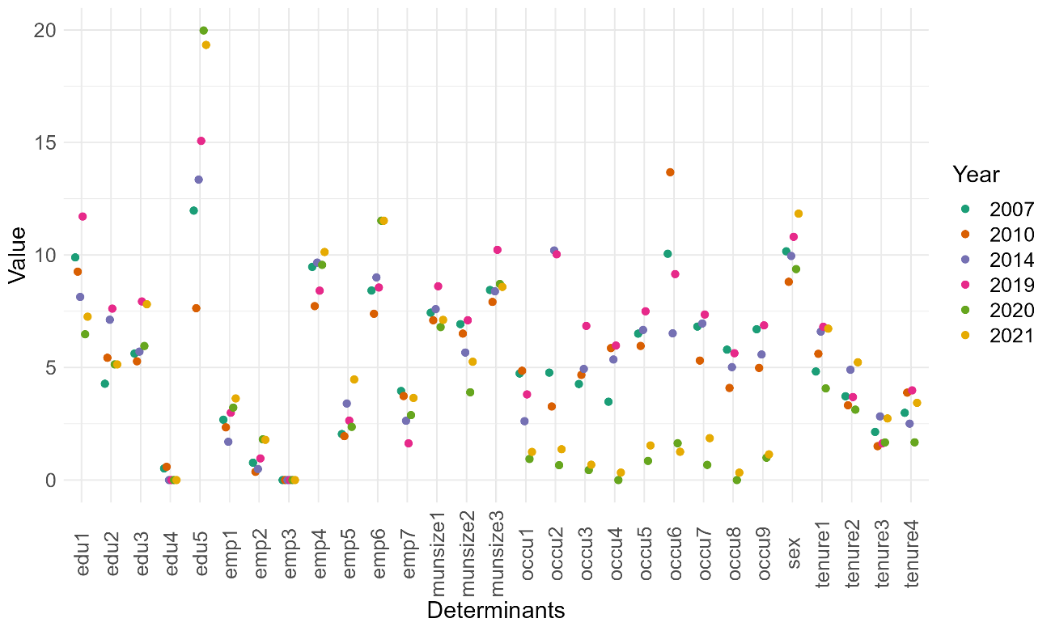
of income distribution and poverty across the different age groups. Figures 10, 11 and 12 illustrate the changes in the relevance of determinants in explaining income distribution
among young individuals, middle-aged individuals, and older adults, while Figure 13, 14 and 15 do the same for explaining poverty incidence.
The results presented in Figures 10, 11 and 12 highlight several interesting trends regarding the evolution of income decile determinants
for individuals based on their age profile, with the following four standing out:
1. The explanatory factors analysed are more relevant for explaining income distribution
among middle-aged individuals than among young or older individuals.
2. The explanatory factors have generally lost relevance in explaining the individual’s
income decile over the course of the period.
3. The decline in the relevance of explanatory factors is greater among young individuals
than among older adults and middle-aged individuals.
4. The most relevant explanatory factors differ for each group, highlighting the heterogeneity
in the factors influencing income distribution based on individuals' age profiles.
In the young group, the most relevant explanatory factors are related to employment
status, gender, and educational attainment. Among the employment-related variables,
being employed (emp1) or studying (emp4) are highly significant, although their importance
decreases over the period. Within the educational variables, having higher education
(edu5) stands out as the most relevant factor, despite its declining relevance throughout
the period. On a second level of importance are factors such as the type of municipality,
occupation, and the tenure type of the primary residence. Specifically, owning a home
(tenure1) emerges as a relevant factor, and among the occupational variables, working
in jobs related to hospitality and retail (emp6) is also important. In terms of territorial
scope, the three variables that take into account the population density of the municipality
are of similar relevance. This shows that the concentration of young people in the
lower income strata is not exclusively an urban phenomenon.
Among middle-aged individuals, three variables stand out in explaining their distribution
across income deciles: gender, being employed (emp1), and engaging in household duties
(occu6). Notably, the relevance of household duties has increased over the period.
A second group of significant explanatory factors includes variables related to education,
type of municipality, housing tenure, and type of occupation. It is noteworthy that
educational attainment, type of municipality, and, especially, housing tenure have
gained relevance in explaining individuals’ income decile over time, whereas gender,
employment status, and occupation-related variables have lost importance. This shift
highlights the growing role of access to housing as a determinant of well-being for
middle-aged individuals. It can also be observed that within this group, the type
of municipality is a determining factor, especially the fact of belonging to smaller
municipalities.
In the group of older adults, the most prominent explanatory factors relate to gender,
educational attainment, and employment status. Specifically, having higher education
(edu5) emerges as a highly significant factor, with its importance increasing considerably
over the period. However, having primary or secondary education also appears to be
relevant. Regarding employment status, being retired (emp4) and engaging in household
duties (emp6) are the most significant factors, both of which have grown in importance
over the period. Within this group, the type of municipality is a determining factor,
with the fact of living in a sparsely populated municipality standing out above the
rest.
Figure 10Income distribution determinants for young individuals in Galicia 2007-2021 Source: The authors from INE (2022).
Figure 11Income distribution determinants for middle-aged individuals in Galicia 2007-2021 Source: The authors from INE (2022).
Figure 12Income distribution determinants for old individuals in Galicia 2007-2021 Source: The authors from INE (2022).
Figures 13, 14 and 15 show the evolution of the relevance of explanatory factors in poverty incidence across
different age groups. Three main conclusions can be drawn from the analysis:
1. The explanatory factors analysed are more relevant for explaining poverty incidence
among middle-aged individuals than among young or older individuals.
2. Explanatory factors maintain a similar relevance throughout the period for middle-aged
and older adults but show a decrease in relevance among young individuals.
3. The most relevant explanatory factors in all three groups are related to the individuals'
employment status.
Within the group of young individuals, two explanatory factors stand out due to their
high relevance: being employed (emp1) and studying (emp3). However, it is noteworthy
that both of these factors have lost considerable relevance over the period. Among
middle-aged individuals, two factors also stand out: being employed (emp1) and engaging
in household duties (emp6). For older adults, the key explanatory factors are being
retired (emp4) and engaging in household duties (emp6), increasing its relevance during
the analysed period.
Regarding the variation in the relevance of productive factors, it should be noted
that among middle-aged individuals, being employed (emp1) has significantly increased
in relevance. The same trend is observed for being unemployed (emp2). In contrast,
engaging in household duties (emp6) has lost relevance over the period.
Figure 13Poverty incidence determinants for old individualsin Galicia 2007-2021 Source: The authors from INE (2022).
Figure 14Poverty incidence determinants for middle-aged individuals in Galicia 2007-2021 Source: The authors from INE (2022).
Figure 15Poverty incidence determinants for old individuals in Galicia 2007-2021 Source: The authors from INE (2022).
5. DISCUSSION
The results obtained show that, over the past few decades, particularly since the
Great Recession, the well-being of young people in Galicia (those under the age of
35) has deteriorated. Specifically, the findings reveal that young individuals are
increasingly concentrated in the lower income deciles, while middle-aged adults (aged
35 to 64) and older individuals (over 65) have experienced upward social mobility.
This shift is also reflected in a sharp rise in the incidence of poverty among the
youngest age groups. Moreover, an analysis of the determinants of poverty and income
among young people reveals that most of these factors have lost explanatory power,
highlighting the widespread and persistent nature of poverty among youth throughout
the period.
Underlying the deterioration in the well-being of young people over recent decades
are, among other factors, a decline in their labour market participation and an increase
in job insecurity. Furthermore, as evidenced by the results obtained, public policies
have done significantly less to offset the loss of well-being among young people compared
to the other two age groups.
These results show that the crisis has disproportionately affected young people, concentrating
its negative effects on this group. As a consequence, several related issues arise
that merit further discussion. The fact that income losses are concentrated among
the young, with long-lasting effects over time, highlights the need to introduce new
income replacement policies targeted at younger individuals and/or to expand existing
ones. In response to this need, the introduction of a basic income scheme specifically
aimed at young people could be a promising alternative, enabling them to cope with
greater income volatility. This proposal aligns with the ideas of authors such as
, who advocates for a substantial one-off payment upon reaching adulthood, which he
refers to as a "universal inheritance". Such a policy, however, runs the risk of undermining
horizontal equity, as it provides the same payment regardless of the individual's
socio-economic status. For this reason, it seems pertinent to also consider support
measures targeted at individuals experiencing poverty or precarious living conditions.
As a result of the decline in young people's well-being, further exacerbated by rising
rental prices, the generational gap has widened significantly in Galicia. It is therefore
essential to place youth well-being at the centre of the political agenda. This issue
is all the more pressing given that young people constitute a demographic group with
relatively low political weight and participation due to both demographic and social
factors. This may help explain the limited attention paid to young people by the main
political parties and may partially account for the rise and consolidation of far-right
populism among them.
Thus, the reasons behind young people's discontent, are not only rooted in the sharp
deterioration of their living conditions, as demonstrated in this article, but also
in the neglect they have experienced from public policy. It is therefore essential
to move towards a social pact that addresses the living conditions of young people,
so that they may be compensated, at least in part, for bearing the brunt of economic
crises without reaping the benefits of subsequent recoveries. Without such a pact
and effective policies, Galician society —and Spanish society more broadly— may face
a scenario of generational conflict that undermines social cohesion between age groups
and fuels the growth of political movements that exacerbate such divisions, despite
offering no real solutions to the challenges at hand.
Another aspect that emerges from the analysis is the significant role of family support
during economic crises, which is generally provided from older to younger generations.
While this is undoubtedly true and relevant, it is worth questioning to what extent
it is effective and desirable for the main source of support for young people to come
from families rather than directly from the public sector. The main concern underlying
this question lies in the unequal capacity of households to provide support and the
potential dependency relationships it may foster. In a society with the demographic
situation and trends currently observed in Galicia, making young people’s minimum
well-being dependent on their families does not appear to be the most appropriate
strategy for addressing the region’s natural demographic decline. Therefore, it seems
more appropriate to direct policies explicitly towards young people—or, at the very
least, towards those who lack sufficiently strong family support networks to sustain
a minimum and stable standard of living.
6. CONCLUSIONS
This research analyses the changes in income distribution and poverty incidence in
Galicia between 2007 and 2021 focusing on the generational disparities. The findings
of this study show that young people have been the most affected by adverse economic
dynamics over the period analysed, with the impact of the pandemic being particularly
striking. Specifically, the results demonstrate that those under 35 have experienced
a reduction in their income levels, an increase in income inequality, and higher levels
of poverty incidence. In contrast, middle-aged adults (aged 35 to 64) and older adults
(over 65) have seen an increase in their income levels during the period and experience
lower levels of poverty by the end of the period.
These different dynamics between young people and other adults are explained in part
by the higher dependence of young people on market income, who face higher rates of
unemployment, job insecurity and lower wages, as well as limited access to stable
jobs. On the other hand, middle-aged and older adults have benefited from greater
coverage of social benefits, such as pensions and public transfers, as well as greater
employment stability, particularly in sectors with less exposure to temporary and
precarious employment. This imbalance also highlights that current public policies
are limited when it comes to protecting young people from the effects of economic
crises.
The analysis underscores that the income sources and the income distribution and poverty
determinants differ markedly across age groups. For young people, the decline in wages
and limited access to stable employment have contributed to their welfare reduction.
Middle-aged individuals, while generally are better positioned, also face challenges,
particularly concerning housing access and employment stability. Older adults, benefiting
from a robust social safety net, remain relatively insulated from poverty but still
experience inequalities in income distribution.
These results point to the urgent need for targeted economic and social policies.
Addressing youth poverty and income inequality requires not only improving labour
market conditions but also implementing youth-focused social benefits and housing
support programs. At the same time, policies must ensure the continued protection
of older adults and support the middle-aged population in maintaining economic stability.
Educational attainment has behaved differently across age groups. It has increased
in importance as an explanatory factor among older adults, where higher education
has become a key determinant of higher earnings. Among young people, however, its
importance has declined slightly, highlighting the limitations of the labour market
to reward educational attainment in this group. This could be explained by the processes
of educational expansion or a lower value of qualifications for generating educational
returns.
Housing has been identified as a key factor in income distribution and poverty incidence,
especially for young and middle-aged adults. The results show an increase in the role
of tenure in explaining income inequalities, especially for middle-aged adults, while
for young people there is an increasing dependence on imputed rents. This phenomenon
reflects the difficulty for young people to access home ownership or rental housing,
forcing them to delay their emancipation or even return to the parental home, as had already pointed out for southern European countries. In this context, it is essential
to move towards a new social contract that recognises and addresses the deterioration
in young people's living conditions. This should be reflected in ambitious, sustained
public policies that promote the well-being of young people, reduce their reliance
on family support and strengthen social cohesion in the face of increasingly challenging
demographic trends.
By identifying the evolving determinants of income distribution and poverty, this
study provides a foundation for policymakers to design interventions that promote
equity and social cohesion across generations. Future research could further investigate
the long-term effects of these disparities and the impact of policy interventions
on reducing generational inequality.
Acknowledgements
This research has been supported by the ICEDE research group, to which the authors
belong, Galician Competitive Research Group ED431C 2022/15 financed by Xunta de Galicia
and project “REVALEC” REFERENCE PID2022-141162NB-I00 Financed by MCIN/ AEI / 10.13039/501100011033
/ EFRD, EU.
Also, José Manuel Amoedo the support received from the Xunta de Galicia 2021 predoctoral
training support programme (ayudas de apoyo a la etapa de formación predoctoral) with
reference number ED481A 2021/084. Hugo Campos-Romero acknowledges the support received
from the Xunta de Galicia 2024 postdoctoral training support programme (ayudas de
apoyo a la etapa de formación posdoctoral), co-funded by the Consellería de Cultura,
Educación, Formación Profesional y Universidades and the Agencia Gallega de Innovación
(reference number ED481B_048), as well as the funding received by the European Union
EACEA for the project “CEBCAT”, reference 101179061, financed by the Erasmus+ Programme.
7. REFERENCES
1
Amoedo, J. M., & Sánchez-Carreira, M. del C. (2023). The initial effects of Covid-19
on income inequalities in Galicia and their distribution in society. Revista Galega de Economía, 32(1), 1-23. https://doi.org/10.15304/rge.32.1.8551
2
Ayala, L., & Cantó, O. (2022). Radiografía de medio siglo de desigualdad en España. Fundación "la Caixa".
3
Atkinson, A. B. (2015). Inequality: What can be done? Harvard University Press.
4
Bentolila, S., Felgueroso, F., Jansen, M. & Jimeno, J. F. (2022). Lost in recessions:
youth employment and earnings in Spain. SERIEs, 13, 11-49. https://doi.org/10.1007/s13209-021-00244-6
5
Blanco, O., & Julián, D. (2019). A typology of precarious employment for Chile: Precariousness
as a cross-class phenomenon. CEPAL Review, 129, 91-128. https://doi.org/10.18356/8f5ac9c8-es
6
Boertien, D., & López-Gay, A. (2023). The polarization of real estate ownership and
increasing wealth inequality in Spain. European Sociological Review, 39(4), 615-629. https://doi.org/10.1093/esr/jcac072
Breiman, L., Cutler, A, Andy, L., & Wiener, M. (2024). Breiman and Cutlers Random Forests for Classification and Regression. [R package version 4.7-1.2].
10
Calzada, I., del Pino, E., & Jaime-Castillo, A. M. (2022). La sociedad española demanda
mayor igualdad económica. In Ayala, L. (Coord.), Desigualdad y pacto social (pp. 149-164). El Observatorio Social, Fundación la Caixa.
11
Chauvel, L. (2010). The long-term destabilization of youth, scarring effects, and
the future of the welfare regime in post-trente glorieuses France. French Politics, Culture & Society, 28(3), 74-96. https://doi.org/10.3167/fpcs.2010.280305
12
Chybalski, F., & Marcinkiewicz, E. (2022). A multidimensional approach to intergenerational
balance measurement: a cross-sectional study for European countries. Social Justice Research, 35, 206-241. https://doi.org/10.1007/s11211-022-00392-5
13
Corbelle, F., & Troitiño, A. (2013). Inequality and Poverty in Galicia between 2007
and 2010. How is the Distribution of Crisis Effects? Revista galega de economía, 22(2), 167-200. https://doi.org/10.15304/RGE.22.EXTRA.1406
14
del Río, C., & Gradín, C. M. (2003). A distribución da renda en Galicia: Balance das
tres últimas décadas. Revista Galega de Ciencias Sociais, (1), 41-56.
15
Díez, J. M., & Pardo, A. (2020). Despoblación, envejecimiento y políticas sociales
en Castilla y León. Revista Galega de Economía, 29(2), 1-18. https://doi.org/10.15304/rge.29.2.6959
16
Durán, J. M., & Esteller, A, (2022). ¿Se adapta el sistema fiscal español a la demanda
social de redistribución? In Ayala, L. (Coord.), Desigualdad y pacto social (pp. 93-110). El Observatorio Social, Fundación la Caixa.
17
EAPN-ES [Red Europea de Lucha contra la Pobreza y la Exclusión Social en el Estado
Español] (2022). Evolución estatal de la pobreza y la exclusión. En XVII Informe sobre el Estado de la Pobreza (pp. 13-75). EAPN-ES.
18
Escalonilla, M., Cueto, B., & Pérez-Villadóniga, M. J. (2022). Is the millennial generation
left behind? Inter-cohort labour income inequality in a context of economic shock.
Social Indicators Research, 164, 285-321. https://doi.org/10.1007/s11205-022-02958-x
Fernández-Leiceaga, X. (2024). Demographic regression and local finances: the case
of the Galician municipalities 2001-2019. Revista Galega de Economía, 33(3), 9601. https://doi.org/10.15304/rge.33.3.9601
21
de la Fuente, A. (2021). The economic consequences of Covid in Spain and how to deal
with them. Applied Economic Analysis, 29(85), 90-104. https://doi.org/10.1108/AEA-11-2020-0158
22
Gradín, C. M. (2001). Polarización y desigualdad en Galicia y España, un análisis
comparativo. Revista de Estudios Regionales, (59), 47-68.
23
Grömping, U. (2015). Variable importance in regression models. Wiley interdisciplinary
reviews. Computational statistics, 7(2), 137-152. https://doi.org/10.1002/wics.1346
24
Hess, M., Nauman, E., & Steinkopf, L. (2017). Population ageing, the intergenerational
conflict, and active ageing policies–a multilevel study of 27 European countries.
Journal of Population Ageing, 10, 11-23. https://doi.org/10.1007/s12062-016-9161-3
25
Carrascal, A., & Fernández, M. (2015). Tourism and income distribution: Evidence from
a developed regional economy. Tourism Management, 48, 11-20. https://doi.org/10.1016/j.tourman.2014.10.016
26
IGE [Instituto Galego de Estatística] (2024). Enquisa estrutural a fogares. Ficheiro de microdatos (edicións 2008-2022).
27
INE [Instituto Nacional de Estadística] (2022). Encuesta de condiciones de vida. Microdatos.
INEbase.
28
Liu, M., Hu, S., Ge, Y., Heuvelink, G. B., Ren, Z., & Huang, X. (2021). Using multiple
linear regression and random forests to identify spatial poverty determinants in rural
China. Spatial Statistics, 42, 100461. https://doi.org/10.1016/j.spasta.2020.100461
29
Merino-Llorente, M. C., & Arechavala, M. N. (2020). European part-time workers’ health
and well-being in times of crisis. The case of female part-timers. Hacienda Pública Española, 235(4), 61-86. https://dx.doi.org/10.7866/HPE-RPE.20.4.4
30
Módenes, J. A. (2022). Inestabilidad y problemas de acceso a la vivienda, una realidad
cada vez más extendida: Evolución reciente de las desigualdades demográficas y sociales
en el acceso y la estabilidad residenciales. In Ayala, L. (Ed.), Desigualdad y pacto social (pp. 59-76). El Observatorio Social, Fundación la Caixa.
31
Moreno, A. (2012). The transition to adulthood in Spain in a comparative perspective:
The incidence of structural factors. Young, 20(1), 19-48. https://doi.org/10.1177/110330881102000102
32
OECD [Organisation for Economic Co-operation and Development] (2022). Delivering for
youth: How governments can put young people at the centre of the recovery. OECD Policy Responses to Coronavirus (COVID-19). OECD Publishing. https://doi.org/10.1787/92c9d060-en
33
Pena-Boquete, Y., & Dios-Murcia, I. (2021). Factors behind the employment loss in
Galicia: Great Recession of 2008 vs. the first wave of the COVID-19 pandemic. Revista Galega de Economía, 30(1), 1-18. https://doi.org/10.15304/rge.30.1.7451
34
Piketty, T. (2014). Capital in the Twenty-First Century. Harvard University Press.
35
Piketty, T. (2019). Capital and ideology. Harvard University Press.
36
Rice, J. M., Temple, J. B. & McDonald, P. F. (2021). Intergenerational inequality
and the intergenerational state. Journal of Population Research, 38(4), 367-399. https://doi.org/10.1007/s12546-021-09273-1
37
Rodgers, G., & Rodgers, J. (1989). Precarious jobs in labour market regulation: The growth if atypical employment in
Western Europe. International Labour Organization.
38
Sánchez, M. C., Sánchez, P., Cruz, M. M., & Sánchez, F. J. (2013). Precariedade laboral-Pobreza
en Galicia en tempos de crise. Revista Galega de Economía, 22, 201-224. https://doi.org/10.15304/rge.22.Extra.1407
39
Simón, P. (2021). El impacto de la pandemia en los jóvenes: una aproximación multidimensional.
Panorama social, (33), 109-125.
40
Sohnesen, T. P., & Stender, N. (2017). Is random forest a superior methodology for
predicting poverty? An empirical assessment. Poverty & Public Policy, 9(1), 118-133. https://doi.org/10.1002/pop4.169
41
Soriano, I., & Gainza, X. (2025). La Desigualdad de Riqueza en Perspectiva Generacional:
Evidencia de la Encuesta Financiera de las Familias (2002-2020). Revista Española de Investigaciones Sociológicas, (189), 149–166. https://reis.cis.es/index.php/reis/article/view/60
42
Stiglitz, J. (2013). The Price of Inequality: How Today's Divided Society Endangers Our Future. W.W. Norton & Company.
43
Úbeda, M., Cabasés, M. À., Sabaté, M., & Strecker, T. (2020). The Deterioration of
the Spanish Youth Labour Market (1985–2015): An Interdisciplinary Case Study. YOUNG, 28(5), 544-563. https://doi.org/10.1177/1103308820914838
44
Van de Velde, C. (2022). ¿Una brecha generacional global?: Juventud y relaciones intergeneracionales
en el siglo xxi. In L. Sepúlveda & A. Moreno (Eds.), Transiciones educativo-laborales de jóvenes en tiempos de incertidumbre (pp. 53–78). Ediciones Universidad Alberto Hurtado. https://doi.org/10.2307/j.ctv3596xhc
45
Vázquez-Taín, M. Á. (2020). Demografía y sostenibilidad del sistema público de pensiones.
Revista Galega de Economía, 29(2), 1-18. https://doi.org/10.15304/rge.29.2.6917
APPENDIX
Table A.1. Income composition by age group in Galicia (2007-2021)
Source: The authors from INE (2022)
Income source
Young
Middle
Old
2007
2010
2014
2019
2020
2021
2007
2014
2010
2019
2020
2021
2007
2010
2014
2019
2020
2021
Wages
51.13%
44.36%
34.12%
39.33%
32.20%
35.28%
46.60%
46.97%
48.50%
52.87%
51.76%
55.32%
1.36%
1.61%
2.07%
3.65%
2.98%
3.59%
Mixed
2.84%
0.85%
2.68%
1.07%
1.90%
1.91%
9.05%
6.61%
6.56%
7.82%
4.60%
4.96%
1.71%
1.63%
1.22%
1.62%
1.23%
8.15%
Financial
2.90%
3.53%
3.11%
0.92%
1.06%
1.01%
2.57%
2.93%
2.24%
0.84%
0.64%
0.48%
4.57%
3.85%
4.43%
1.99%
1.94%
1.99%
Real Estate
1.71%
1.55%
2.59%
2.65%
3.11%
3.71%
1.41%
1.64%
1.03%
1.63%
1.29%
1.48%
2.18%
2.00%
1.32%
1.97%
2.31%
2.12%
Imputed rent
34.11%
36.30%
47.45%
67.98%
53.99%
49.01%
26.47%
25.49%
24.45%
29.38%
22.51%
22.63%
25.84%
25.17%
25.92%
28.15%
27.44%
30.74%
Unemployment benefits
2.71%
6.00%
4.42%
2.09%
5.03%
3.59%
4.50%
7.22%
6.73%
5.00%
9.21%
6.22%
0.25%
0.57%
0.18%
0.28%
1.34%
0.92%
Retirement benefits
4.83%
4.85%
6.04%
6.61%
7.29%
7.04%
9.09%
8.56%
9.65%
8.96%
8.85%
8.16%
61.51%
65.39%
65.92%
63.24%
64.01%
64.20%
Other benefits
0.47%
1.77%
1.67%
2.38%
2.19%
3.07%
0.42%
0.84%
0.92%
1.20%
1.25%
1.85%
0.51%
0.24%
0.25%
0.62%
0.27%
5.19%
Source: The authors from
Notes
[1] By way of clarification, a brief description of the following terms is given below:
vulnerability, precariousness, relative poverty and absolute poverty. Vulnerability
is defined as a situation that generates an increased likelihood of falling into poverty
or precariousness in the face of changes in the environment. Precariousness refers
to the existence of instability in fundamental aspects such as employment, housing
or access to basic services. The difference between relative poverty refers to how
the two are measured. On the one hand, relative poverty measures the situation of
an individual in comparison with the rest by establishing a moving threshold (commonly
used for income is 60% of the median income). On the other hand, absolute poverty
measures the individual's situation by setting a fixed threshold (e.g. having an income
below a certain amount).
[2] It measures the percentage of people at risk of poverty or social exclusion, understood
as the situation of those who meet at least one of three criteria: having a disposable
income below 60% of the national median (at risk of poverty), living in conditions
of severe material and social deprivation (lacking at least 7 out of 13 essential
elements), or residing in households with low employment intensity (adults worked
less than 20% of their labour potential in the year). The difference between relative
poverty refers to how both are measured. On the one hand, relative poverty measures
the individual's situation in comparison with the rest by setting a moving threshold
(commonly used for income at 60% of median income). On the other hand, absolute poverty
measures the individual's situation by setting a fixed threshold (e.g. having an income
below a certain amount).
Otros datos estadísticos
Imágenes
José Manuel Amoedo
ICEDE Research Group, Department of Applied Economics, Faculty of Economics and Business Sciences. Universidade de Santiago de Compostela, Avenida do Burgo das Nacións, s/n, 15782, Santiago de Compostela, Spain
Bruno Blanco-Varela
ICEDE Research Group, Accounting and Finance Department, Faculty of Economics and Business Sciences, Universidade de Santiago de Compostela, Avenida do Burgo das Nacións, s/n, 15782, Santiago de Compostela, Spain
Hugo Campos-Romero
ICEDE Research Group, Department of Applied Economics, Faculty of Economics and Business Sciences. Universidade de Santiago de Compostela, Avenida do Burgo das Nacións, s/n, 15782, Santiago de Compostela, Spain