This article analyzes the differential patterns in the criminal disappearances of women in Spain. Although official statistics show a male prevalence in missing persons cases, women are the predominant victims in the most serious cases. Through a qualitative methodology, three key typologies are identified: intimate femicide, linked to the “relational factor” and a history of prior abuse; non-intimate sexual femicide; and human trafficking for sexual exploitation. In these cases, the concealment of the body is detected not as a mere act of self-covering, but as a post-mortem expression of domination and symbolic erasure of the victim. Therefore, the lack of a gender perspective from the outset of the investigation represents a critical deficiency. This can lead to incorrect risk assessment and fatal delays, undermining the effectiveness of justice.
Keywords:
criminal disappearances, gender-based violence, femicide, gender perspective, concealment of the body
Llorens Sellés: DESAPARICIONES CRIMINALES DE MUJERES EN ESPAÑA: ANÁLISIS PENAL Y PATRONES DIFERENCIALES
1. Introducción
1.1. Contextualización del fenómeno de las desapariciones
El fenómeno de las desapariciones en España es una realidad social de notable magnitud.
Según los datos del Centro Nacional de Desaparecidos (en adelante CNDES), durante
el año 2024 se registraron 26.345 denuncias por desapariciones. A primera vista, las cifras globales sugieren una mayor prevalencia masculina en
cuanto a desapariciones, ya que un 58,5% de esas denuncias corresponden a hombres,
frente al 41,5% que corresponden a las mujeres. Sin embargo, un análisis más profundo revela una paradoja cuantitativa-cualitativa
que es central para este artículo. La inmensa mayoría de estos casos, aproximadamente
el 91%, son catalogados como desapariciones voluntarias, detectándose una alta reincidencia entre menores de edad, de nacionalidad española,
con la misma prevalencia de los hombres frente a las mujeres.
Este panorama estadístico general, si bien es relevante, oculta una realidad criminológica
diferenciada y de extrema gravedad: las desapariciones criminales. Dentro del reducido
número de desapariciones clasificadas como forzosas (un 0,6% del total) y aquellas que culminan con el hallazgo de un cadáver (de una persona que ha sido
víctima de un hecho delictivo), los patrones se invierten y las dinámicas de género
emergen con una evidente claridad. Es en este contexto donde la pregunta: «¿Por qué
desaparecen de forma diferente las mujeres?» adquiere una crucial relevancia. No se
trata solo de una diferencia numérica, sino de una distinción etiológica fundamental:
una violencia específica dirigida contra las mujeres por el mero hecho de serlo.
1.2. Impacto Mediático y Justificación del Estudio
La conciencia social y la agenda político-legislativa en España han sido profundamente
moldeadas por casos de desaparición y asesinatos de mujeres que han trascendido la
crónica de sucesos para convertirse en catalizadores de un debate nacional. El caso
de Ana Orantes, asesinada en 1997 tras denunciar públicamente en televisión cuatro
décadas de maltrato, representó un punto de inflexión que visibilizó la violencia
de género como un problema estructural y no como un asunto privado, impulsando de
manera decisiva la promulgación de la Ley Orgánica 1/2004, de medidas de protección
integral contra la violencia de género.
Más recientemente, los casos de Marta del Castillo, Diana Quer y Marta Calvo, entre otros casos de gran repercusión social, han puesto de relieve la angustia
de la desaparición seguida de un homicidio, en el que posteriormente se oculta el
cadáver, generando una intensa demanda social de respuestas penales y procesales de
mayor contundencia. Estos casos no son meros ejemplos; son hitos que han forzado al sistema legal y
a la sociedad a afrontar las manifestaciones más extremas de la violencia contra las
mujeres. La sentencia del caso Diana Quer, por ejemplo, al confirmar la prisión permanente
revisable, subraya “la perversidad del acto” y el “desprecio absoluto a la mujer” como elementos centrales del crimen.
A pesar del enorme impacto de estos sucesos, se constata un déficit en cuanto a estudios
jurídico-penales que analicen de forma integral los patrones diferenciadores de las
desapariciones criminales de mujeres. Este artículo se justifica en la necesidad de
proporcionar, en esta materia, un análisis riguroso que conecte la evidencia empírica,
la teoría criminológica de género y la aplicación práctica del Derecho Penal.
1.3. Objeto del Estudio
El objetivo principal de este artículo es analizar por qué y cómo las desapariciones
criminales de mujeres en España presentan patrones específicos y diferenciados a los
que afectan a los hombres. Se busca analizar si estas diferencias están intrínsecamente
ligadas al hecho de ser mujer. Para ello, se examinará cómo estos patrones se reflejan
en el ordenamiento jurídico-penal español, analizando la tipificación de los delitos,
la interpretación jurisprudencial y los protocolos de investigación, con el fin de
argumentar la necesidad ineludible de adoptar una perspectiva de género en la calificación
y enjuiciamiento de estos hechos.
2. Marco teórico
Para abordar la complejidad de las desapariciones criminales de mujeres, es preciso
establecer un marco teórico que integre conceptos criminológicos, penales y de la
teoría de género.
2.1. Desapariciones de Etiología Criminal: Definición y Tipología
Una desaparición se considera de etiología criminal, cuando su origen es un ilícito
penal. Esta categoría se encuentra integrada en las distintas tipologías identificadas
por el CNDES, que son las siguientes:
-
Desapariciones voluntarias: Constituyen la mayoría de los casos denunciados (aproximadamente un 91%) y se refieren a personas que deciden ausentarse por voluntad propia. Este grupo incluye
una alta proporción de fugas de menores de centros de protección o del hogar familiar.
-
Desapariciones involuntarias: Hacen referencia a casos donde la ausencia es ajena a la voluntad de la persona,
como puede ser un accidente, desorientación, etc., siempre que no medie causa delictiva alguna.
Dentro de esta categoría se incluye un subtipo denominado “desapariciones sin causa
aparente” que son aquellas en las que no existe ningún motivo aparente o conocido
para que tal hecho se produzca.
-
Desapariciones forzosas: Este es el término que utiliza el CNDES para las desapariciones de etiología inequívocamente
criminales, como secuestros, detenciones ilegales, etc. Aunque éstas son estadísticamente
minoritarias (solo un 0,6% de los casos de desapariciones en 2024), son las de mayor gravedad y el foco principal de este artículo.
Es crucial señalar que una desaparición inicialmente clasificada como voluntaria o
involuntaria podría ser recalificada a criminal (forzosa) a medida que avanzara una
investigación y emergieran indicios de un delito subyacente, como un homicidio. En
el caso de las desapariciones involuntarias sin causa aparente, la recalificación
se daría una vez se conocieran las causas o motivos de dicha ausencia.
2.2. Clasificación desde la Perspectiva Penal
Las desapariciones criminales en España no están tipificadas como un delito específico.
El Código Penal español (en adelante CP), articula un conjunto de tipos delictivos,
que constituyen el marco jurídico para perseguir los actos subyacentes a las desapariciones
criminales.
Así, el Código Penal castiga la sustracción parental de menores de edad (art. 225
bis CP) y la inducción de menores o personas con discapacidad necesitadas de especial
protección al abandono del domicilio (art. 224 CP). Estos actos pueden constituir
formas de desaparición en la medida en que implican la separación de la víctima de
su entorno habitual, pudiendo dar lugar al desconocimiento de su paradero.
Otros delitos estrechamente vinculados con las desapariciones criminales son el secuestro
y la detención ilegal cuando no se da razón del paradero de la persona privada de
libertad (art. 166 CP), generándose así una auténtica situación de desaparición desde
una perspectiva victimológica y jurídico-penal, al provocar en los familiares y allegados
una incertidumbre prolongada sobre la suerte y el paradero de la víctima.
Asimismo, deben considerarse aquellos delitos que, en muchos casos, se traducen en
la desaparición del cuerpo de la víctima, como ocurre con el homicidio (art. 138 CP)
y el asesinato (art. 139 CP). El Código Penal también tipifica las conductas encaminadas a facilitar la desaparición
de la víctima tras su fallecimiento, como sucede con el delito de profanación de cadáver
(art. 526 CP); y aquellas destinadas a dificultar su localización; tales como el delito de encubrimiento
(art. 451 CP); o el delito contra la integridad moral en su modalidad de ocultación reiterada de
información sobre el paradero de un cadáver (art. 173.1 CP).
A modo de conclusión puede afirmarse que, aunque no exista un tipo único de “desaparición
criminal”, el Código Penal ha creado un entramado legal que permite perseguir todos
los actos delictivos que suelen causar o prolongar una desaparición.
2.3. La perspectiva de Género en el Derecho Penal: Conceptos clave
La aplicación neutral de las normas penales es insuficiente para capturar una realidad
como es la de la violencia contra las mujeres. La perspectiva de género, en este sentido,
ofrece un marco analítico indispensable para comprender estas dinámicas.
Violencia Estructural y el "Factor Relacional": La violencia de género no es una suma de actos individuales y aislados, sino la manifestación
de una violencia estructural; es decir, un daño a las necesidades humanas básicas que se produce en contextos
de poder asimétricos y que está normalizado e institucionalizado en la sociedad. En el caso de la violencia contra las mujeres, esta estructura es el patriarcado. Dentro de esta violencia estructural, el "factor relacional" es un concepto criminológico clave que explica por qué la mayor parte de la violencia
grave contra las mujeres es perpetrada por hombres con los que tienen o han tenido
un vínculo íntimo o de confianza. La relación de pareja, en esas circunstancias, en lugar de ser un espacio de seguridad,
se convierte en el epicentro del riesgo, donde en determinados casos, se ejercen dinámicas
de control coercitivo, dominación y posesión que pueden escalar hasta la violencia
letal.
Feminicidio como Categoría Criminológica: Aunque el término "feminicidio" no está tipificado como tal en el Código Penal español, su uso como categoría criminológica es fundamental para el análisis. Se define el
feminicidio como el asesinato de una mujer por razones de género, es decir, por ser mujer. Este concepto político y analítico, atribuible a Diana Russell, permite distinguir estos crímenes de otros homicidios y visibilizar una serie de
características específicas que los motivan. La doctrina ha desarrollado diversas tipologías que pueden ser de gran utilidad
para este artículo:
Feminicidio Íntimo: Cometido por un hombre con quien la víctima tenía o tuvo una relación de pareja.
Es la forma más común y se conecta directamente con el "factor relacional" y la violencia
de género del art. 173.2 CP.
Feminicidio No Íntimo: Perpetrado por un desconocido, a menudo con un componente sexual, como en el caso
Diana Quer.
Feminicidio por Conexión: Asesinato de una mujer (p. ej., una amiga o familiar) que se interpone o se encuentra
"en la línea de fuego" de un ataque dirigido a otra mujer.
Feminicidio por Trata: Ocurre en el contexto de la trata de personas para explotación sexual.
La utilidad de estas categorías no es meramente académica. Permiten a los operadores
jurídicos y policiales enmarcar la investigación desde el inicio, buscando indicios
de dominación, control, violencia sexual o misoginia que serían claves para una correcta
calificación jurídica, especialmente para la hipotética aplicación de una agravante
de género (art. 22.4 CP) y la posibilidad de modular entre el homicidio o el asesinato
en virtud de las circunstancias que concurrieran en el caso (art. 138 y ss CP).
3. Metodología
Este artículo emplea una metodología de investigación cualitativa, documental y analítica
que integra múltiples fuentes para triangular los hallazgos y garantizar la solidez
de las conclusiones. El enfoque metodológico se articula en torno a cuatro ejes principales:
1. Análisis de Datos Cuantitativos y Oficiales: Se ha realizado un examen exhaustivo de los informes estadísticos publicados por
el Centro Nacional de Desaparecidos (CNDES), dependiente del Ministerio del Interior, con especial atención a los informes anuales
de 2023 y 2024. Estos datos proporcionan la base empírica sobre el volumen, la tipología (voluntaria,
involuntaria, forzosa) y las características sociodemográficas (sexo, edad, nacionalidad)
de las desapariciones en España. Complementariamente, se han analizado las estadísticas
de criminalidad del Ministerio del Interior para contextualizar los delitos violentos.
2. Análisis Jurisprudencial: Se ha llevado a cabo un análisis pormenorizado de sentencias clave dictadas por el
Tribunal Supremo y diversas Audiencias Provinciales. Este análisis no se limita a una mera cita, sino que profundiza en la ratio decidendi (razonamiento jurídico) de cada fallo. Se han seleccionado casos paradigmáticos que
ilustran los patrones de desaparición criminal de mujeres, como el caso de la joven
Marta del Castillo, desaparecida en Sevilla en el año 2009, cuyo cuerpo todavía no
ha sido hallado y el caso de la joven Diana Quer, desaparecida en A Pobra do Caramiñal en el año
2016, cuyo cuerpo fue encontrado un año y cuatro meses después de la desaparición,
tras ser detenido su asesino. Asimismo, se han examinado sentencias que establecen doctrina sobre cuestiones cruciales
como la aplicación de la agravante de género (p. ej., STS 917/2023), el concurso de
delitos y el autoencubrimiento impune.
En este contexto, se realizó una investigación empírica propia sobre una muestra de
138 casos de desapariciones criminales de mujeres ocurridos en España entre los años
1979 y 2025 (únicamente el primer semestre). El análisis se apoyó sobre un total de
269 sentencias, así como en la cobertura de dichos casos en hemerotecas digitales de medios de comunicación
de alcance nacional. El objetivo principal consistió en identificar patrones recurrentes en cuanto a
perfil del autor, determinar el móvil del crimen, examinar los distintos modus operandi, y estudiar el tratamiento dado al cuerpo de la víctima.
Procedimiento de selección: Los casos fueron seleccionados mediante un criterio mixto. En primer lugar, se llevó
a cabo una búsqueda en dos bases de datos jurídicas (La Ley Digital y CENDOJ) introduciendo como palabras clave “ocultación de cadáver”. Los resultados obtenidos
fueron ordenados de acuerdo con criterios de relevancia establecidos por las propias
bases de datos. Posteriormente, respetando el orden establecido por las bases de datos,
se realizó una depuración manual de los resultados para excluir aquellos supuestos
en los que la desaparición del cuerpo no constituía un elemento central del delito
o en los que la localización del cadáver se hubiera producido de manera inmediata.
Criterios de inclusión:
-
Casos de desapariciones de etiología criminal en España entre 1979 y el primer semestre
de 2025.
-
Resoluciones judiciales (sentencias de Audiencias Provinciales y del Tribunal Supremo)
en las que se hace referencia expresa a ocultación, inhumación clandestina o desmembramiento
del cadáver.
-
Sentencias firmes o confirmadas en apelación/casación.
-
Casos en los que, aun sin hallazgo del cadáver, existió condena penal basada en prueba
indiciaria (p. ej., Marta del Castillo).
-
Casos paradigmáticos de alto impacto mediático (ej. Diana Quer, Rocío Wanninkhof),
siempre que estuvieran vinculados a un procedimiento judicial.
Criterios de exclusión:
-
Desapariciones voluntarias, accidentales o de etiología no criminal.
-
Casos de trata de seres humanos sin desaparición efectiva de la víctima.
Descripción de la muestra: La muestra abarca 138 desapariciones criminales de mujeres, que involucran a 161 víctimas y 155 autores identificados. La distribución policial
de la investigación de los casos, en virtud de sus respectivas demarcaciones competenciales,
fue la siguiente: Guardia Civil 44,20% (61); Policía Nacional 32,61% (45); Mossos
d’Esquadra 21,74% (30); Ertzaintza 0,72% (1); y Policía Foral 0,72% (1). Los casos analizados se reparten por todas las Comunidades Autónomas, con la única
excepción de Cantabria. Los porcentajes de participación territorial en la muestra
son los siguientes: Cataluña el 23,91%; Andalucía el 17,39%; Valencia el 11,59%; Madrid
el 10,87%; Canarias el 10,14%; Castilla León y Galicia el 5,80% cada una; Asturias
y Castilla La Mancha el 3,62% cada una; Aragón el 2,17%; Baleares y el País Vasco
el 1,45% cada una; y finalmente Murcia, Navarra y Extremadura el 0,72% cada una.
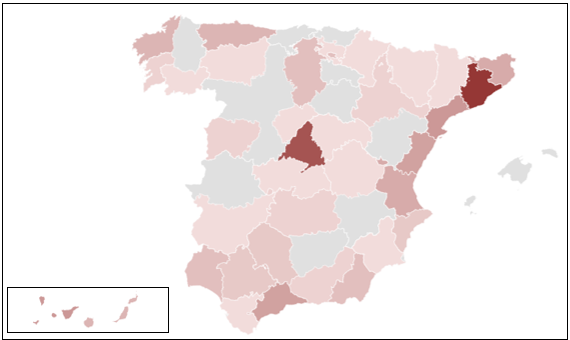
La distribución territorial de los casos de la muestra se detalla en el siguiente
mapa de calor (Imagen 1), que permite visualizar la concentración relativa de las desapariciones criminales
de mujeres analizadas en cada provincia.
Limitaciones y alcances del estudio: El presente trabajo debe entenderse a la luz de determinadas limitaciones metodológicas.
En primer lugar, la selección de casos se realizó a partir de resoluciones judiciales
y noticias vinculadas a la “ocultación de cadáver”, lo cual puede introducir un sesgo
de inclusión, dejando fuera desapariciones criminales sin esta calificación procesal
o sin hallazgo de restos. En segundo lugar, existe una dependencia inevitable de la
cobertura mediática, que ha condicionado la notoriedad de ciertos casos frente a otros
de menor repercusión.
Asimismo, las estadísticas oficiales del Centro Nacional de Desaparecidos (CNDES)
no ofrecen una desagregación sistemática por sexo en las desapariciones catalogadas
como “forzosas”, lo que obliga a inferir patrones a partir de muestras jurisprudenciales
y no de la totalidad de los registros.
Estas limitaciones determinan que los resultados no puedan extrapolarse de manera
general a todas las desapariciones en España. No obstante, los hallazgos permiten
identificar tendencias significativas en las desapariciones criminales de mujeres,
ofreciendo claves para mejorar la investigación policial y la interpretación judicial
de estos fenómenos.
Utilidad de la muestra propia: La incorporación de un análisis propio sobre una muestra de 138 casos, responde a
una necesidad metodológica insoslayable: trascender las limitaciones de las estadísticas
oficiales para el específico objeto de investigación. Las fuentes públicas, aunque
valiosas, no permiten desentrañar las particularidades de las desapariciones criminales
de mujeres, pues adolecen de dos carencias fundamentales.
En primer lugar, no ofrecen una desagregación detallada por género dentro de la categoría
de desapariciones forzosas o de etiología criminal. En segundo lugar, las estadísticas sobre homicidios o asesinatos omiten un dato
criminológicamente vital para este artículo: si el autor ocultó o destruyó el cadáver,
pudiendo contribuir así la desaparición de la víctima.
Esta investigación casuística, sustentada sobre un número significativo de casos,
solventa directamente estas lagunas. Permite aportar cifras concretas y verificables
sobre variables no registradas oficialmente, complementando las tesis defendidas en
el presente artículo con un fundamento empírico robusto, a la vez que ofrecen una
aproximación fidedigna a la realidad del fenómeno.
3. Análisis Normativo y Doctrinal: El presente artículo también, se fundamenta en una revisión sistemática de la legislación
penal española, principalmente los artículos del Código Penal que tipifican la detención
ilegal, el secuestro, el homicidio, el asesinato, la trata de seres humanos y la violencia
de género. Este análisis normativo se contrasta y enriquece con doctrina penalista
y criminológica, tanto nacional como internacional, sobre conceptos como la perspectiva
de género en el Derecho Penal, la violencia estructural y la categoría criminológica
del feminicidio, entre otros conceptos de interés.
4. Revisión de Protocolos Institucionales: Para evaluar la respuesta del sistema, se han analizado los protocolos y guías de
actuación policial y judicial. Destaca el análisis del Protocolo para la Valoración
Policial del Nivel de Riesgo de Violencia de Género y la Instrucción 1/2009 de la Secretaría de Estado de Seguridad sobre desapariciones
de alto riesgo. Estos documentos son esenciales para comprender cómo se valora el
riesgo en las primeras horas de una desaparición y cómo se activan los mecanismos
de protección e investigación.
Mediante la combinación de estas fuentes, el artículo identifica los patrones recurrentes
en las desapariciones criminales de mujeres y analiza su tipificación penal asociada,
valorando la coherencia y eficacia de la respuesta institucional.
4. Análisis y Discusión
El análisis de las desapariciones de mujeres de etiología criminal en España revela
un conjunto de factores diferenciales que no solo explican por qué sus casos son distintos,
sino que también exigen una respuesta penal y procesal específica. Esta sección desglosa
dichos factores, su encaje en el Código Penal y el impacto de la perspectiva de género
en la investigación.
4.1. Factores Diferenciales en la Desaparición de Mujeres
A diferencia de las desapariciones de hombres, que en su vertiente criminal suelen
estar asociadas a la delincuencia común, las de las mujeres se inscriben mayoritariamente
en un marco de violencia de género.
4.1.1. El Contexto de Violencia de Género Previa
Un factor de presencia abrumadora en las desapariciones criminales de mujeres es la
existencia de un historial de violencia de género. La Memoria de la Fiscalía General
del Estado (FGE) de 2023, analizando los datos de 2022, revela que en el 44% de los
feminicidios consumados la víctima había presentado denuncia previa. Esta cifra, que indica que en 11 de cada 25 casos existen antecedentes previos denunciados
de violencia, demostraría que la desaparición criminal feminicida no sería un acto
aislado, sino que representaría el clímax de una escalada de violencia prolongada.
Este patrón, además, se alinea con el modelo del ciclo de la violencia (The Cycle Theory of Violence) descrito por la psicóloga Lenore Walker (1979), que identifica tres fases recurrentes:
acumulación de tensión, explosión violenta, y reconciliación o "luna de miel". Con cada repetición del ciclo, la violencia tiende a agravarse y la fase de "luna
de miel" a acortarse o desaparecer, pudiendo culminar en el feminicidio. La desaparición, en este contexto, es la última y más brutal de las explosiones
de violencia, que probablemente ha sido precedida por un largo historial de agresiones físicas,
psicológicas, sexuales y económicas.
No obstante, en el caso de desapariciones criminales feminicidas, se da un dato alarmante,
extraído de la investigación propia realizado, la ausencia de denuncias previas por
los malos tratos sufridos. Esta invisibilidad oficial, es un factor crítico que dificulta
enormemente la correcta calificación inicial de la desaparición como de “alto riesgo”
por parte de las Fuerzas y Cuerpos de Seguridad.
4.1.2. El Vínculo con el Victimario: El "Factor Relacional"
El segundo factor diferencial es la identidad del autor. En la gran mayoría de los
casos de desaparición criminal de mujeres, el perpetrador es su pareja o expareja. Este dato se confirma en el análisis de 138 casos, donde en 70 de ellos el autor
era la pareja o expareja de la víctima (50,72% de los casos analizados), muy alejado
del 13,04% cometido por conocidos o amistades o del 11,59% cometido por personas desconocidas
por la víctima. Este "factor relacional" es la piedra angular para entender este fenómeno.
El crimen nace mayoritariamente de una dinámica de poder y control coercitivo que
el agresor busca mantener o recuperar, especialmente ante la decisión de la mujer
de terminar la relación. La ruptura de la pareja es un momento de riesgo extremo, como demuestran estudios
criminológicos que indican que hasta un tercio de los feminicidios se producen en
un contexto de separación. El agresor, que percibe la autonomía de la mujer como una traición o una afrenta
a su autoridad, reacciona con una violencia letal para reafirmar su dominio.
4.1.3. El Móvil del Crimen y la Causa de la Muerte
El análisis de los casos en la investigación revela que, ante la desaparición criminal
de mujeres, el ámbito delincuencial predominante es el relacionado con la violencia
de género (el 50,72% de los casos), seguido de la delincuencia sexual (18,84%) y de
la delincuencia común (16,67%). En este contexto, los móviles principales son el sentido de posesión y
la incapacidad del autor para aceptar la autonomía de la mujer, especialmente su decisión
de poner fin a la relación (en un 30,56% de los casos); o la dinámica de malos tratos
y violencia contra la mujer con una deriva fatal (el 36,11% de los casos), siendo
los celos el tercer factor que lleva a la muerte de la mujer en el ámbito de la violencia
de género, según esta investigación (en un 9,72% de los casos). En cuanto a la causa
de la muerte, se observa una prevalencia de métodos que no requieren una planificación
sofisticada y que denotan un contacto directo y brutal: los golpes con objetos contundentes
o directamente con los puños suponen el 32,61% de las muertes en los casos analizados,
seguidos de los estrangulamientos en un 25,36%; muy por encima del uso de armas blancas (15,94%) o de fuego (2,90%).
4.1.4. El Contexto de Explotación Sexual y Trata
Una tipología específica de desaparición que afecta casi exclusivamente a mujeres
y niñas es la vinculada a la trata de seres humanos con fines de explotación sexual, tipificada en el artículo 177 bis del Código Penal. En estos casos, la desaparición es el medio para someter a la víctima. Las redes
de trata utilizan el engaño (falsas ofertas de trabajo), la coacción o el abuso de
una situación de vulnerabilidad para captar a las víctimas, privarlas de su libertad
y explotarlas sexualmente. Aunque esta modalidad no siempre culmina en homicidio, la privación de libertad
y la explotación constituyen en sí mismas una forma de "desaparición" social y jurídica.
4.1.5. La Ocultación del Cadáver como Acto de Dominación Machista
En los casos que terminan en feminicidio, un patrón recurrente y de profundo significado
criminológico es la ocultación, desmembramiento o destrucción del cadáver. Si bien
este acto tiene una finalidad pragmática de autoencubrimiento para eludir la acción de la justicia, su análisis desde una perspectiva de género
revela una dimensión adicional: constituye el último acto de dominación y cosificación
de la mujer. Al hacer desaparecer el cuerpo, el agresor no solo busca la impunidad, sino que
borra a la víctima, le niega una sepultura digna y somete a su familia a una tortura
psicológica indefinida, conocida como "duelo ambiguo". Este acto de borrado simbólico y físico es una manifestación extrema del sentido
de posesión que el agresor ejerce sobre la mujer, considerándola un objeto de su propiedad
incluso después de la muerte.
La investigación empírica original realizada revela las modalidades más frecuentes
que utilizan los autores para hacer desaparecer a la víctima mujer, siendo la más
frecuente la ocultación en espacios abiertos (21,74%), seguida muy de cerca por la
ocultación en vivienda o lugares cerrados (19,57%), arrojar el cuerpo a medio acuático
(14,59%), la diseminación o destrucción total del cuerpo (13,77%), este último asociado
a los intentos más desesperados para garantizar la impunidad y que a su vez refleja
el máximo grado de cosificación de la víctima, o el enterramiento (11,59%). En las
desapariciones criminales relacionadas con la violencia de género, se observa una
distribución más diversificada de los métodos de ocultación: espacios abiertos (20,83%),
medio acuático (19,44%) y diseminación o destrucción del cuerpo (18,06%), lo que podría
reflejar un mayor grado de planificación criminal en estos supuestos. En contraste,
en las desapariciones criminales que son precedidas por un delito sexual, el abandono
del cuerpo de la víctima en espacios abiertos es la modalidad dominante (56%), reflejando
una criminalidad más oportunista y situacional, donde el ocultamiento es inmediato
y requiere de una menor logística.
Más allá de la simple ocultación, el análisis propio realizado sobre la alteración
activa del cuerpo de la víctima revela una intencionalidad aún mayor. Aunque en la
mayoría de los casos (61,59%) no se altera el cadáver tras provocarle la muerte, cuando
ocurre, el descuartizamiento es la técnica principal (22,46% del total de casos, y
58,49% de los casos con alteración), seguida de la quema (8,70%). En el ámbito de
la violencia de género, la proporción de alteración es superior, destacando un mayor
recurso a la quema (12,50%) y a la combinación de técnicas (5,56%), lo que apunta
a una voluntad más intensa de borrar no solo el crimen, sino el vínculo previo con
la víctima. Por el contrario, en los delitos sexuales la alteración es excepcional
(el 80,77% de los autores no alteran el cuerpo), lo que refuerza la hipótesis de un
patrón de abandono inmediato tras la agresión.
La jurisprudencia, aunque a veces dubitativa, ha comenzado a reconocer este plus de
antijuridicidad, debatiendo si tales actos deben quedar impunes bajo el paraguas del
autoencubrimiento o si constituyen delitos autónomos como contra la integridad moral
de los familiares (art. 173.1 CP) u otros, como la profanación de cadáveres (art. 526 CP).
Esta complejidad criminológica encuentra necesariamente un correlato en el debate
jurídico sobre su correcta calificación penal, como se analiza a continuación.
4.2. El Encaje Penal Diferenciado: Una Cuestión de Calificación Jurídica
La singularidad de estos patrones de desaparición exige una respuesta penal que sepa
interpretarlos y calificarlos adecuadamente. El análisis de la jurisprudencia en casos
emblemáticos es fundamental para entender cómo los tribunales abordan estos desafíos.
4.2.1. Homicidios y Asesinatos con Ocultación del Cadáver
La ausencia del cuerpo de la víctima es uno de los mayores desafíos probatorios. La
jurisprudencia española, consolidada en casos como el de Marta del Castillo, admite
la condena por homicidio o asesinato basada exclusivamente en prueba indiciaria. Para ello, se exige que los indicios sean plurales, estén plenamente acreditados
por prueba directa, se interrelacionen entre sí y conduzcan, mediante un proceso de
inferencia lógica y racional, a la conclusión de la autoría más allá de toda duda
razonable.
El caso Diana Quer es paradigmático en la aplicación del artículo 140.1.2º del CP,
que impone la prisión permanente revisable cuando el asesinato es "subsiguiente a
un delito contra la libertad sexual que el autor hubiera cometido sobre la víctima". El Tribunal Supremo validó la inferencia del jurado sobre el móvil sexual, a pesar
de la ausencia de pruebas biológicas directas, basándose en un conjunto de indicios:
la forma de abordaje, el traslado a un lugar aislado, la desnudez del cadáver y la
falta de cualquier otra motivación plausible (STS 636/2020, de 26 de noviembre ECLI:
ES:TS:2020:3799). La sentencia es crucial porque reconoce que incluso actos "mínimos"
contra la libertad sexual son suficientes para activar esta hiperagravante, y enmarca
el crimen en un contexto de "desprecio absoluto a la mujer".
4.2.2. El Dilema del Autoencubrimiento Impune vs. Profanación de Cadáveres
Como se ha adelantado, la doctrina del autoencubrimiento impune sostiene que los actos
realizados por el autor de un delito para ocultar su crimen (como deshacerse del cadáver)
no son punibles de forma autónoma, al estar amparados por el principio de no exigibilidad
de una conducta diferente y el derecho a no autoincriminarse. Esta ha prevalecido en la práctica judicial, con importantes matices que han llevado
a absolver por el delito de profanación de cadáveres (art. 526 CP) en determinados
casos de homicidio con ocultación del cuerpo de la víctima.
Sin embargo, esta doctrina presenta fisuras. La jurisprudencia matiza esta impunidad,
argumentando que, si los actos de ocultación son particularmente vejatorios, crueles
o humillantes, pueden trascender la mera finalidad de encubrimiento y constituir un
delito autónomo contra la integridad moral de los familiares de la víctima (art. 173.1
CP)
Por tanto, cabe afirmar que el tratamiento jurídico de la manipulación del cadáver
ha oscilado entre su consideración común un supuesto de autoencubrimiento impune y
su calificación como delito autónomo. La clave diferenciadora radicaría en la finalidad
y en la intensidad del menosprecio mostrado hacia la víctima.
Desde una perspectiva de género, no obstante, se podría argumentar que el desmembramiento
o la destrucción del cuerpo de una mujer a manos de su pareja o expareja no sería
un acto neutro de ocultación, sino que podría llevar implícito un plus de dominación,
cosificación o ensañamiento post mortem que debería tener una respuesta penal diferenciada.
4.2.3. La Agravante de Género (art. 22.4ª CP)
La introducción de la agravante de género en 2015 fue un hito legislativo. El Tribunal Supremo ha consolidado una doctrina clara sobre su aplicación: no se
trata de una agravante automática por el hecho de que la víctima sea mujer, sino que
debe probarse un móvil discriminatorio. El delito debe ser una manifestación de la dominación y el sentimiento de superioridad
del hombre sobre la mujer. La jurisprudencia ha admitido como indicios de este móvil
las expresiones del autor ("si no eres mía, no eres de nadie"), el contexto de control y celos, o la comisión del acto como castigo por la decisión
de la mujer de romper la relación. Crucialmente, el TS ha determinado que no se requiere una relación de pareja previa
para su aplicación, extendiendo su alcance a feminicidios no íntimos donde se acredita un móvil misógino.
4.3. Impacto de la Perspectiva de Género en la Investigación Penal
La aplicación de una perspectiva de género desde el primer momento de la investigación
es determinante para el éxito del proceso penal y la protección de las víctimas.
4.3.1. Protocolos de Actuación y Valoración de Riesgo
España cuenta con herramientas avanzadas como el Sistema de Seguimiento Integral en
los casos de Violencia de Género (VioGén), que incluye un Protocolo de Valoración
Policial del Riesgo (VPR). Este sistema evalúa una serie de factores de riesgo para determinar el nivel de peligro y asignar las medidas de protección adecuadas.
De forma crucial, la Instrucción 1/2009 de la Secretaría de Estado de Seguridad establece que la desaparición de una persona se considerará "de alto riesgo", entre otros supuestos, cuando "la persona desaparecida es víctima de violencia de
género, con o sin medidas de protección establecidas". Esto implica, en teoría, que
la denuncia por la desaparición de una mujer con antecedentes de maltrato debe activar
de forma inmediata todos los recursos de investigación urgente, sin necesidad de esperar
24 o 48 horas. No obstante, quedarían excluidas de este caso aquellas mujeres que no hubieran denunciado
o aquellas que pudieran haber sido víctimas de un feminicidio no íntimo o de trata,
entre otras situaciones vistas.
Sin embargo, el gran desafío reside en la aplicación efectiva de estos protocolos.
La transición de una "búsqueda de vida" a una "búsqueda de cuerpo" es un momento crítico, especialmente ante la ausencia de denuncias previas.
Los datos de la investigación realizada son reveladores: a pesar de que se denunciaron
el 78,87% de las desapariciones vinculadas a crímenes relacionados con la violencia
de género, tan solo el 16,36% fueron calificadas inicialmente como forzosas. Un alarmante
21,82% se catalogaron como voluntarias, en numerosas ocasiones porque el propio autor
manipula el relato inicial indicando que la víctima se habría marchado por decisión
propia. La mayoría de los casos (60%) quedaron en una zona gris, clasificados como
"sin causa aparente". Esta infravaloración sistemática del riesgo puede ocasionar un retraso fatal en
la investigación.
La corrección de esta clasificación inicial llega en muchos casos, por desgracia,
demasiado tarde. La investigación muestra que el cambio a desaparición forzosa (criminal)
se produce principalmente por el hallazgo del cadáver (41,67%) o como consecuencia
de la investigación policial ya avanzada (37,50%), y solo en un 18,75% por la confesión
del autor.
Si en el lugar donde se presenta la denuncia no se aplica una perspectiva de género,
existe el riesgo como hemos visto, de que la desaparición de una mujer a manos de
su pareja sea inicialmente minimizada o catalogada erróneamente, por ejemplo, como
una "ausencia voluntaria tras una discusión". Cabe recordar que en las desapariciones
de mayores de edad consideradas como voluntarias la actuación policial se limitaría
a conocer la situación, el buen estado e integridad física de la persona desaparecida, siendo considerada una desaparición de riesgo limitado, lo que conlleva el uso de unos recursos mínimos para su localización. Es por ello
por lo que, este sesgo, basado en estereotipos de género, puede contribuir a un retraso
fatal en la investigación, que permitiría la destrucción de pruebas y la posible consolidación
de la impunidad del agresor.
4.4. Dificultades en la Instrucción
La instrucción de casos de desaparición con presunción de homicidio se enfrenta a
enormes dificultades:
La Incertidumbre y el Duelo Ambiguo: La principal dificultad es la angustia de no saber. Las familias quedan atrapadas
en un limbo emocional, sin poder realizar el duelo y dedicando sus vidas a la búsqueda. Esta incertidumbre se traslada al proceso judicial.
Obstáculos Procesales: Mientras el caso se tramita como una desaparición y no como un homicidio, la familia
puede tener dificultades para personarse como acusación particular por el delito,
limitando su participación en la investigación, y colocándola en una situación aún más complicada si la desaparición se califica
como voluntaria. En estos casos, los derechos de las víctimas indirectas a la verdad,
la justicia y la reparación quedarían por tanto en suspenso.
Prueba y Cadena de Custodia: La ausencia del cuerpo del delito obligaría a desarrollar una investigación policial
especialmente meticulosa y especializada. Cada indicio (restos biológicos, datos de
geolocalización, testimonios) deberá ser recogido, preservado y analizado con extremo
rigor para construir un caso sólido de prueba indiciaria que pueda, en su caso, desvirtuar
la presunción de inocencia.
5. Conclusiones
A la pregunta de si las mujeres desaparecen de forma diferente a los hombres en España,
la respuesta es inequívoca y contundente en lo que respecta a las desapariciones de
etiología criminal: sí, las mujeres desaparecen de una forma distinta a los hombres.
Esta diferencia no es una mera cuestión estadística, sino una distinción cualitativa
profunda, arraigada en la causa, el contexto, el autor y el significado último del
acto criminal.
La segunda cuestión, el porqué de esta diferencia, se responde a través de la convergencia
de los factores analizados a lo largo de este artículo:
El contexto es la violencia de género. Mientras que las desapariciones criminales
de hombres suelen vincularse a la delincuencia común o a ajustes de cuentas, la investigación
empírica sobre 138 casos demuestra que el ámbito delincuencial predominante en la
desaparición de mujeres es la violencia de género (50,72%), seguida de la violencia
sexual (18,84%). La desaparición no es un suceso aislado, sino que, en una abrumadora
mayoría de los casos, representa el clímax de una escalada de violencia previa, a
menudo cronificada en el ámbito de la pareja.
La identidad del autor suele estar marcada por el "factor relacional". El principal
agente de riesgo para una mujer no es un desconocido, sino su entorno más íntimo.
El análisis apunta a que en más de la mitad de los casos (50,72%), el autor del crimen
es la pareja o expareja de la víctima. El crimen nace de una dinámica de poder, control
y dominación machista que se exacerba ante la decisión de la mujer de ejercer su autonomía,
siendo la ruptura de la relación el principal detonante.
El móvil suele estar relacionado con un profundo sentido de posesión. Los crímenes
que culminan en la desaparición de una mujer no suelen tener una motivación económica
o instrumental. El móvil predominante, como se ha evidenciado, es la reafirmación
del dominio sobre la mujer, a la que el agresor considera un objeto de su propiedad.
La violencia letal se emplea como castigo por su desobediencia y como un medio para
negarle la libertad, incluso en la muerte.
La ocultación del cadáver, por tanto, sería el último acto de dominación. El acto
de hacer desaparecer el cuerpo, presente en un porcentaje altísimo de los casos de
feminicidio, trasciende la mera finalidad de autoencubrimiento. Se trata de un acto
cargado de profundo simbolismo: la cosificación final de la víctima, a quien se le
niegan su identidad, su dignidad y el derecho a un duelo. Es la manifestación extrema
del deseo del agresor de borrar a la mujer de la existencia, infligiendo un sufrimiento
añadido y perpetuo a sus familiares, conocido como "duelo ambiguo".
En consecuencia, este artículo detecta una necesidad imperativa de que el sistema
de justicia penal en su conjunto —desde las Fuerzas y Cuerpos de Seguridad que reciben
la primera denuncia hasta los tribunales que enjuician los hechos— aplique una perspectiva
de género de forma transversal y obligatoria. Ignorar estos patrones diferenciales
no es una opción neutral; es un sesgo que puede llevar a minimizar el riesgo inicial,
a catalogar erróneamente una desaparición de alto riesgo como una "fuga voluntaria"
y, en última instancia, a retrasar una investigación cuyas primeras horas son vitales.
La correcta calificación jurídica, la aplicación de la agravante de género y la valoración
del plus de antijuridicidad que supone la ocultación del cadáver no son meras herramientas
dogmáticas, sino exigencias de justicia material para comprender y castigar un fenómeno
criminal propio.
BENITO DÍAZ, I. D., “Respuesta penal ante la problemática de la trata de seres humanos
con fines de explotación sexual y laboral en España. Una aproximación crítica”, Foro, vol. 25, núm. 2, 2022, pp. 23-66. https://dx.doi.org/10.5209/foro.90763
3
BERMEJO, J. C., “Duelo ambiguo”, Revista Chilena de Endocrinología y Diabetes, vol. 13, núm. 4, 2020, pp. 177-178.
4
CAROSIO, A., “Feminicidio: Morir por ser mujer”, Revista Sujeto, Subjetividad y Cultura, núm. 6, 2013, pp. 68-73.
5
CENDOYA PÉREZ, N. / SANTOS HERMOSO, J. / GONZÁLEZ ÁLVAREZ, J. L., “Vulnerabilidades
de las víctimas de feminicidio en España”, Behavior & Law Journal, vol. 8, núm. 1, 2022, pp. 45-61. https://doi.org/10.47442/blj.v8.i1.93
6
CERECEDA FERNÁNDEZ-ORUÑA, J. / TOURÍS LÓPEZ, R. M. / CARRASCO DEL REY, T., “Informe
personas desaparecidas España. Año 2019”, Ministerio del Interior, 2019.
7
CERECEDA FERNÁNDEZ-ORUÑA, J. / TOURÍS LÓPEZ, R. M., “Protocolo de Actuación de las
Fuerzas y Cuerpos de Seguridad ante casos de Personas Desaparecidas”, Ministerio del Interior, 2019.
8
CONSEJO GENERAL DEL PODER JUDICIAL, “El Tribunal Supremo establece que la aplicación
de agravante de género no requiere que exista una relación entre agresor y víctima”,
Poder Judicial España, 2018.
9
DE ALENCAR-RODRIGUES, R. / CANTERA, L., “Violencia de género en la pareja: Una revisión
teórica”, Psico, Vol. 43, núm. 1, 2012, pp. 116-126.
10
DOMÈNECH GUSTEMS, J., “Tratamiento policial de las personas desaparecidas. Especial
atención a los familiares de los desaparecidos”, Fiscal.es, 2017.
11
FERNÁNDEZ TERUELO, J. G., “Perfiles del fenómeno y causas de la ineficacia de los
mecanismos preventivos frente a los feminicidios de pareja”, Post Crimen, Ciencia, Sociedad, 2021.
12
GONZÁLEZ ÁLVAREZ, J. L. / LÓPEZ OSSORIO, J. J. / MUÑOZ RIVAS, M., “La valoración policial
del riesgo de violencia contra la mujer pareja en España: Sistema VioGén”, Ministerio del Interior, 2018.
13
HUERTA MATA, R. M., “Control coercitivo social como factor de riesgo de violencia
de pareja”, Centro de Estudios Mexicanos y Centroamericanos. Trace, núm. 82, México DF, 2022, pp. 66-83.
14
LLORENS SELLÉS, P., “La protección jurídica de las personas desaparecidas y sus familias:
perspectivas actuales y desafíos del siglo XXI”, Ius et Scientia, 2024, pp. 106–138. https://doi.org/10.12795/IESTSCIENTIA.2024.mon.05
15
LÓPEZ DE ZUBIRÍA DÍAZ, S., El tratamiento de la violencia de género desde la perspectiva criminológica, ed. Aranzadi, 2020.
16
LÓPEZ NÚÑEZ, M. I., “La construcción de la masculinidad y su relación con la violencia
de género”, Comunitania: Revista Internacional de Trabajo Social y Ciencias Sociales, núm. 5, 2013, pp. 61-84. https://doi.org/10.5944/comunitania.5.4
17
MACIÁN MARTOS, A., “Análisis Criminológico-Jurídico del Caso Diana Quer”, Gaceta Internacional de Ciencias Forenses, núm. 37, 2020, pp. 56-96.
MONTERO FERRER, C., “Estudio comparado entre España y México sobre el marco jurídico
aplicable al feminicidio”, Boletín mexicano de derecho comparado, vol. 52, núm. 154, 2017, pp. 147-170.
20
MOSCOSO D’ABATE, C., “Asesinato sin cuerpo: un análisis jurisprudencial de la suficiencia
de la prueba circunstancial”, Revista Jurídica Universidad de Puerto Rico, vol. 49, núm. 3, 2015, pp. 583-604.
21
MUNIESA TOMÁS, P. / BRAVO, M. / PAVÓN BONILLA, J. / GÓMEZ HERRERO, F. J. / CARRASCO
DEL REY, T. / VINUESA FABIÁN, N. / PONCE DE LEÓN ROMERO, H. / JUANINO GARCÍA, R. /
ROMERO RAMOS, L. J. / PRIETO ARJONA, R. / PRIETO CACHINERO, I. / GARCÍA FERNÁNDEZ,
M. / DEVESA MARTÍN, A., “Informe anual personas desaparecidas 2023”, Ministerio del Interior, 2024.
22
MUNIESA TOMÁS, P. / BRAVO, M. / PAVÓN BONILLA, J. / GÓMEZ HERRERO, F. J. / CARRASCO
DEL REY, T. / VINUESA FABIÁN, N. / PONCE DE LEÓN ROMERO, H. / JUANINO GARCÍA, R. /
ROMERO RAMOS, L. J. / PRIETO ARJONA, R. / PRIETO CACHINERO, I. / GARCÍA FERNÁNDEZ,
M. / DEVESA MARTÍN, A., “Informe anual personas desaparecidas 2025”, Ministerio del Interior, 2025.
23
PUENTE MARTÍNEZ, A. / UBILLOS LANDA, S. / ECHEBURUA, E. / PÁEZ ROVIRA, D., “Factores
de riesgo asociados a la violencia sufrida por la mujer en la pareja: una revisión
de meta-análisis y estudios recientes”, Anales de Psicología, Vol. 32, núm. 1, 2016, pp. 295-306. https://doi.org/10.6018/ANALESPS.33.1.238141
24
RAMOS PADILLA, M. A., “Salud mental y violencia estructural en varones de sectores
urbanos pobres”, en CACERES, C., CUETO, M., RAMOS PADILLA, M. A. y VALLENAS, S. (Coords.).
La salud como derecho ciudadano. Perspectivas y propuestas desde América Latina, Universidad Peruana Cayetano Heredia, Lima, 2003, pp. 309-318.
25
RETAMA DOMÍNGUEZ, M. / ROJAS RAJS, M. S., “La desaparición de personas como forma
de violencia y sus efectos”, Revista Mexicana de Ciencias Penales, vol. 2, núm. 8, 2019, pp. 111-126.
26
SANTOS HERMOSO, J / LÓPEZ HEREDIA, M. / SÁNCHEZ MARTÍN, B. / GONZÁLEZ ÁLVAREZ, J.
L., “La ruptura de la pareja y su influencia en la dinámica relacional en casos de
feminicidio”, Revista Española de Investigación Criminológica (REIC), vol. 19, núm. 1, 2021.
27
SORDO RUZ, T. / LAPORTA HERNÁNDEZ, E., “El Feminicidio en España: Entre el rechazo
conceptual y las resistencias político-jurídicas”, Revista-red de estudios sociales, Vol. 8, núm. 14, 2020, pp. 28-30.
28
VARELA CASTEJÓN, X. / FERNÁNDEZ SUAREZ, N., “Algunas reflexiones sobre la perspectiva
de género”, Monográfico perspectiva de género en el proceso penal, Vol. 1, núm. 10, Comisión Penal Juezas y Jueces para la democracia, 2018, pp. 7-11.
29
VÁZQUEZ-PORTOMEÑE SEIJAS, F., “Sobre la tipificación del feminicidio en España. Algunas
consideraciones críticas”, Revista de Derecho Penal y Criminología, núm. 20, UNED, 2018, pp. 207-247. https://doi.org/10.5944/rdpc.20.2018.26449
30
WALKER, L., The battered woman, ed. Harper & Row, New York, 2019.
[32] El término femicide se ha vinculado tradicionalmente a Diana Russell como su principal difusora, si bien
la propia autora reconoció haberlo escuchado con anterioridad. En 1974 tuvo noticia
de que Carol Orlock preparaba una antología titulada precisamente Femicide, que finalmente no llegó a publicarse. No obstante, la utilización del vocablo es
muy anterior: ya en 1801 aparece en la obra A Satirical View of London at the Commencement of the Nineteenth Century, donde se definía como el asesinato de una mujer. Posteriormente, en 1827, la tercera
edición de The Confessions of an Unexecuted Femicide, de William MacNish, relataba el homicidio cometido por el propio autor contra una
mujer. Asimismo, el Oxford English Dictionary, en su edición de 1989, documenta que la voz femicide figuraba en el Wharton’s Law Lexicon de 1848, en el que se sugería que constituía un delito susceptible de enjuiciamiento
().
[39] STS 237/2014, de 25 de marzo [Rec. 1294/2013] ECLI: ES:TS:2014:1120.
[40] STS 636/2020, de 26 de noviembre [Rec. 10447/2020] ECLI: ES:TS:2020:3799
[41] Las sentencias objeto de análisis han sido: 4 de Juzgados de Instrucción, 114 de
Audiencias Provinciales, 71 de Tribunales Superiores de Justicia y 80 del Tribunal
Supremo
[42] Las noticias han aportado en determinados casos, detalles no contemplados en las
sentencias analizadas, así como hechos más recientes que todavía no habían sido enjuiciados
y por tanto no se disponía de sentencias para ello.
[43] Aranzadi La Ley S.A.U.
[44] Centro de documentación digital del Consejo General del Poder Judicial
[45] Lo que vendría a ser una desaparición que se produce de manera no intencionada.
[46] Principalmente desapariciones tras la comisión de un homicidio/asesinato.
[47] Los porcentajes de casos tienen coherencia respecto de la casuística investigada,
ya que los dos Cuerpos policiales de ámbito nacional, comprenden más del 75% de los
casos; siendo ligeramente superior el porcentaje del Cuerpo de la Guardia Civil, dada
su mayor extensión en cuanto a demarcación policial. Asimismo el Cuerpo de Mossos
d’Esquadra presenta un mayor número de casos en cuanto a su investigación respecto
de los otros dos cuerpos autonómicos competentes, lo que se debe indudablemente a
la existencia de un departamento específico para la investigación de desapariciones
criminales (Unidad Central de personas desaparecidas – División de investigación Criminal),
que implica una mayor judicialización de casos que el resto de Cuerpos autonómicos.
[51] Esta afirmación se extrae de un estudio realizado por el autor del presente artículo,
sobre 306 casos de desaparición de personas de índole criminal, que todavía no ha
visto la luz y que forma parte de su Tesis doctoral.
[56] Conforme a los criterios establecidos en la Instrucción 1/2009 de la Secretaría de
Estado de Seguridad sobre actuación policial ante la desaparición de menores de edad
y otras desapariciones de alto riesgo.
[61] Principalmente relacionados con delitos contra el patrimonio.
[62] Se debe considerar al valorar estos porcentajes, que en un 13,77% de los casos no
se pudo determinar la causa de la muerte.
[63] Conforme a dicho artículo se castiga como autor de un delito de trata de seres humanos
“el que, sea en territorio español, sea desde España, en tránsito o con destino a ella,
empleando violencia, intimidación o engaño, o abusando de una situación de superioridad
o de necesidad o de vulnerabilidad de la víctima nacional o extranjera, o mediante
la entrega o recepción de pagos o beneficios para lograr el consentimiento de la persona
que poseyera el control sobre la víctima, la captare, transportare, trasladare, acogiere,
o recibiere, incluido el intercambio o transferencia de control sobre esas personas,
con cualquiera de las finalidades siguientes:
a) …/…
b) La explotación sexual, incluyendo la pornografía.
…/…”
[64] .
[65] Así se contempla en el “Protocolo de Actuación de las Fuerzas y Cuerpos de Seguridad
ante casos de personas desaparecidas” del Centro Nacional de Desaparecidos que las
clasifica como desapariciones de personas fundadas en un entorno o ámbito delictivo
().
[66] Así se contemplan casos en el que el descuartizamiento del cuerpo de la víctima no
se limita a su ocultación, sino que incluye actos, que según el Tribunal sentenciador,
estarían destinados a humillar a la mujer como son amputaciones de pechos, amputación
de la vagina y apuñalamiento de matriz (STSJ Cataluña 33/2013 de 9 de diciembre, rec.
23/2013); o casos en que tras descuartizar el cuerpo de la víctima, introdujo los
restos en un arcón congelador, colocando su zona genital expuesta en la parte superior,
siendo lo primero visible al abrirlo (SAP Madrid 373/2021 de 7 de julio, rec. 1808/2020)
[67] .
[68] Como en el caso de la desaparición y muerte de Marta del Castillo (STS 62/2013 de
29 de enero, rec. 10145/2012), o la desaparición y muerte de las niñas Anna y Olivia
a manos de su padre (Juzg. Instrucción 3 de Güimar -Tenerife-)
[69] Así se contempla en sentencias del Tribunal Supremo como la 357/2023 de 16 de mayo
[Rec. 10452/2022] o la 934/2022 de 30 de noviembre [Rec. 10092/2022] entre otras.
[70] En la sentencia 234/2024 de 12 de marzo [Rec. 11117/2023], el Alto Tribunal sostiene
que la prueba indiciaria, también denominada indirecta, no debe ser considerada, por
su propia naturaleza, como inferior en cuanto a su eficacia probatoria o capacidad
para generar convicción respecto de la prueba directa. Confirma además que su admisión
resulta fundamental para impedir situaciones de impunidad inaceptables y, en modo
alguno, supone una merma en las garantías que dimanan del principio de presunción
de inocencia. De hecho, en numerosas ocasiones, la prueba indiciaria ofrece un grado
de convicción superior al que podría derivarse de una concurrencia de pruebas directas
coincidentes en una misma dirección.
[71] La Sentencia del Tribunal Constitucional 133/2014, de 22 de julio [Rec. 3930/2012]
(posteriormente reiterada en la STC 146/2014, de 22 de septiembre [Rec. 3794/2012]),
con remisión a una línea jurisprudencial consolidada representada por las SSTC 126/2011
de 18 de julio [Rec. 6988/2004], 109/2009 de 11 de mayo [Rec. 6939/2005] y 174/1985
de 17 de diciembre [Rec. 558/1983], reafirma que la prueba indiciaria puede ser base
suficiente para dictar una sentencia condenatoria sin que ello suponga vulneración
del derecho fundamental a la presunción de inocencia. No obstante, para que dicha
prueba pueda considerarse constitucionalmente válida, deben concurrir ciertos requisitos:
a) los hechos base, es decir, los indicios, deben estar plenamente acreditados; b)
los hechos típicos deben derivarse de forma precisa y directa de esos indicios; c)
el órgano judicial ha de exponer expresamente tanto los hechos base como el proceso
lógico mediante el cual se extraen las conclusiones incriminatorias, permitiendo así
un control de la razonabilidad de la inferencia; y d) dicho razonamiento ha de estar
respaldado por pautas derivadas de la experiencia común o de criterios racionales
compartidos. Tal como expresó la STC 169/1989, de 16 de octubre [Rec. 1980/1989],
este proceso de inferencia debe sustentarse en “una comprensión razonable de la realidad
normalmente vivida y apreciada conforme a criterios colectivos vigentes”, doctrina
reiterada en las SSTC 220/1998 de 16 de noviembre, FºJº 4º [Rec. 59/1997]; 124/2001
de 4 de junio, FºJº 12º [Rec. 4703/1997]; 300/2005 de 21 de noviembre, FºJº 3º [Rec.
5402/2003]; y 111/2008 de 22 de septiembre, FºJº 3º [Rec. 724/2006].
[72] .
[73] La sentencia del Tribunal Supremo (STS 636/2020 de 26 de noviembre) determina que
de los hechos declarados probados se desprende con claridad que no es necesario exigir
un elemento adicional de atentado a la libertad sexual para apreciar la agravante
específica contemplada en el artículo 140.1.2.º del Código Penal. Cualquier comportamiento
de naturaleza sexual, por mínimo que sea, desplegado mediante el uso de la fuerza,
como fue el caso del acusado al despojar a la víctima de sus prendas y de su ropa
interior, para posteriormente acabar con su vida y arrojar su cuerpo desnudo a un
pozo, constituye una acción que encaja de forma plenamente adecuada en el tipo penal
aplicado.
La extrema gravedad de la conducta se ve acentuada por el absoluto desprecio manifestado
hacia la dignidad de la mujer, tanto por la forma en que fue abordada y retenida,
como por la finalidad inequívoca del agresor, centrada exclusivamente en la satisfacción
de un móvil sexual. Ningún otro propósito habría quedado acreditado, a pesar de los
intentos del recurrente por presentar el robo como motivación alternativa. La acción
fue ejecutada con determinación y premeditación, trasladando a la víctima a un lugar
aislado, lo que refleja la voluntad deliberada de asegurar la impunidad de la agresión
y la imposibilidad de que pudiera recibir auxilio alguno.
[74] El tratamiento jurisprudencial de esta cuestión en el ámbito nacional tiene una larga
trayectoria, habiéndose orientado históricamente hacia la exclusión de responsabilidad
penal por conductas subsumibles en el autoencubrimiento, basándose en el principio
de no exigibilidad de una conducta distinta por parte del autor del delito (STS 62/2013
de 29 de enero y STS 20/2016 de 26 de enero, entre otras).
[75] El derecho a no autoincriminarse se encuentra estrechamente vinculado al principio
de presunción de inocencia, ambos reconocidos como garantías esenciales del proceso
penal en el artículo 24.2 de la Constitución Española. Esta disposición consagra el
derecho de toda persona a ser tratada como inocente mientras que no se demuestre lo
contrario, a un proceso público con todas las garantías, y a no verse compelida a
declarar contra sí misma en el curso del procedimiento penal.
[76] Como en los casos contemplados en las sentencias de la Audiencia Provincial de Madrid
326/2021 de 21 de junio [Rec. 1803/2020] o del Tribunal Superior de Justicia de Cataluña
66/2018 de 30 de julio [Rec. 17/2017], entre otras.
[77] STS 62/2013 de 29 de enero [Rec. 10145/2012]
[78] Como ejemplo más evidente los hechos juzgados en la Audiencia Provincial de Madrid,
mediante sentencia 373/2021 de 7 de julio [Rec. 1808/2020], donde el autor tras acabar
con su vida desnudó el cuerpo de la víctima y lo descuartizó en siete partes, colocándolas
en un arcón congelador de modo que la cabeza quedara en el fondo del arcón y su zona
genital expuesta en la parte superior.
[79] La Ley Orgánica 1/2015, de 30 de marzo, por la que se modifica la Ley Orgánica 10/1995,
de 23 de noviembre, del Código Penal, incorpora el género como motivo de discriminación
en la agravante 4ª del artículo 22 del Código Penal. Esta inclusión, tal y como se
indica en la propia Ley Orgánica, encuentra su justificación en la noción de género
recogida en el Convenio del Consejo de Europa sobre prevención y lucha contra la violencia
contra las mujeres y la violencia doméstica (Convenio de Estambul, n.º 210), aprobado
por el Comité de Ministros el 7 de abril de 2011. Conforme a dicho instrumento internacional,
el género se define como “los roles, comportamientos, actividades y atributos socialmente
construidos que una determinada sociedad considera apropiados para mujeres y hombres”.
Esta construcción social puede dar lugar a formas de discriminación específicas que
no se derivan necesariamente del sexo, y que por tanto justifican su reconocimiento
autónomo como circunstancia agravante.
[80] En relación con la agravante genérica por motivos de género, la Sala Segunda del
Tribunal Supremo, en su Sentencia n.º 799/2023, de 25 de octubre [Rec. 10252/2023],
ha ratificado su consolidada doctrina sobre la materia, afirmando su concurrencia
en los casos en que se acredita que la acción delictiva se fundamenta en una actitud
discriminatoria vinculada a estereotipos de género.
[81] STS 420/2018 de 25 de septiembre [Rec. 10235/2018].
[82] La jurisprudencia penal ha delimitado el contenido de la agravante de género, precisando
que su aplicación exige no solo una manifestación objetiva de desprecio hacia la mujer
en cuanto tal (ya sea en la forma de ejecución del delito, el lenguaje empleado o
el contexto relacional), sino también que el autor actúe con conciencia de dicha discriminación
y con voluntad de ejercer poder o dominación sobre la víctima. En este sentido, la
STS 420/2018 de 25 de septiembre [Rec. 10235/2018] ya reconocía que la agravante resulta
aplicable cuando la acción típica se enmarca en un patrón de conducta que refleja
una cultura de desigualdad y supremacía masculina. Esta línea fue reiterada en resoluciones
posteriores como las SSTS 565/2018 de 19 de noviembre [Rec. 10279/2018], 707/2018
de 15 de enero [Rec. 10353/2018] y 99/2019 de 26 de febrero [Rec. 10497/2018], en
las que se establece que basta con constatar una manifestación objetiva de discriminación
motivada por el género, acompañada del elemento subjetivo consistente en la conciencia
del autor sobre el menosprecio y su voluntad de ejecutar el delito bajo dicha perspectiva
de dominación.
[83] .
[84] .
[85] Antecedentes del agresor, vulnerabilidad de la víctima, existencia de amenazas, etc.
[86] .
[87] Boletín Oficial de la Guardia Civil (BOGC), nº14 de 20 de mayo de 2009, p. 3168.
[88] Las valoraciones se realizan por el autor del artículo en virtud de las circunstancias
conocidas del caso en el momento de la interposición de la denuncia, conforme a los
requisitos que se establecen en el Protocolo de actuación para las FFCCS ante casos
de desapariciones () y en virtud de la experiencia como profesional en dicha materia.
[89] .
[90] .
[91] .
[92] .
[93] .
Other statistics
Images
Pedro Llorens Sellés
Capitán-Profesor de la Academia de la Guardia Civil de Baeza (Jaén). Doctorando en Ciencias Jurídicas y Sociales por la Universidad de Málaga. ORCID ID: 0009-0005-7030-9075. E-mail: 0611291271@uma.es