1. INTRODUCTION
Contemporary politics in the Basque Country has been marked by political violence, either perpetrated on Basque soil, or in the name of ‘the Basque people’, or against Basque citizens. By far the deadliest group, and the one that has attracted most public attention, has been Basque Country and Freedom (ETA), including its different factions and groups. In addition, far right and vigilante groups were active in the 1970s and 1980s, and cases of torture by police forces have been denounced (). Accordingly, much research has focused on this violence, especially on that of ETA. Previous studies have focused on the history of this organisation (; ) and the factors conditioning terrorist activity (; ) and lower intensity violence (), including the factors that led to their termination (; ). Scholars have also explored the ideological underpinnings of violence (; ; ), Basque and Spanish citizens’ attitudes towards it (), and civil society’s () and political parties’ () reactions to it. Finally, the consequences of this violence (; ; ), as well as the attention received by the victims of terrorism and how they have been framed in the political discourse () have also been studied in detail—to name but some of the central contributions in this field of research. However, there is a dearth of research on how the general public debate on political violence has evolved above and beyond the discourses of specific political actors (with the exception of ). This study contributes to partly filling this lacuna by focusing on how communication on political violence by political parties sitting in the Basque parliament evolved from 1980 to 2011.
More specifically, this is a descriptive research drawing on the structural topic modelling of a sample of parliamentary debates, which also convey a sense of how violence was framed in the general public debate in the Basque Country. It will be argued that the debate went through three periods, marked by turning points around 1987 and 1998. In 1987, the Basque Nationalist Party (EAJ-PNV) stopped framing ETA’s activists as mistaken freedom fighters and politically motivated idealists and presented political violence as the result of intolerance. In 1998, the parliamentary debate was reorganised into two blocs, pitting nationalists against non-nationalists, which was followed by unusually high levels of attention to violence. In this regard, communication somewhat paradoxically intensified as violence declined. This reorganisation into two blocs notwithstanding, discourses, except for that of the nationalist left, concurred in framing violence as the upshot of bigotry, and in granting a special position to the victims of violence. These discursive shifts largely mirror growing rejection of ETA’s violence among Basque citizens. The study further shows that it is the nationalist/ non-nationalist divide, rather than the left/ right one, that organised the views on political violence.
In the next section, I describe the research design, followed in the next one by a presentation and discussion of the main findings. The conclusions restate the main ideas.
2. DATA AND METHODS
The study focuses on parties’ discourses on political violence between 1980 and 2011. Political parties have become key actors in the functioning of representative governments (), and despite recent changes (), they continue to play a central role in public institutions at both the national and subnational levels (). Knowledge of their evolving political positions is therefore relevant. Furthermore, political parties remain significant societal actors, as they both shape and reflect public debates and public opinion. In this regard, extensive media coverage is given to parties and political elites more generally (; ); political parties echo existing discourses and concerns as part of their electoral-cum-coalition building strategies (), and they provide cues that are used by citizens to form their political preferences (). Therefore, a sense of how violence was framed in public communication in the Basque Country can be conveyed by examining parties’ discourses. 1980 was the year when the Basque parliament met for the first time after the transition to democracy, while in 2011 the main violent actor in the Basque Country, namely ETA, announced the ‘definitive cessation of its armed activity’.
Textual data has been retrieved from debates on general politics (GP) as well as from debates to designate the new Basque prime minister or Lehendakari (DL). These textual sources have been selected for several reasons (). First, these debates cover the whole period of analysis, with at least one debate for every year, except for 1986 and 1990 (Table A1 in the Supplementary Material [SM]). Furthermore, these are general debates, which means that speakers have more freedom than in public policy debates to decide how much attention to devote to the issue of violence and how to frame it. Furthermore, these are public debates that attract some media attention, which implies that parties are likely to give speeches that have been agreed upon in advance, where widely held positions among party members are expressed. Finally, these are debates in which party leaders or spokespersons participate, which also results in an increased likelihood of these debates reflecting parties’ positions, rather than those of a specific person or fraction.
One might object to relying on parliamentary debates, as Popular Unity (Herri Batasuna; HB) boycotted the Basque Parliament during much of the 1980s, and different groups associated with the nationalist left were outlawed in the 2000s. However, the discourse of the nationalist left remained highly stable over time, as shall be shown below—hence, their (self-)exclusion from parliamentary life is unlikely to have greatly affected the results of this study. Nevertheless, this limitation is taken into account in the interpretation of the findings.
The analysis unfolded in various steps. First, relevant passages were identified with the help of a list of keywords, which resulted from background knowledge and the reading of a random selection of passages (section 1 of the SM). They were searched for in the entire transcripts of the debates, leading to the identification of relevant passages, which were defined as paragraphs containing two or more of the keywords. This resulted in a corpus of 202,783 words, distributed across 193 (Party x Year) documents. Next, the STM was implemented.
The STM is a variation of the Latent Dirichlet Allocation (LDA), which is a generative probabilistic model (; ; ). LDA rests on the assumptions that a single text can deal with different topics, and that, when addressing different topics, speakers use a different set of vocabulary. The model thus aims to calculate how likely each topic is for a specific text, and how probable different words are for a topic. The STM also takes into account external factors associated with the documents, thus allowing researchers not only “to discover topics”, but also to “estimate their relationship to document metadata” (). Accordingly, the main advantages of the STM and LDA are that they are “inductive, reader-neutral analytic” methods; they allow for ‘polysemy’, namely “the same words can be used in different relational contexts”, thus with different meanings; and they assume that documents are ‘heteroglossic’, that is, made of different topics ().
In line with best practices suggested in the literature, the texts were pre-processed, i.e. they were first lowercased and stemmed; punctuation, numbers, stopwords and unusual words were then removed, and common collocations were finally joined (; ).
The STM’s results depend on the parameter settings; among other things, on the number of topics that researchers estimate can be found in the corpus. Therefore, I explored different options and eventually settled for eight topics (K8). The most important criterion guiding the selection of the final model was the “overall level of interpretability” () of the topics and the STM’s outputs (section 4 of the SM), which is closely related to the issue of model validation.
According to , common validations of STM and LDA’s models tend to reflect the concerns of computer scientists, which differ from those of social scientists. They thus propose the model’s interpretability and its alignment with known facts of the social context as validation methods for the findings, as this ensures that the topics are indeed connected to relevant social processes, rather than being methodological artefacts (). Ultimately, what underlies this validation strategy is the principle of triangulation, namely the use of different research methods, theories or sources of data to crosscheck the findings. In this regard, the temporal organisation of topics in K8 is consistent with changes in the Basque party system, as described by previous research (). Specifically, it coincides with the periods of adversarial politics and single-party governments of EAJ-PNV (1980-1987), cross-cleavage cooperation and coalition governments between EAJ-PNV and the Socialist Party of the Basque Country (PSE) (1987-1998), and bloc politics along the nationalist/ non-nationalist divide (1999-2012).
3. RESULTS
According to the STM’s outputs (Tables A3 and A4 of the SM), the topics can be described in the following way. Topic 1 associates violence with the historical or political conflict between the Spanish state and the Basque Country—a conflict that, according to this framing, involves the clash of two nationalist projects and violence from both sides, especially the Spanish one. Consequently, topic 1 emphasises the role of state repression, as well as the situation of Basque prisoners. This political conflict—so the argument goes—can only be overcome by engaging in negotiations and through a peace process in which the right to self-determination of the Basque people is acknowledged.
Topic 1 clearly captures the discourse of the so-called nationalist left, but it also had a sizeable presence in Basque Solidarity’s (Eusko Alkartasuna; EA) discourse, especially between 1997–2000 and 2005–2008. In 1998 and 2007, it was also visible in the discourse of EAJ-PNV, as well as being dominant in Aralar’s speeches in 2007.
Topic 2 associates political violence with terrorism and the killing of people for their political ideas—hence, it concentrates on its exclusionary effects and the intolerance of those perpetrating it. Additionally, topic 2 discusses the detrimental effects of violence on the economy, especially in a context with high levels of unemployment and industrial disputes, also marked by the kidnapping of businessmen. Shortcomings in the leadership of the Basque Government, that is, of EAJ-PNV, against terrorism are also mentioned, while speakers assert their willingness to cooperate with the Basque Government and insist on the need to reach agreements to fight terrorism.
Topic 2 was the dominant topic between 1980 and 1987, except for 1984, in order to then become marginal, and it exerted a stronger influence over the discourses of non-nationalists than over those of nationalists.
Topic 3 is about issues related to political violence in the 1990s. Accordingly, it captures communication on street violence, as well as on some high-profile abductions that happened in this period; on the unity of democrats in the context of the Ajuria Enea Pact, and on civil society’s reaction and campaigns against violence and ETA in particular.
Topic 3 was especially popular in the 1990s, yet it did not completely disappear from the political discourse afterwards, as it alludes to some key issues in the recent history of the Basque Country (i.e. the Ajuria Enea Pact, street violence, kidnappings, and civil society mobilisations against ETA). After 1998, it reappeared from time to time in the speeches of non-nationalist parties in particular and became associated with non-nationalist positions.
Topic 4 is about a few disagreements, engaged with or thematised by speakers, that marked political debates on how to deal with ETA in the 1980s and, to a lesser extent, the 1990s. It is about the repression of ETA, in particular the extradition of ETA members; the conditions under which negotiations with ETA should (not) take place, as well as being about the content of said negotiations. It is also about the institutional structure of the Basque Country and its powers, linked to the problem of political violence by some speakers, while others preferred to keep these issues separate. Finally, topic 4 also captures meta-communication on what some assertions about ETA implied.
Topic 4 was particularly important in the early 1980s —in particular in 1984— across the political spectrum and especially in EAJ-PNV’s discourse, which saw the development of the Basque self-government as a factor that could undermine support for ETA. It also played a role in the 1990s, largely due to EA sticking to it in this period.
Topic 5 is about the alleged complicity of EAJ-PNV with ETA and the need to defeat terrorism, which is framed as antithetical to freedom. According to this topic, this defeat should be the result of the rule of law, which is taken to imply outlawing the parties of the nationalist left and refusing to negotiate with ETA. Finally, emphasis is also placed on the need to show solidarity with the victims of violence.
Topic 5 started to become increasingly visible in 1998 and 1999, and remained significant since then, with about a bit less than half of the communication on political violence during the 2000s being about topic 5. It was clearly the dominant topic of non-nationalist parties in the 2000s, although from time-to-time nationalists, too, engaged to some extent with this topic.
Topics 6 and 8 are closely related. Both of them describe the basics of nationalist governments’ policies towards violence in the late 1990s and 2000s. Emphasis is put on the need for a peace process based on dialogue and aimed at coexistence, rather than the defeat of one party, while speakers also stress their ethical commitment to human rights, to the rights and liberties of all, as well as against violence. As an upshot, the articulation of a collective memory of violence that recognises all victims is defended, especially as part of topic 6. In addition, speeches influenced by topics 6 and 8 claim that politics needs to be ‘normalised’, by which they mean that the political, namely nationalist, conflict in the Basque Country, which should be construed as distinct from violence and thus be addressed independently, needs to be tackled. Its solution lies in the recognition, both by the Spanish state and ETA, of the Basque people’s ‘right to decide’.
Both topics were especially salient in the late 1990s and the 2000s and were typical of nationalist parties as well as United Left-The Greens (EB-B). Topic 8 captures in particular EB-B’s version of these themes, while topic 6 reflects the nationalist one. Non-nationalist forces, in particular Alavese Unity (UA) and PSE, also engaged from time to time with topic 6.
Finally, the content of topic 7 is not fully clear. Compared to topics 6 and 8, it condemns ETA’s violence in stronger terms and gives less space to issues such as political ‘normalisation’. Emphasis is placed on the rejection of violence on the part of Basque society and on ETA’s bigotry, whose violence—so it is argued—is not the result of a political conflict but of sheer intolerance. Human rights—a concept also used to argue in favour of improving the situation of ETA’s prisoners—and the right to life are also central ideas. Furthermore, topic labels such as ‘leadership’, ‘Lehendakari’ and ‘commitment’ (apuesta), suggest that this topic also revolves around the conventional actions and role of public institutions and political actors, rather than around a specific political project.
Topic 7 gained in importance in the periods 1987–1989, 2000, and 2003–2004. Although the content of the topic is not fully clear, it captures EAJ-PNV’s shift from framing ETA as a group of mistaken freedom fighters to seeing it as an upshot of intolerance. As stated in one of the most representative speeches of this topic, ‘the violence that Basque society suffers today is a consequence of the intolerance and totalitarianism of those who commit it’ (EAJ-PNV, 2000GP).
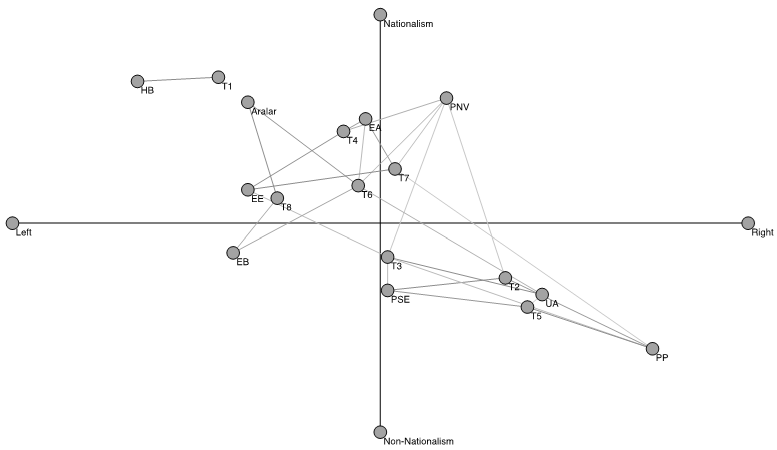
Much of the discussion thus far is summarised in Figure 1, which provides a graphical representation of the position of parties and topics on the two-dimensional space that has traditionally organised politics in the Basque Country (; ). It shows, first, that topics are more strongly organised along the nationalist/ non-nationalist divide than the left/ right one, with the caveat that EB-B belongs to the nationalist discursive coalition. Secondly, it illustrates that the so-called nationalist left remained an outlier throughout 1980-2011, notwithstanding some periods of greater cooperation with other parties.

To keep the figure readable, only parties with four or more speeches in the text corpus have been included, and parties’ acronyms have been used sparsely. ‘HB’ stands for HB, EH, Batasuna and EHAK; ‘PSE’ for PSE and PSE-EE, and ‘PP’ for PP, AP and Coalición Popular. A line denotes a relatively strong relationship between a topic and a party. For more details, see section 6 of the SM.
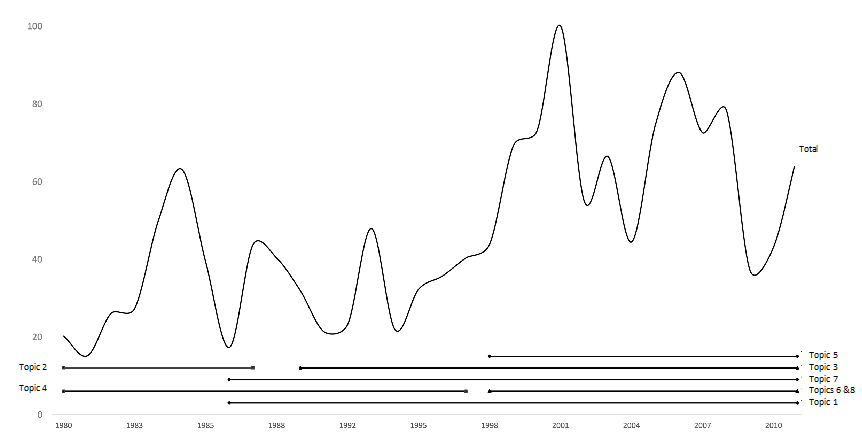
If time is considered, the data allows to periodise the debate. According to the amount of communication, as measured by the number of words comprised by the ‘relevant passages’, a trendless fluctuation can be observed between 1980 and 1994, when an upward trend started (Figure 2). However, it is not until 1999 when figures that are unusually high, given previous levels of attention devoted to political violence, can be found. The quantity of communication reached its peak in 2001, and although it fluctuated since then, levels of attention remained generally high. This change approximately coincided with a new period of bloc politics in the Basque Country (), in which political violence was a major factor provoking division between nationalists and non-nationalists. Whether this issue was utilised as a tool for inter-party competition (), or whether the reconfiguration of the party system resulted from different approaches to, and tolerance of, political violence, or both, cannot be adjudicated with the data analysed. In any case, communication intensified as ETA’s strength (as measured by the number of people killed) diminished. Indeed, at the 0.01 level, 1-tailed, there is a statistically significant negative correlation between the number of words used to talk about political violence and the number of killings by ETA (; ), both for Spearman’s rho (ρ) and Kendall’s tau (τ) as correlation coefficients (ρ = -0.597 and τ = -0.438 for data provided by ; ρ = -0.597 and τ = -0.440 for data from ).

The years of the debates are plotted on the horizontal axis. 1984 and 1987 appear twice, as two debates took place in both years, while there are no values for 1986 and 1990. On the vertical axis, the curve shows the amount of communication on political violence as measured by the number of words used to talk about violence (Table A1). Values have been standardised as a percentage of the words used in 2001. Topic lines mark the periods in which topics were salient.
If the content of the debates is also considered (Figure 2), three periods can be distinguished, notwithstanding some topics cutting across periods. The first period, 1980-1987, is marked by topics 2 and 4. While the latter continued to be salient after 1987, the influence of the former waned around that year. Furthermore, up to 1987 EAJ-PNV had recurrently condemned ETA’s violence and rejected its political strategy, but it had also used expressions such as ‘armed struggle’ (e.g. in 1980DL and 1984GP), or presented ETA activists as mistaken freedom fighters, emphasising the political motivations underlying violence (e.g., in 1984GP and 1985GP). In 1987, this political dimension of violence and the idealistic nature of its perpetrators clearly moved to the background, while an uncompromising condemnation of ETA’s violence, captured by topic 7, now framed as undermining freedom, came to the fore. As stated by EAJ-PNV in 1988GP: “we must refuse to interpret terrorist actions. (…) ETA does not kill or kidnap to force a negotiation (…) ETA simply kills and kidnaps, and that is where the meaning of its action ends for us”. This discursive shift happened in a context where the passivity of some sectors of the Basque citizenry was already declining (), and it approximately coincided with the beginning of civil society’s mobilisation against ETA in the Basque Country ()—hence, it can be seen as mirroring a broader change in the public attitudes towards ETA. EA, which split from EAJ-PNV in 1986, also adhered to this frame since its inception.
The second period, 1987–1998, which coincides with a new period of enhanced inter-party cooperation (), is characterised by the prevalence of topic 3, the continuation of topic 4, and the emergence of topics 1, due to HB now participating in the Basque Parliament, and 7, which captures the aforementioned categorical condemnation of violence. At the end of the 1990s, the parliamentary debate on violence was reorganised into two blocs. Non-nationalists embraced topic 5, while nationalists endorsed topics 6 and 8.
Interestingly, both EAJ-PNV and EA partly adopted the rhetoric of the nationalist left (topic 1), again advocating for negotiation with ETA, as well as including the nationalist left in the process of peacebuilding, at the same time as urging for the handling of the ‘political conflict’ in the Basque Country. Yet, by construing this conflict as distinct from violence, namely as the clash of different nationalist projects and feelings, they could also stick to topic 7’s claim that violence was the result of bigotry. Thus, below the polarised political rhetoric, consensus continued to exist over the framing of violence as the result of intolerance and as antithetical to, rather than motivated by the desire for, freedom. In short, it is the non-nationalist frame of the early 1980s (topic 2) that eventually became dominant in the parliamentary arena.
An additional point of convergence (except for the nationalist left again) is the special attention given to the victims of violence in communication—although disagreement existed over who exactly should be counted as a victim. While the framing of violence as an exclusionary phenomenon is consistent with this focus on victims, the elapse of time between the emergence of this frame and the enhanced attention to the victims suggests that both issues should be seen as evolving independently from each other (). Be that as it may, at the end of the period, consensus emerged over the fact that victims deserved a special ‘support and closeness’ (EAJ-PNV, 2008GP) from public institutions and Basque society, which they had lacked in the past.
The Basque case thus conforms to Alexander’s () model of the civil sphere as a social sphere marked a binary cultural code used to categorise social actors as ‘civil’ or ‘anticivil’. Parties’ discourses —except for the nationalist left— clearly agreed on construing ETA, and political violence more generally, as ‘anticivil’ after 1987. This is in line with Basque public opinion, although the timing of the discursive changes suggests that Basque political parties did not led this attitudinal change (Figure A1 in the SM), which can be more easily explained by reference to civil society actors ().
4. CONCLUSIONS
In this paper I have reported research on the evolution of the debate on political violence among parties sitting in the Basque Parliament between 1980 and 2011. To explore this question, an unsupervised machine learning technique —namely the STM— was applied to transcripts of parliamentary debates. According to the data, three periods can be distinguished, namely 1980–1987, 1987–1998, and 1998–2011. Among other changes happening in 1987, EAJ-PNV clearly modified its view of political violence, which was no longer framed as the result of politically motivated idealists and mistaken freedom fighters, but as the upshot of intolerance and anti-democratic attitudes, thus converging on the positions of non-nationalist forces. In 1998, the debate polarised around two blocs, encouraging unusually high levels of communication as political violence declined. This polarisation notwithstanding, discourses (except for that of the nationalist left) agreed on framing violence as the result of intolerance, and as antithetical to freedom, as well as on granting a special position to the victims of violence. The political debate thus moved in the same direction as public attitudes towards violence, probably mirroring, rather than leading, said shift in public attitudes. Overall, it is the nationalist/ non-nationalist divide, rather than the left/ right one, that organised the views on political violence.
5. REFERENCES
1
Abadie, A., Gardeazabal, J., Kennedy, J. F., Angrist, J., Duflo, E., Heckman, J., Hernán, M., Angel Martínez, M., De Motta, A., Rodrik, D., Rubio, G., Saez, E., Sandler, T., Stock, J., Ventura, J., Viceira, L., & Zeckhauser, R. (2003). The Economic Costs of Conflict: A Case Study of the Basque Country. American Economic Review, 93(1), 113–132. https://doi.org/10.1257/000282803321455188
2
3
Alexander, J. C. (2006). The Civil Sphere. Oxford University Press. https://doi.org/10.1093/ACPROF:OSO/9780195162509.001.0001
4
5
Benoit, K., Watanabe, K., Wang, H., Nulty, P., Obeng, A., Müller, S., & Matsuo, A. (2018). quanteda: An R package for the quantitative analysis of textual data. Journal of Open Source Software, 3(30), 774. https://doi.org/10.21105/JOSS.00774
6
Budge, I. (2015). Issue Emphases, Saliency Theory and Issue Ownership: A Historical and Conceptual Analysis. West European Politics, 38(4), 761–777. https://doi.org/10.1080/01402382.2015.1039374
7
8
de la Calle, L., & Sánchez-Cuenca, I. (2013). Killing and Voting in the Basque Country: An Exploration of the Electoral Link Between ETA and its Political Branch. Terrorism and Political Violence, 25(1), 94–112. https://doi.org/10.1080/09546553.2013.733271
9
De La Calle, L. (2007). Fighting for local control: Street violence in the Basque Country. International Studies Quarterly, 51(2), 431–455. https://doi.org/10.1111/j.1468-2478.2007.00458.x
10
11
12
FVT [Fundación Víctimas del Terrorismo] (n.d.). Víctimas mortales de ETA. Retrieved 4 June 2025, from https://fundacionvt.org/fundacion/victimas-mortales-de-eta/
13
Funes, M. J. (1998). Social Responses to Political Violence in the Basque Country. Journal of Conflict Resolution, 42(4), 493–510. https://doi.org/10.1177/0022002798042004005
14
15
Hovy, D. (2020). Elements in Quantitative and Computational Methods for the Social Sciences: Text Analysis in Python for Social Scientists: Discovery and Exploration. Cambridge University Press. https://doi.org/10.1017/9781108873352
16
Leonisio, R. (2013). Las víctimas del terrorismo en el discurso de los partidos políticos vascos: una aproximación cuantitativa (1980-2011). Revista de Estudios Políticos, (161), 13–40. https://doi.org/10.18042/39545
17
18
Leonisio, R. (2019). El impacto del terrorismo en el discurso político en España: un análisis de contenido de los discursos de los presidentes de Gobierno en los debates parlamentarios. Revista Española de Ciencia Política, 49, 129–149. https://doi.org/10.21308/RECP.49.06
19
Leonisio, R., & López, R. (2017). Between fear, indignation and indifference: Basque public opinion and socio-political behaviour facing terrorism. In R. Leonisio Calvo, F. Molina Aparicio & D. Muro (Eds.), ETA’s terrorist campaign: from violence to politics, 1968-2015 (pp. 143–162). Routledge/Taylor & Francis Group.
20
21
22
23
24
Lucas, C., Nielsen, R. A., Roberts, M. E., Stewart, B. M., Storer, A., & Tingley, D. (2015). Computer-Assisted Text Analysis for Comparative Politics. Political Analysis, 23(2), 254–277. https://doi.org/10.1093/PAN/MPU019
26
Martín-Peña, J., & Opotow, S. (2011). The legitimization of political violence: A case study of ETA in the Basque country. Peace and Conflict, 17(2), 132–150. https://doi.org/10.1080/10781919.2010.550225
27
28
Mees, L. (2003). Nationalism, Violence and Democracy. The Basque Clash of Identities. Palgrave Macmillan UK. https://doi.org/10.1057/9781403943897
29
Méndez, M. (2020). Parties and Party Systems. In D. Muro & I. Lago (Eds.), The Oxford Handbook of Spanish Politics (pp. 331–348). Oxford University Press. https://doi.org/10.1093/OXFORDHB/9780198826934.013.20
30
Mohr, J. W., & Bogdanov, P. (2013). Introduction—Topic models: What they are and why they matter. Poetics, 41(6), 545–569. https://doi.org/10.1016/J.POETIC.2013.10.001
31
32
Muro, D. (2009). The politics of war memory in radical Basque nationalism. Ethnic and Racial Studies, 32(4), 659–678. https://doi.org/10.1080/01419870801943654
33
Parkinson, J. (2006). Rickety Bridges: Using the Media in Deliberative Democracy. British Journal of Political Science, 36(1), 175–183. https://doi.org/10.1017/S0007123406000093
34
Roberts, M. E., Stewart, B. M., & Tingley, D. (2019). stm: An R Package for Structural Topic Models. Journal of Statistical Software, 91(2), 1–40. https://doi.org/10.18637/JSS.V091.I02
35
37
Tejerina, B. (2001). Protest Cycle, Political Violence and Social Movements in the Basque Country. Nations and Nationalism, 7(1), 39–57. https://doi.org/10.1111/1469-8219.00003
38
Torcal, M., Martini, S., & Orriols, L. (2018). Deciding about the unknown: The effect of party and ideological cues on forming opinions about the European Union. European Union Politics, 19(3), 502–523. https://doi.org/10.1177/1465116518769754
39
40
41
Zabalo, J., & Saratxo, M. (2015). ETA ceasefire: Armed struggle vs. political practice in Basque nationalism. Ethnicities, 15(3), 362–384. https://doi.org/10.1177/1468796814566477
APPENDIX. Supplementary Materials
1. Keywords
These are the keywords used to identify relevant passages: violen*; terroris*; ETA; victima*; paz; pacifica*; armas; kale borroka; lucha armada; atenta*; secuestr*; extors*; derechos humanos; conflicto; represión; guerra sucia. Except for ‘ETA’, keywords were not case-sensitive.
Keywords were derived from background knowledge and the reading of a random selection of passages. The validation of the K8 model suggests that the keywords performed adequately in identifying the relevant passages of the parliamentary debates. Furthermore, studies on the salience of the centre/ periphery cleavage in parliamentary debates in the Basque Country () and on ETA’s victims in the discourses of Basque political parties () show patterns that are consistent with the evolution of parliamentary communication on political violence as captured by these keywords (Table A1). More specifically, they yield correlation coefficients of 0.77 and 0.62, respectively, which are significant at the 0.01 level. These correlation values are noteworthy given that different, albeit interrelated, topics are being measured.
2. Stopwords
Stopwords are words that appear often in a corpus and are not expected to provide much substantive information in connection to a specific research question. In this study, the dictionary of Spanish stopwords provided by Quanteda was used (), and additional ones were identified to further reduce the noise of the data. Table A2 provides the extended list of stopwords.
3. Compounded Collocations
Collocations are words that tend to occur together forming a “single meaningful concept” (). According to the methodological literature, it is advisable to treat collocations as one word to reduce the noise in the data (). Given that many collocations are domain-specific, they must be identified by researchers. To do so, I examined the 100 most common bigrams and 75 most frequent trigrams. Their frequency and the strength of their association were the criteria used to settle for these numbers. More specifically, the identification of which 2- and 3-grams formed a collocation was guided by the question of which of them had a distinctive meaning (e.g. partido_nacionalista_vasco) as opposed to comprising words that simply co-occur (e.g. ‘puede ser’). Table A2 provides the list of collocations that were compounded.
4. Model Selection and Description of the Topics
The selection of the model and the interpretation of the topics are the result of a hermeneutical exercise, in which possible ways of understanding the topics, arrived at after reading some of the outputs that are produced by the implementation of the STM, are checked for consistency against additional outputs, until a satisfactory overall interpretation is found (; ; ). In this specific study, the model K6 (i.e. with six topics) was as easy to interpret as K8, and both models greatly overlapped. I chose K8, however, because this model provides more information, including information pinpointing EAJ-PNV’s change in the framing of ETA’s violence around 1987 (discussed in section 3 of the research note).
5. Tables
Source: own elaboration.
Source: own elaboration based on outputs produced by the K8 model.
[i] ‘Highest Prob’ refers to the most common words in a topic. ‘FREX’ refers to words that are both relatively frequent and exclusive. Similarly, ‘Lift’ and ‘Score’ identify words that are relatively frequent and exclusive, but they give greater weight to terms that are uncommon in other topics (for details, ).
Source: own elaboration based on outputs produced by the K8 model.
[i] The values for Aralar and 1980 are not shown, as they have been set to zero. One of the core features of the STM is to estimate the association between metadata and the topics. This is what the regression table shows. To read the data, it should be recalled that the model for topical prevalence is ‘Party + Year’—hence, the equation ‘Intercept_Topic_n + EstimatedEffect_Topic_n,Party_y + EstimatedEffect_Topic_n,Year_x’ provides an approximate estimation of the proportion of Topic_n in the discourse of Party_y in Year_x. It should be considered, however, that a rigorous exploration of the data also needs to take into account estimation uncertainty, which the stm package by calculates by using the method of composition. Uncertainty estimates can then be used to calculate confidence intervals. Due to space considerations, this data is not shown.
6. Figures
Addendum to Figure 1
Parties’ positions in Figure 1 are the means of the time series A.2.02.03.034, A.2.02.03.050, A.2.02.03.029, A.2.02.03.033, A.4.02.01.036, A.4.02.01.037, A.4.02.01.027, A.4.02.01.030, A.4.02.01.033, A.4.02.01.031, and A.4.02.01.032 by the Spanish Centre for Sociological Research, CIS. For parties for which no specific time series is available, the studies included in the series A.4.02.01.036 and A.2.02.03.034 with data on them have been used. In all cases, only data within the time range specified for this study (i.e. 1980-2011) has been considered. Topics’ positions have been calculated on the basis of parties’ coordinates. To determine which parties and to what extend they were going to influence topics’ positions, two criteria have been combined. First, parties that were not in the Basque Parliament in the period in which a topic was salient (Figure 2) have been excluded. Secondly, the strength of their association with a topic, as measured by the normalised values (on a 0-1 scale) of parties' estimated effects on topical prevalence (Table A4), have been considered. More specifically, parties with normalised values of 0.5 or higher—or the top three parties most strongly associated with a topic if fewer than three parties had normalised values equal to or higher than 0.5—have been used to calculate a topic’s position. Topics’ coordinates are the weighted means of the coordinates of these parties. Finally, for each topic-party pair with a normalised relationship of 0.5 or higher, a line has been drawn.
Notes
[1] How to describe the conflict pitting Basque nationalists against non-nationalists or unionists, or Spanish nationalists, or constitutionalists, is a controversial issue. In this paper, I draw on the usual distinction between ‘nationalists’ and ‘non-nationalists’, because these terms are common in opinion polls, and Basque and Spanish citizens appear to have no problems in placing themselves as well as parties along the continuum marked by these titles.